
How Sharda Associates Helps You
Sharda Associates provides expert advice on financial planning, income tax filing, GST compliance, project reports, MSME registration, loan documentation, startup guidance, ROC compliance, and business consultation services throughout India. Our skilled professionals assist salaried employees, startups, freelancers, professionals, and business owners with taxation, financial planning, and legal documents professionally and effectively.
We also offer full support for Detailed Project Reports, CMA Reports, Feasibility Reports, Mudra Loan Project Reports, PMEGP Project Reports, accounting services, taxation solutions, and financial advice services needed for business growth and regulatory compliance. Our staff focuses on precise paperwork, open consulting, and prompt service assistance to assist clients in achieving financial stability and long-term company success.
Introduction
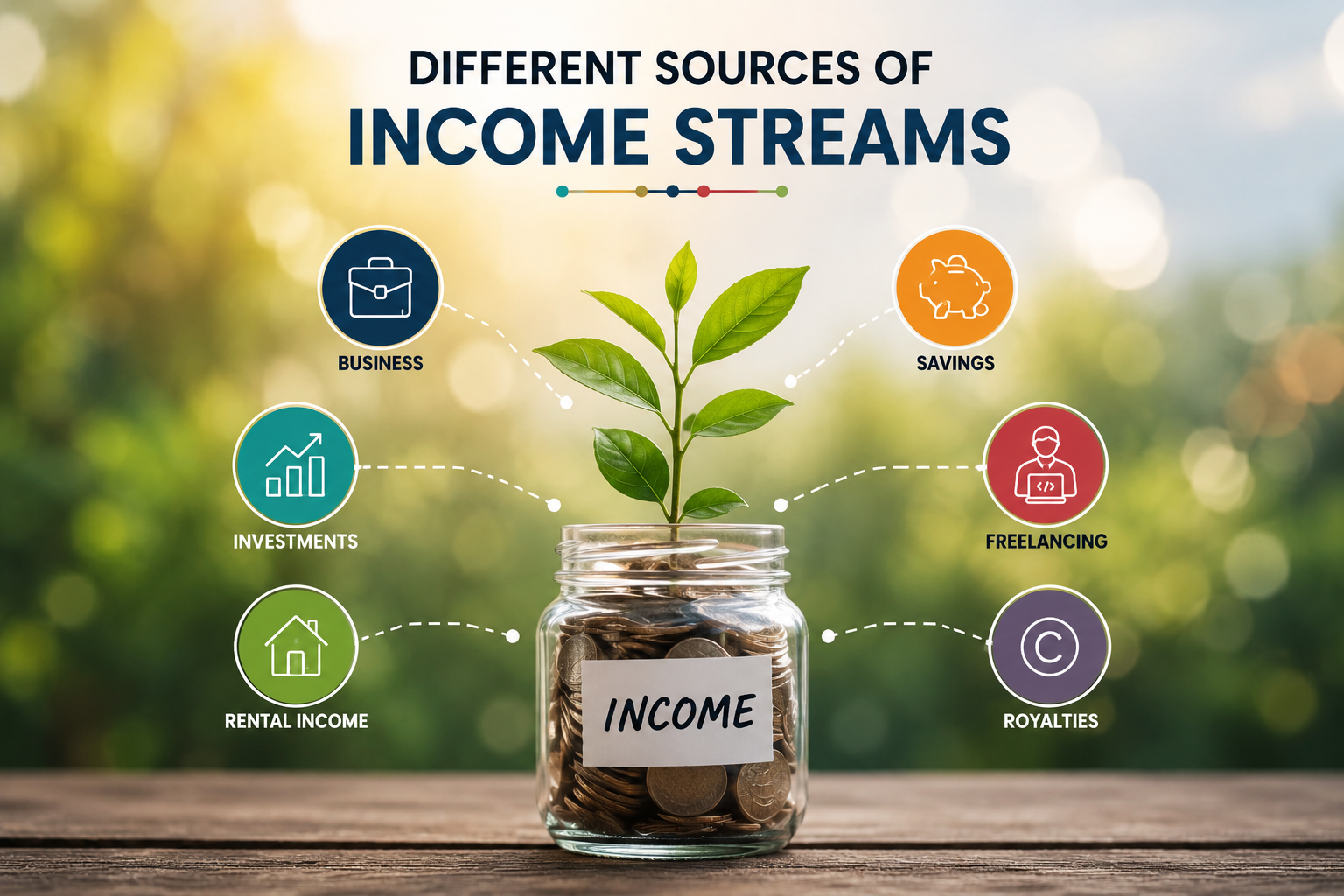
Income streams are vital for financial stability, wealth development, and long-term financial progress. Individuals in 2026 are increasingly pursuing several earning alternatives rather than relying just on one source of income. Salary earnings, business profits, rental income, investments, freelancing, and passive income options have all become important aspects of modern financial planning.
Having various sources of income boosts savings, lowers financial risks, and provides more financial security during unpredictable economic times. Understanding these revenue categories is also critical for effective tax planning, investment management, and sound financial decisions. This tutorial covers the various income streams in India and their significance in obtaining financial independence and long-term financial stability.
Understanding Income Streams in India
An income stream is a regular source of revenue. Financial experts encourage having various income streams because relying solely on one might lead to financial instability amid job losses, business downturns, or unanticipated emergencies.
Income streams are often classified as active or passive. Active income, like wages or commercial activities, necessitates direct involvement and ongoing work. Passive income continues to generate earnings with little effort after the initial setup or investment.
The Indian taxation system divides incomes into categories to ensure accurate tax calculation and compliance. Understanding these income classifications enables taxpayers to prevent filing errors and enhance overall financial management.
The fundamental goal of creating several revenue sources is to improve financial security, strengthen cash flow, and increase investment capacity.
Understanding Income Streams in India.
An income stream is a regular source of revenue. Financial experts encourage having various income streams because relying solely on one might lead to financial instability amid job losses, business downturns, or unanticipated emergencies.
Income streams are often classified as active or passive. Active income, like wages or commercial activities, necessitates direct involvement and ongoing work. Passive income continues to generate earnings with little effort after the initial setup or investment.
The Indian taxation system divides incomes into categories to ensure accurate tax calculation and compliance. Understanding these income classifications enables taxpayers to prevent filing errors and enhance overall financial management.
The basic goal of diversifying income streams is to improve financial security, boost cash flow, expand investment capacity, and promote long-term asset accumulation.
Why Multiple Income Streams are Important in 2026.
Financial diversification has grown in importance by 2026 as a result of rapid economic change and digital transformation. Salaried employees are beginning side enterprises, freelancers are investing in digital assets, and entrepreneurs are creating passive income streams alongside their principal firms.
Having several revenue sources provides numerous financial benefits. It increases financial flexibility, promotes savings growth, and offers greater protection against market volatility. Additional revenue streams boost loan eligibility, creditworthiness, and future investment options.
Technology and online platforms have made it easier for people to earn money by freelancing, consulting, affiliate marketing, content production, digital items, online enterprises, and stock market investments. Financial advisors today actively advocate for diverse earnings as a key approach for obtaining financial independence.
Income from Salary
Salary income is o
ne of the most prevalent and reliable kinds of income in India. It includes employer-provided salary, bonuses, commissions, pensions, allowances, and job benefits. Salarie
d employees often get regular monthly wages, making salary income a dependable financial source.
According to the Income Tax Act, salary income mig
ht comprise base salary, House Rent Allowance, Dearness Allowance, incentiv
es, provident fund contributions, gratuity, and retir
ement benefits. Employers deduct tax at the source before making wage payments and supply Form 16 for filing inc
ome tax returns.
In 2026, many professionals will combine salary income with side enterprises, freelance services, or
investment income to better their overall financial situation and long-term savings potential.
Income from business or profession
Business or professional income is defined
as earnings from self-employment, consulting, trading, freelancing, manufacturing, professional services, startups, or business activities. Entrepreneurs, MSMEs
, consultants, digital marketers, doctors, lawyers, and service providers rely heavily on this source of revenue.
Business income mi
ght fluctuate according to market demand, operational
efficiency, client base, and industry trends. In India, digital enterprises and internet services will be among the fastest-growing inc
ome sectors by 2026.
Consulting services, freelancing projects, a
gency operations, manufacturing firms, retail trading, online storefronts, and professional practices can all contribute to business income. Acc
ounting records, GST compliance, invoicing, financial reporting, and tax planning are all required for effective business income management.
With the rise of digi
tal adoption and startup growth, many people are turnin
g to entrepreneurship and freelancing as supplementary revenue streams in addition to traditional work.
Income from House Property
Income from home property refers to the money earned from renting out residential or commercial properties. Rental income has been one of India’s most popular passi
ve income streams due to its consistent yields and long-term asset appreciation.
Residential rent,
office space leasing, warehouse rentals, commercial property
rent, and co-living spaces are all sources of monthly income for property owners. Real estate investments continue to be an appealing wealth-building option for investors in
both metropolitan and emerging locations.
The Income Tax Ac
t permits property owners to deduct certain expenses, such as municipal taxes an
d home loan interest advantages. Proper documentation and rental agreements are essential for tax and regulatory reasons.
Rental revenue
potential in India is expected to increase dramatically by 2026 as urbanization and infrastructural development accelerate.
Income from capital gains.
Capital gains income is generated when an individual sells capital assets for a profit. These assets could include stocks, mutual funds, real estate, gold, bonds, or other investment vehicles.
Capital gains are classified as Short-Term Capital Gains or Long-Term Capital Gains based on the asset holding term. The appropriate taxation depends on the type of investment and the length of ownership.
In recent years, stock market participation and mutual fund investments have risen dramatically in India, making capital gains a key source of income for many individuals. Profits from the sale of shares, property, mutual funds, gold, or bonds are taxed in accordance with current government legislation.
Capital gains tax regulations are frequently revised, making comprehensive financial planning and professional tax counsel essential for investors and taxpayers.
Income From Other Sources
Income from other sources includes profits that do not fall into the salary, business, real estate, or capital gains categories. This category includes various incomes and passive financial income.
Savings account interest, fixed deposit income, dividend income, royalty revenue, lottery winnings, referral commissions, online platform profits, digital monetization income, gifts that exceed exemption restrictions, and commission-based earnings are some examples.
With the tremendous rise of digital content creation and online monetization platforms in 2026, many people are making money through blogging, YouTube channels, affiliate marketing, online education, and social media sites.
Proper reporting of such income during Income Tax Return filing is critical for maintaining compliance and avoiding tax difficulties.
Passive Income Opportunities in 2026
In recent years, passive income has emerged as one of the most widely discussed financial concepts. Passive income is defined as earnings obtained with minimal continuous work after an initial investment or setup.
Rental properties, dividend-paying securities, affiliate marketing, digital products, online courses, blogging revenue, YouTube monetization, REIT investments, and royalty income are all popular ways to generate passive income.
Passive income helps people achieve financial stability while lowering their need for active working hours. Many professionals are now creating passive income streams in addition to their regular professions or enterprises in order to increase their financial security and retirement planning.
Digital transformation and internet company concepts have greatly enhanced passive income potential in India.
Importance of Tax Planning for Multiple Income Sources
Managing various income streams necessitates effective tax planning and financial record-keeping. Incorrect reporting or paperwork can lead to penalties, notifications, and compliance concerns when completing an income tax return.
Tax planning enables individuals to lawfully decrease their tax bill, maintain financial transparency, properly arrange their records, and claim applicable deductions. Individuals who make income from several sources should keep meticulous track of their invoices, investment records, bank accounts, rental agreements, and tax documentation.
Professional tax experts and financial advisors can help individuals streamline tax filing procedures and properly classify various income sources under applicable tax legislation.
Financial Advantages of Multiple Income Streams
Having several revenue streams promotes long-term financial security and economic stability. Diversified incomes boost cash flow, encourage larger savings, and open up more investment choices.
Additional income sources can also help people manage emergencies, attain financial goals, and minimize their reliance on a single employer or business. Multiple income streams help with retirement planning, debt control, educational finance, and wealth growth.
Financial independence has been a top priority for modern professionals and businesses, making diverse earning options more crucial in 2026.
Latest Financial Trends in India 2026
In 2026, India’s financial environment is expected to become more digital and investment-driven. Online enterprises, fintech platforms, digital payments, freelance markets, and AI-powered financial systems are changing the way people earn and handle money.
The rise of the creator economy, retail investment, remote employment opportunities, internet consulting firms, and startup culture has prompted people to build more sophisticated financial portfolios with numerous income streams.
Financial knowledge and internet use are also fast expanding, allowing consumers to better comprehend investments, taxes, passive income, and wealth-building prospects.
Conclusion
The concept of various income streams is becoming increasingly significant in 2026 as economic conditions change, inflation rises, and financial responsibilities grow. In today’s environment, relying solely on one source of income is considered financially risky.
Understanding the seven various types of revenue streams helps people improve their financial planning, tax management, investment selections, and long-term wealth growth. Diversified earnings, which include salary and business income as well as rental earnings, investments, and passive income sources, provide better financial flexibility and stability.
Individuals who effectively manage several income streams can increase their savings, reduce financial risks, attain financial independence, and generate more prospects for long-term financial success.
Sharda Associates provides financial and tax support. Learn more about us.
About us
Sharda Associates is an established financial and business consulting firm in India that provides expert services in Income Tax Return filing, GST registration, MSME registration, project reports, CMA studies, feasibility reports, startup registration, accounting, taxation, and business consultancy solutions.
Our skilled professionals give dependable and transparent financial advice to salaried employees, startups, MSMEs, freelancers, and established enterprises throughout India. We simplify taxation, financial documentation, compliance management, and investment-related services to assist businesses and people in achieving efficient financial growth.
At Sharda Associates, we prioritize accuracy, competent counsel, prompt processing, and client satisfaction while assisting clients in remaining completely compliant with Indian financial and tax requirements.
Call +91 79870 21896 or WhatsApp +91 89899 77769.
Frequently Asked Questions.
- What are the seven main sources of income under the Indian tax system?
Salary income, business revenue, house property income, capital gains, professional income, passive income, and income from other financial activities are the most common sources of income.
- Why are many income streams critical to financial security in 2026?
Multiple income sources decrease financial dependency, increase savings chances, promote investment growth, and offer more protection against economic unpredictability and financial emergencies.
- Is rental income taxable under the Indian income tax law?
Yes, rental income derived from residential or commercial buildings is taxed as income from house property under Indian tax laws.
- What is passive income, and why is it gaining popularity in India?
Passive income is defined as earnings obtained with minimal continuous work via investments, digital assets, rental properties, online businesses, and long-term financial prospects.
- Are stock market profits taxable in India?
Yes, profits from shares, mutual funds, or investment assets are taxable as capital gains, subject to appropriate holding periods and tax restrictions.
- Can salaried employees legitimately obtain additional income?
Yes, paid employees can lawfully earn money through freelancing, investments, internet enterprises, consulting services, affiliate marketing, and other allowed financial activities.
- Why is tax planning important for those who earn from many sources?
Tax planning assists individuals in maintaining compliance, organizing records appropriately, reducing legal tax burden, avoiding penalties, and improving financial management techniques.
- How can Sharda Associates assist with financial planning and taxation services?
Sharda Associates offers experienced support in taxation, project reports, GST registration, financial planning, accounting, compliance services, and business consulting solutions throughout India.