
Madhya Pradesh Logistics & Warehousing Policy
The Madhya Pradesh Logistics & Warehousing Policy promotes investment in warehouses, cold storage, logistics parks, and supply chain infrastructure across the state. Sharda Associates helps businesses prepare professional project reports, subsidy documentation, and loan proposals for smooth approvals, ensuring trusted financial guidance and reliable consultancy support for logistics and warehousing projects in India.

Why Madhya Pradesh
Why Madhya Pradesh for Logistics and Warehousing?
Madhya Pradesh occupies a uniquely strategic geographic position for logistics — it is the only state that shares borders with five other major states: Uttar Pradesh, Rajasthan, Gujarat, Maharashtra, and Chhattisgarh. This central location makes MP a natural hub for goods movement across North, West, and Central India.
Key logistics advantages of MP:
National highway connectivity: NH 3 (Agra-Mumbai), NH 7 (Varanasi-Kanyakumari), NH 12 (Jabalpur-Jaipur), NH 26 (Lucknow-Jabalpur) — multiple national corridors passing through MP create strong warehousing demand at intersection points.
Rail connectivity: MP is on the Delhi-Chennai and Delhi-Mumbai rail freight corridors. Dedicated Freight Corridor (DFC) connectivity improves the economics of multi-modal logistics.
Proximity to major industrial hubs: Pithampur near Indore (automotive — Eicher, Force Motors, Minda), Mandideep near Bhopal (pharma, FMCG, engineering), Malanpur near Gwalior (industrial estate), Jabalpur (engineering, defence manufacturing).
Agricultural output: MP is India’s largest soybean producer, major wheat and pulses state — creating warehousing demand for agricultural commodities (APMC mandis, procurement agencies, food processing input storage).
Why Madhya Pradesh
What Is the MP Logistics and Warehousing Policy 2025?
The Madhya Pradesh Logistics and Warehousing Policy provides a framework for attracting private investment into logistics infrastructure—warehouses, cold storage, logistics parks, multi-modal hubs, and freight villages across the state.
The policy operates within the framework of the National Logistics Policy (NLP) announced by the central government and PM Gati Shakti — the national master plan for multimodal connectivity. MP’s state policy supplements central schemes with state-specific incentives.
Eligible infrastructure categories under the policy:
Conventional warehouses: General storage for industrial goods, FMCG, consumer goods, e-commerce fulfilment. Typically 10,000-1,00,000 sq ft covered godown/warehouse structures.
Cold chain infrastructure: Temperature-controlled storage for agricultural produce, pharmaceuticals, dairy, and processed food. High capital, high subsidy potential.
Logistics parks and IFCs (Integrated Freight Complexes): Large-scale integrated facilities with warehousing, truck parking, weigh bridges, repair facilities, fuel station, and associated commercial services.
Multi-modal logistics hubs: Facilities combining road, rail (ICD/CFS), and potentially air freight capabilities — connecting multiple transportation modes at one location.
Agricultural warehouses and silos: Covered storage for agricultural commodities — eligible for WDRA (Warehousing Development and Regulatory Authority) registration and negotiable warehouse receipt (NWR) financing.
Key Benefits Under the Policy
Benefits
State government provides a percentage capital subsidy on eligible warehouse/logistics infrastructure project cost — released as backend support after completion and inspection.

Narendra Modi
Prime Minister India

Dr. Mohan Yadav
Chief Minister Madhya Pradesh

Land allotment through MPSIDC
- MP State Industrial Development Corporation (MPSIDC) facilitates land allotment at notified logistics zones and industrial areas — providing access to developed industrial land with existing infrastructure (road, power, water).
Stamp duty exemption/concession
- 50% reimbursement (up to ₹5 crore) for developing warehousing & cold storage facilities.

Electricity tariff concession
- Preferential electricity tariff for large logistics facilities (especially cold storage, which has high electricity consumption).
Single-window clearance
- Environment NOC, building plan approval, fire NOC, utility connections — coordinated through Invest MP portal.

SGST reimbursement
- State shares a percentage of SGST collected from the project for a defined period post-commissioning.
PM Gati Shakti linkage
MP logistics projects aligned with PM Gati Shakti NMP (National Master Plan) get coordinated central + state support for infrastructure connectivity (road, rail, utility) to the project site.
Journey
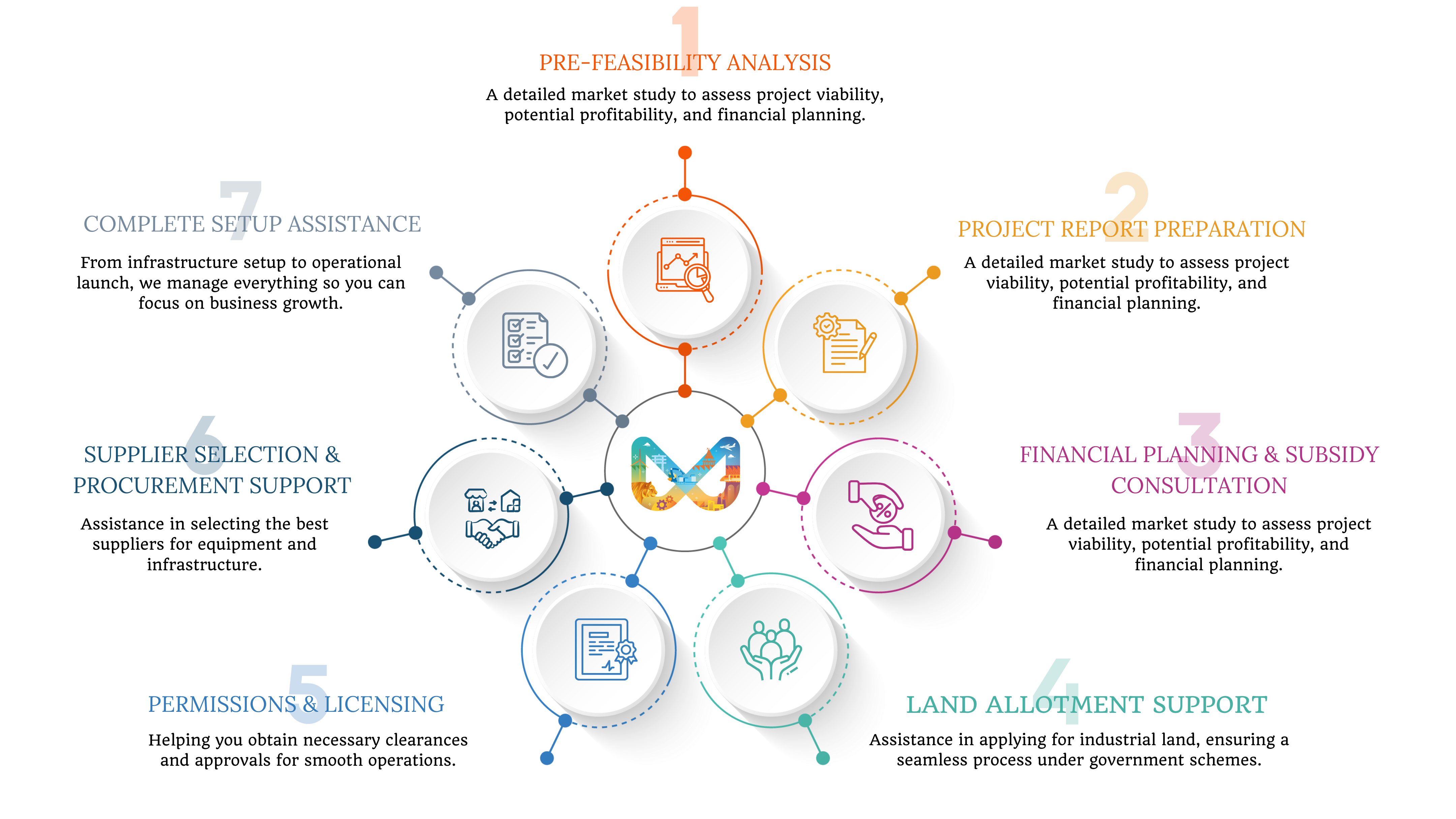
How Sharda Associates Simplifies Your Investment Journey
bussiness
Eligible Investors & Investment Opportunities
The policy is open to domestic and international investors, focusing on:
Wealth Management
Right people together made to challenge established thinking and drive transform
Restructuring
Right people together made to challenge established thinking and drive transform
WDRA Registration
WDRA Registration — For Agricultural Warehouses
For warehouse operators planning to store agricultural commodities, WDRA (Warehousing Development and Regulatory Authority) registration is a critical credential:
What WDRA provides: A WDRA-registered warehouse can issue Negotiable Warehouse Receipts (NWRs) to farmers and commodity depositors — these NWRs can be pledged at banks for commodity finance (crop loans against stored produce).
Benefits of WDRA registration:
- Warehouses earn storage income from farmers, traders, and procurement agencies
- NWRs issued by the warehouse enable depositors to get bank loans against stored commodity — making the warehouse a financing partner in the agricultural value chain
- Higher trust and utilisation from government procurement agencies (FCI, state civil supplies corporations)
Minimum infrastructure standards for WDRA: Covered, weatherproof structure; pest control systems; weighbridge; fire safety; temperature monitoring (for notified commodities); proper documentation systems.
For agricultural warehouses in MP, WDRA registration combined with AIF (Agriculture Infrastructure Fund) financing and NABARD refinancing creates a strong project finance stack.
What Sharda Associates Provides
What Sharda Associates Provides for Logistics Projects
Feasibility study and DPR: For banks and NBFCs financing warehouse construction or logistics park development—revenue model (per-sq-ft storage fees, value-added services), construction cost, occupancy ramp-up, DSCR analysis, and scheme benefit integration.
AIF (Agriculture Infrastructure Fund) documentation: For agricultural warehouses — AIF application, project report meeting NABARD/bank standards, and CGTMSE guarantee documentation for collateral-free finance.
WDRA registration support: Infrastructure documentation for WDRA registration — layout, pest control plan, fire safety, weighbridge, and operational procedures as per WDRA standards.
MP Logistics Policy scheme application: Registration, capital subsidy application, MPSIDC land allotment documentation, and single-window approval coordination.
Project finance documentation: For larger logistics parks needing project finance from infrastructure lenders — DPR, information memorandum, and lender due diligence support.
Call +91 89899 77769
FAQ
Frequently Asked Questions
A state government policy attracting private investment into logistics infrastructure — warehouses, cold storage, logistics parks, and multi-modal hubs in MP. Benefits include capital subsidy, MPSIDC land allotment, stamp duty concession, electricity tariff concession, SGST reimbursement, and single-window clearances. Aligned with PM Gati Shakti National Master Plan for multimodal connectivity.
MP is the only Indian state sharing borders with five major states (UP, Rajasthan, Gujarat, Maharashtra, Chhattisgarh) — making it a natural goods movement hub for North, West, and Central India. Multiple national highways (NH 3, 7, 12, 26), Dedicated Freight Corridor connectivity, major industrial clusters (Pithampur, Mandideep, Malanpur, Jabalpur), and India's largest soybean production state create both infrastructure and commodity warehousing demand.
WDRA (Warehousing Development and Regulatory Authority) registers warehouses to issue Negotiable Warehouse Receipts (NWRs) — official receipts that farmers and commodity depositors can pledge at banks for crop loans against stored produce. WDRA-registered warehouses in MP command higher trust from FCI, state civil supplies agencies, and commodity traders, and enable the agricultural value chain financing that makes rural warehouses commercially viable.
Three categories: (1) Industrial/FMCG warehouses near Pithampur, Mandideep, Malanpur — serving manufacturing clusters. (2) Agricultural commodity warehouses and silos in Sagar-Damoh-Hoshangabad belt — soybean, wheat, pulses storage for APMC, FCI, and commodity traders. (3) Cold storage — for horticultural produce (garlic, onion, potato), pharma distribution, and agricultural inputs across the state.
Agriculture Infrastructure Fund — central government scheme providing 3% interest subvention for 7 years on loans up to Rs.2 crore for eligible agri-infrastructure (warehouses, cold storage, primary processing). CGTMSE guarantee for collateral-free lending. Combined with WDRA registration and NABARD refinancing, AIF creates a strong low-cost finance package for agricultural warehouses in MP.
: PM Gati Shakti is the national multimodal connectivity master plan — coordinating road, rail, waterway, air, and utility infrastructure planning across all states. MP logistics projects aligned with Gati Shakti get coordinated central + state support for road connectivity to logistics parks, railway siding access, and utility infrastructure — reducing the developer's cost of off-site connectivity that often makes logistics parks unviable.