
Yes. A Detailed Project Report (DPR) can technically be generated online in around 3 minutes when the required business and financial inputs are already available. However, generating a DPR in 3 minutes and making it bank-ready are not the same thing. A bank-ready DPR must also have realistic project costs, sales assumptions, working capital, financial projections, DSCR, repayment capacity and figures that match the applicant’s supporting documents.
A lender is interested in realistic project cost, sales assumptions, working capital, profitability, cash flow and repayment capacity. Sharda Associates prepares project reports through a CA-expert-led process and provides CA-certified reports where applicable, helping applicants verify these financial aspects before using the report for a loan application.
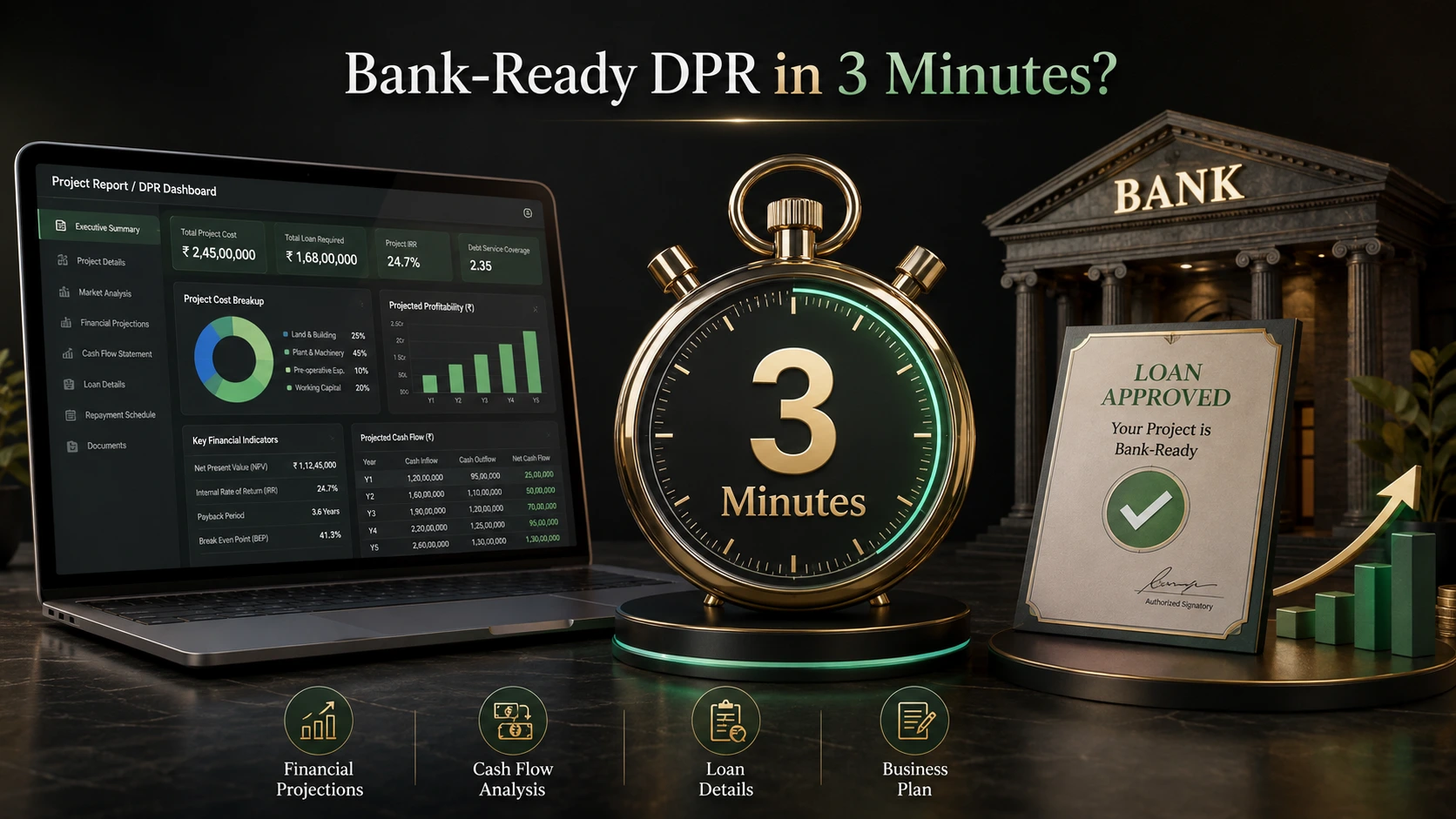
Can You Create a Bank-Ready DPR in 3 Minutes?
Yes, software can generate a DPR in around 3 minutes. But “generated in 3 minutes” does not automatically mean “bank-ready.” Bank readiness depends on the accuracy of project cost, sales, working capital, cash flow, DSCR, repayment schedule, and supporting documents.
Modern project report software can take structured inputs and automatically generate:
- Business and promoter profile
- Project cost
- Means of finance
- Financial projections
- Profit & Loss statement
- Projected Balance Sheet
- Cash flow
- Loan repayment schedule
- DSCR
- Break-even analysis
- Financial ratios
- CMA-related schedules in some systems
Because the formulas and report structure are already programmed, software can calculate and format hundreds of figures almost instantly.
The important distinction is:
It takes three minutes to build a DPR. The quality of the inputs, computations, and lender requirements determine if it is prepared for submission to your specific bank.
What Can Actually Be Generated in 3 Minutes?
Although software platforms and project-report providers frequently utilise the term “bank-ready,” it should not be interpreted as loan-approved or bank-approved.
A bank loan DPR (Detailed Project Report) that is truly helpful should provide the lender with sufficient trustworthy information to comprehend:
- What business is proposed
- How much the project will cost
- How much the promoter will contribute
- How much bank finance is required
- How revenue will be generated
- What major operating expenses will arise
- Whether sufficient working capital is available
- Whether projected cash generation can support repayment
According to official MSME lending guidelines, information about machinery, supplier prices, capacity, estimated production, sales, projected P&L, projected balance sheets, workforce, and the foundation of financial assumptions may be needed for relevant term-loan offers. Lenders and proposals may have different requirements.
Therefore, a bank cannot benefit from a DPR based just on a prepared PDF.
How Does a 3-Minute Online Project Report Work?
Most instant DPR systems follow a similar process.
Step 1: You Enter Basic Project Details
The platform may ask for:
- Business activity
- Project location
- Total investment
- Promoter contribution
- Proposed bank loan
- Machinery investment
- Expected sales
- Operating expenses
- Loan tenure
Step 2: Software Performs the Calculations
Pre-programmed formulas may calculate:
- Depreciation
- Interest
- Profit
- Tax assumptions
- Loan repayment
- Working capital
- DSCR
- Break-even
- Financial ratios
Step 3: The System Generates the DPR
The programme creates a prepared PDF by combining your inputs, calculations, and prewritten content.
This can actually occur quite quickly.
Determining if the inputs and assumptions make financial and commercial sense is frequently the more time-consuming aspect of preparing a professional project report than creating a PDF.
What Information Should You Have Before Generating an Instant DPR?
A good online report starts with good information.
Before using an instant DPR generator, collect:
| Information | What You Should Ideally Have |
| Machinery | Supplier quotations |
| Building | Actual construction/rent estimate |
| Loan | Expected amount and financing structure |
| Promoter contribution | Amount genuinely available |
| Production | Practical installed capacity |
| Selling price | Realistic product/service pricing |
| Raw material | Current expected purchase cost |
| Salaries | Expected manpower and wages |
| Working capital | Stock, receivables and operating needs |
| Sales | Capacity- and market-based assumptions |
Do not ask the software or AI to simply “make suitable figures for bank approval.”
That reverses the correct process.
Your business assumptions should determine the financial ratios—not the other way around.
Where Can a 3-Minute DPR Go Wrong?
1. Unrealistic Sales Projections
Let’s say an automated report predicts ₹1.5 crore sales just to make the project profitable, even though a machine can practically create goods worth ₹60 lakh annually.
The underlying assumption is weak, even though the computations are mathematically correct.
2. Incorrect Working Capital
Businesses require money not only for machinery but also for:
- Raw materials
- Finished stock
- Salaries
- Electricity
- Receivables
- Day-to-day expenses
Underestimating working capital can make the project appear financially stronger than it actually is.
3. Financial Statements May Not Reconcile
P&L, Balance Sheet, cash flow and repayment schedules are interconnected.
Changing the loan amount can affect:
Interest → Profit → Cash Flow → Loan Outstanding → Balance Sheet → DSCR
A good automated system should update every connected statement. The final figures should still be reviewed.
4. Government Scheme Information May Be Outdated
Schemes, subsidies, and eligibility data may also be included in an online tool.
Never accept them without first reviewing the most recent official guidelines.
For instance, eligibility and scheme requirements must be verified using the most recent KVIC guidelines, even if PMEGP formally demands a project report as part of pertinent application material.
Can Software Automatically Adjust DSCR to Make the Report Bankable?
It can change figures, but that’s not always a wise financial move.
The project’s capacity to repay debt from available cash creation is assessed using the DSCR (Debt Service Coverage Ratio).
DSCR should be computed by a system using reasonable assumptions.
It should not start with a desired DSCR and then artificially:
- Increase sales
- Reduce expenses
- Change capacity utilisation
- Reduce working capital
- Manipulate repayment assumptions
just to reach a favourable result.
The purpose of a DPR is to evaluate and explain the project, not manufacture an attractive ratio.
What Should You Check Before Submitting an Instant DPR to a Bank?
Use this simple checklist.
Financial Check
Confirm that:
- Project cost is correct
- Means of finance equals project cost
- Promoter contribution is realistic
- Loan amount is correct
- Sales assumptions are supportable
- Operating expenses are complete
- Working capital is sufficient
- Interest is calculated correctly
- Repayment matches the proposed financing
Statement Check
Verify that:
- Balance Sheet balances
- Cash flow reconciles
- Loan balances reduce correctly
- Depreciation is consistently applied
- P&L figures flow correctly into financial statements
- DSCR is based on the correct figures
Document Check
Where applicable, compare the DPR with:
- Machinery quotations
- Land/building documents
- Existing financial statements
- Bank statements
- Business registrations
- Loan application
- Scheme application
If the same project has different figures in different documents, the lender may ask for clarification.
Instant DPR vs CA-Reviewed DPR: Which Should You Choose?
Neither option is automatically right for everyone.
| Instant Online DPR | Professionally Reviewed DPR |
| Very fast | Takes more review effort |
| Useful for first drafts | Better for complex proposals |
| Automated calculations | Assumptions can be professionally assessed |
| Suitable for straightforward projects | Useful for manufacturing/large projects |
| User responsible for input quality | Financial consistency can be checked |
| Easy to regenerate | Useful when bank raises detailed queries |
For a small and straightforward project, an online report may be enough if you understand and verify the calculations.
Professional or CA review becomes more valuable when the proposal involves:
- Significant bank finance
- Manufacturing
- Multiple machinery items
- Complex working capital
- CMA data
- Existing financial statements
- Detailed repayment modelling
- Government scheme calculations
- Bank-requested revisions
Does a “Sanction-Ready DPR” Guarantee Loan Sanction?
No.
A bank loan cannot be guarantyd by any project report, regardless of whether it was created in three minutes, made by hand, or certified by the CA.
The appraisal is done by the lender.
Rather than using documentation as a stand-in for credit appraisal, RBI has historically emphasised the significance of accurately assessing project cost, financing options, and project-report information in term lending.
Therefore, the safer description is:
“Prepared for bank submission” or “bank-oriented DPR”
rather than suggesting that the document itself guarantees sanction.
So, Is a 3-Minute DPR Worth Using?
Yes, instant DPR technology can be extremely useful when it automates repetitive calculations and report formatting.
But speed should be treated as a convenience—not as proof of financial accuracy or loan acceptance.
A sensible process is:
Real Project Data → Online DPR Generation → Financial Verification → Lender Requirement Check → Corrections → Final Submission
For a simple proposal, you may be comfortable doing those checks yourself. For a complex project, CA or financial-expert review can help identify inconsistencies before the report reaches the lender.
Frequently Asked Questions
1. You can create a bank-ready DPR in 3 minutes?
Yes, software can generate a DPR in around 3 minutes. But “generated in 3 minutes” does not automatically mean “bank-ready.” Bank readiness depends on the accuracy of project cost, sales, working capital, cash flow, DSCR, repayment schedule and supporting documents.
2. Is a 3-minute project report accepted by banks?
There is no universal acceptance rule based on preparation time. Banks consider the report’s information, financial assumptions, supporting documents and their own lending requirements.
3. What is the difference between bank-ready and sanction-ready?
Bank-ready generally means prepared for submission or appraisal. Sanction is the lender’s decision, so a report cannot independently guarantee sanction.
4. Can AI prepare a Detailed Project Report?
Yes. AI can assist with drafting, research organization, explanations and report generation. Important financial and current regulatory information should still be verified.
5. Does an online DPR include DSCR?
Many online DPR tools can calculate DSCR, but you should verify that the underlying profitability and repayment figures are correct.
6. Can software prepare P&L, Balance Sheet and cash flow automatically?
Yes. These can be generated automatically from inputs, but the resulting statements should reconcile with each other.
7. Do I need a CA if I already have an online DPR?
Not always. Professional review becomes more useful when the financial structure is complex or when the lender specifically requests professional certification or additional financial information.
8. Is CA certification mandatory for every DPR?
No universal rule makes CA certification compulsory for every bank loan DPR. Requirements may vary by lender, scheme, project and applicant.
9. Can a 3-minute DPR be used for PMEGP?
Technology can help prepare the report, but the project information and application must comply with the current PMEGP requirements. Always verify current conditions from KVIC.
10. Does a professional DPR guarantee bank approval?
No. A DPR supports credit appraisal. The final loan decision is made independently by the lender.