
Supplier quotations are not merely attachments to a Detailed Project Report (DPR). For a machinery-based bank loan, they can provide the basis for plant and machinery cost, installed capacity, funding requirement and several financial assumptions used in the report. Banks may ask for machinery details, supplier names, prices and quotations or proforma invoices while assessing relevant term-loan proposals.
Sharda Associates follows a CA-expert-led DPR preparation process in which supplier quotations can be connected with project cost, means of finance, depreciation, production assumptions and loan requirements rather than simply adding a quotation at the end of the report.
Why Does a Bank Ask for Supplier Quotations With a DPR?
Suppose your DPR states that plant and machinery will cost ₹35 lakh.
The bank may reasonably want to know:
- Which machines make up the ₹35 lakh?
- Who is supplying them?
- What is the quoted price?
- What capacity will they provide?
- Are freight and installation included?
- Are any essential machines missing?
- Does the proposed loan match the actual investment?
A quotation provides evidence behind one of the most important figures in the DPR: project cost.
Union Bank’s current term-loan checklist specifically refers to details and costs of machinery, suppliers, quotations/proforma invoices, project cost, means of finance and installed-capacity calculations for relevant proposals.
The quotation therefore supports much more than the machinery table.
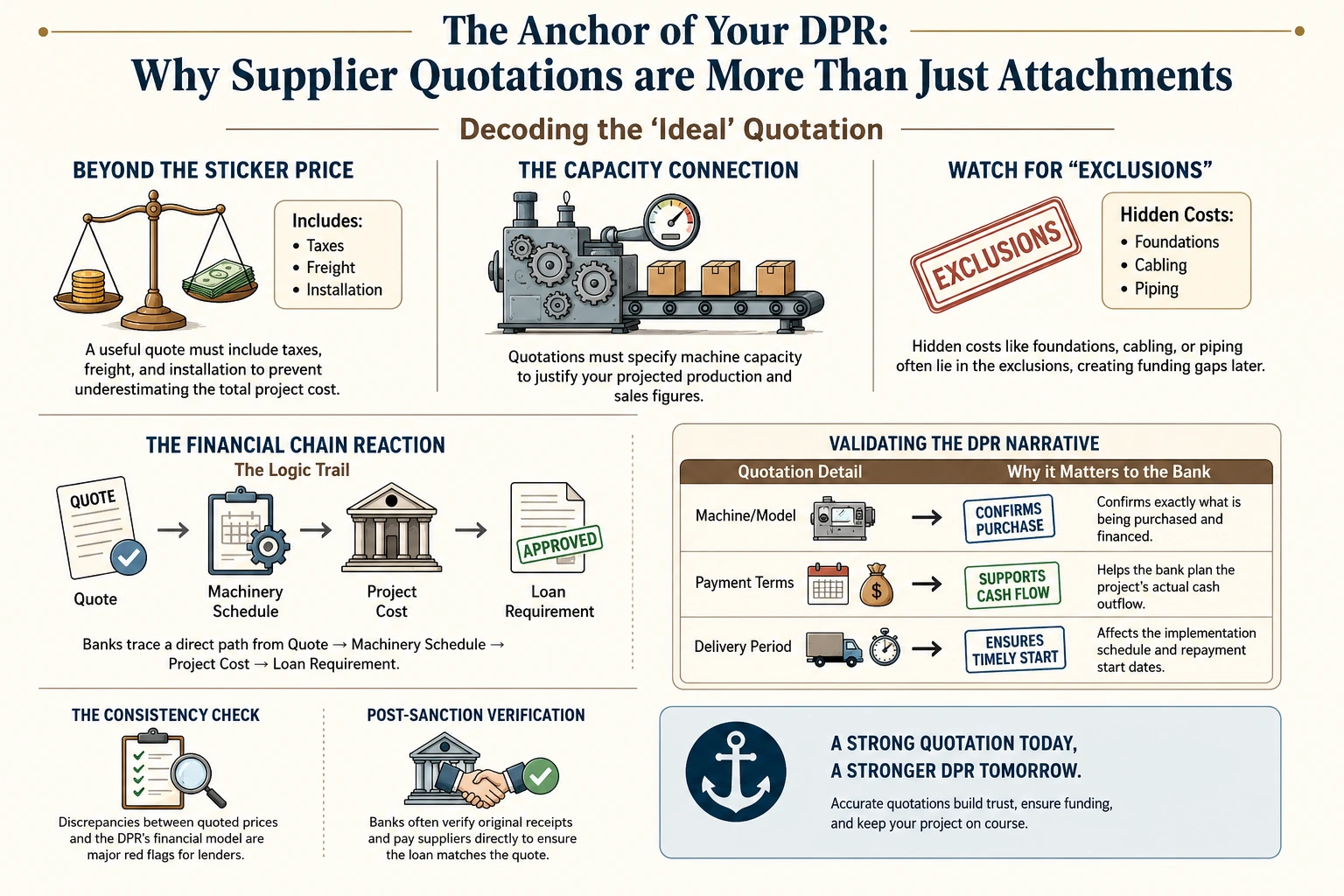
What Details Should a Useful Machinery Quotation Contain?
There is no single universal quotation format for every bank, but a detailed quotation is generally more useful than a one-line price estimate.
Ideally, it should clearly identify:
| Quotation Detail | Why It Matters in the DPR |
| Supplier name | Identifies who will supply the machinery |
| Machine/model | Confirms what is being purchased |
| Quantity | Supports total machinery cost |
| Capacity/specification | Helps support production assumptions |
| Basic price | Forms the starting equipment cost |
| Taxes | Helps determine total payable amount |
| Freight/packing | Prevents underestimating landed cost |
| Installation/commissioning | Identifies additional setup expenses |
| Payment terms | Helps plan project cash outflow |
| Delivery period | May affect implementation schedule |
| Exclusions | Identifies costs that must be added separately |
For imported machinery, the Ministry of MSME’s lender handbook specifically provides for information such as basic machinery cost, freight, insurance and customs duty in relevant term-loan applications.
How Should Supplier Quotations Be Shown Inside the DPR?
Do not simply attach three quotations and leave the reader to work out the total.
Create a machinery schedule.
Illustrative Example
| Machinery | Supplier | Basic Cost |
| Processing Machine | ABC Engineering | ₹12,00,000 |
| Packaging Machine | XYZ Systems | ₹4,50,000 |
| Air Compressor | PQR Equipments | ₹1,50,000 |
| Material Handling System | LMN Industries | ₹2,00,000 |
| Total Basic Machinery | ₹20,00,000 |
Then separately identify other applicable costs such as freight, installation, electrical work or supporting equipment.
This gives the bank a clear path from:
Supplier Quotation → Machinery Schedule → Project Cost → Loan Requirement
That connection is far stronger than stating:
Plant & Machinery: ₹25 lakh
without showing how ₹25 lakh was calculated.
Why Should You Read the “Exclusions” in a Supplier Quotation?
This is one of the most common project-cost problems.
Suppose a machine is quoted at ₹20 lakh.
The entrepreneur puts ₹20 lakh into the DPR.
Later it becomes clear that the quotation excludes:
- Electrical panel
- Cabling
- Compressor
- Foundation
- Installation
- Freight
- Piping
- Generator
- Laboratory equipment
The actual amount needed to make the machine operational may therefore be higher.
The DPR should distinguish between:
machine purchase cost and complete project installation cost.
A low machinery quotation does not necessarily mean the overall project cost is low.
How Does Machinery Cost Affect the Rest of the DPR?
A supplier quotation does not affect only one table.
Consider the chain:
Machinery Cost → Total Project Cost → Promoter Contribution → Term Loan → Depreciation → Interest → Cash Flow → Repayment
If the machinery cost changes substantially, several financial schedules may need to be revised.
For example:
Illustrative Example
Original machinery cost: ₹25 lakh
Revised supplier quotation: ₹32 lakh
If the DPR still shows a total project cost based on ₹25 lakh, the report is no longer consistent with the supporting quotation.
You may need to reconsider:
- Total project cost
- Promoter contribution
- Loan requirement
- Depreciation
- Implementation funding
- Repayment projections
This is why a quotation should ideally be finalised before the financial model is treated as final.
How Do Banks Verify the Project Cost Mentioned in a DPR?
The exact verification process varies by bank, loan product, project size and lender policy, but project-cost appraisal can involve several supporting checks.
The Bank Can Compare the DPR With Supplier Quotations
If your DPR says machinery costs ₹40 lakh but the attached quotations total ₹27 lakh, the difference may require explanation.
Similarly, the bank can compare:
machine → supplier → quoted price → capacity → proposed investment.
Building Cost May Be Checked Separately
Machinery quotations do not prove construction cost.
For a project involving a factory building, official bank documentation may call for architect estimates along with machinery quotations and other project-cost evidence.
This means different cost heads need different support.
The Source of Promoter Contribution Can Be Examined
Suppose the project costs ₹1 crore and the DPR assumes that the promoter will invest ₹25 lakh.
The lender may want to understand where that contribution comes from.
The project-cost assessment therefore covers both:
How much does the project cost?
and
How will that cost be financed?
Actual Cost May Also Matter During Implementation
A sanctioned project is not necessarily forgotten after approval.
Depending on the lending product, banks may require original bills, receipts, evidence of margin contribution and end-use verification during disbursement.
For example, Union Bank’s CBG financing terms state that applicable term loan disbursement can be made directly to suppliers with bills, receipts and end-use verification at stages of implementation. That is a scheme-specific example, but it demonstrates why the quotation used during appraisal should eventually reconcile with the actual procurement trail.
What Happens If the Final Supplier Price Changes After the DPR Is Prepared?
Prices can genuinely change.
A machine quoted at ₹15 lakh when the DPR was prepared may later become ₹16.5 lakh because of:
- Specification changes
- Supplier revision
- Additional accessories
- Freight
- Installation
- Currency movement for imported equipment
That does not automatically make the DPR wrong.
But significant changes should be communicated and reflected in the financing plan where necessary.
Do not simply keep the old project cost while signing a substantially different purchase order.
The practical question becomes:
Who will fund the difference?
If the bank finance remains unchanged, the additional cost may need to come from the promoter or another acceptable source, subject to lender approval.
Should You Take More Than One Supplier Quotation?
There is no universal rule requiring a fixed number of quotations for every bank loan.
However, comparing alternative suppliers can be useful when the machinery is expensive or highly customised.
The purpose is not necessarily to choose the cheapest machine.
A higher-cost machine may legitimately offer:
- Higher capacity
- Better automation
- Lower operating cost
- Additional accessories
- Better quality specifications
- Installation support
If you select the more expensive option, the DPR should make the commercial reason understandable.
How Should Machinery Capacity Connect With Projected Sales?
This is where the quotation becomes particularly important.
Suppose the supplier states that the machine has a capacity of 1,000 units per day.
If your DPR assumes production of 2,000 units per day from that same machine, the report may not be technically consistent unless another shift, additional equipment or another reasonable explanation exists.
The calculation should generally follow:
Machine Capacity → Operating Hours/Shifts → Capacity Utilisation → Production → Sales
Official bank checklists also connect machinery capacity with assumed utilisation, production and sales projections.
A quotation therefore supports both project cost and revenue assumptions.
What Common Supplier-Quotation Mistakes Should You Avoid?
One of the biggest mistakes is using an old quotation simply because it gives a lower project cost.
Also avoid using:
- Different machinery amounts in DPR and loan application
- Quotation for a different machine model
- Price without specification or capacity
- Machinery that does not support projected production
- Quotation that excludes essential accessories without adding them separately
- Duplicate machinery costs
- GST/freight/installation counted twice
- Estimated cost presented as though it were a confirmed supplier quotation
The objective is not to make the project cost as high or as low as possible.
It is to make it realistic and supportable.
What Should You Check Before Finalising the DPR?
Before submission, trace every major capital-cost figure back to its source.
A simple check is:
Quotation amount → DPR machinery table → Project cost → Means of finance → Loan application
These figures should tell the same story.
Then check whether machinery capacity agrees with:
production → sales → raw material → electricity → manpower → working capital.
This is where CA and technical review can complement each other.
A CA or financial professional can review whether the machinery investment flows correctly through project cost and financial projections, while the machinery supplier or technical specialist should support actual technical specifications and capacity.
Final Takeaway
Supplier quotations are one of the foundations of a machinery-based DPR because they help turn an estimated investment into a supportable project cost.
A useful quotation should not merely say:
“Machine – ₹20 lakh.”
It should help answer:
What are you buying? → From whom? → At what cost? → With what capacity? → What additional installation costs exist? → How does this investment support the projected business?
Banks may examine these relationships when assessing project cost and term-loan requirements.
The stronger your connection between the quotation, machinery schedule, project cost, means of finance and financial projections, the easier it becomes to explain your DPR during credit appraisal.
Frequently Asked Questions
1. Is a machinery quotation required for a bank loan project report?
For relevant term-loan proposals, banks may ask for machinery details, supplier information and quotations or proforma invoices. Exact requirements vary by lender and loan.
2. Can I use an online machinery price instead of a supplier quotation?
For preliminary planning it may help, but for significant equipment finance, obtaining a proper supplier quotation gives stronger support for actual project cost.
3. Does the quotation amount have to exactly match the DPR?
The DPR should reconcile with the quotations being relied upon. If additional costs such as freight or installation are added separately, the treatment should be clearly explained.
4. Can I change the supplier after the bank loan is sanctioned?
This may be possible depending on lender terms, but material changes should be discussed with the bank before purchase or disbursement.
5. Does the bank verify the machinery supplier?
Due-diligence and disbursement processes vary by lender and product. Banks may seek supporting invoices, supplier/payment details and end-use evidence in applicable cases.
6. Should GST be included in machinery project cost?
The treatment depends on the transaction, accounting/tax position and availability of applicable input tax credit. It should be handled consistently rather than counted twice.
7. Does machinery capacity have to match the projected sales?
Yes, the technical capacity and operating assumptions should reasonably support the production and sales used in financial projections.
8. Can I use a six-month-old supplier quotation?
Check whether it is still valid. If prices have changed materially, obtain an updated quotation before finalizing the financing requirement.
9. What happens if actual machinery cost exceeds the DPR amount?
The financing structure may need revision. The applicant should determine how the additional project cost will be funded and discuss material changes with the lender.
10. Does a supplier quotation guarantee that the bank will finance the full machine cost?
No. The quotation supports project-cost assessment, but loan quantum depends on the lender’s appraisal, borrower contribution, applicable margin and other credit conditions.