
Many PMEGP applicants assume that once the Khadi and Village Industries Commission (KVIC) or the District Industries Centre forwards their application to a bank, the loan is almost certain. In reality, that forwarding is only an administrative clearance — the bank still conducts its own independent credit appraisal, and applications can be declined at this stage.
This gap exists because PMEGP is a subsidy scheme layered on top of a normal bank loan. Banks therefore continue to apply their standard lending checks, including repayment capacity, project viability, credit history, promoter profile, and documentation, regardless of the government subsidy component.
At Sharda Associates, our CA-led team prepares CA-certified Project Reports and Detailed Project Reports (DPRs) for MSME and PMEGP applicants. One pattern shows up repeatedly: applications that get stuck at the bank stage often trace back to a weak, incomplete, or poorly structured project report, rather than the PMEGP scheme itself.
A properly prepared project report can help present the project’s cost, means of finance, projected sales, profitability, cash flow, repayment capacity, and overall business viability in a structured manner for the bank’s appraisal.
📞 Need a CA-certified PMEGP Project Report or DPR?
Contact Sharda Associates: +91 89899 77769
KVIC Forwarding Is Not the Same as Bank Approval
PMEGP works on a double-filter system. First, KVIC/KVIB/DIC screens applications administratively—checking eligibility, category, and basic documentation—and forwards eligible files to the bank selected by the applicant. Second, the bank conducts its own credit appraisal as it would for any commercial loan, since it is the bank’s own money (90–95% of project cost, depending on category) being lent, with the government subsidy adjusted only after a lock-in period. If the file does not meet the bank’s internal lending standards, it can still be returned or rejected even after clearing KVIC’s screening.
Common Reasons Banks Decline PMEGP Applications
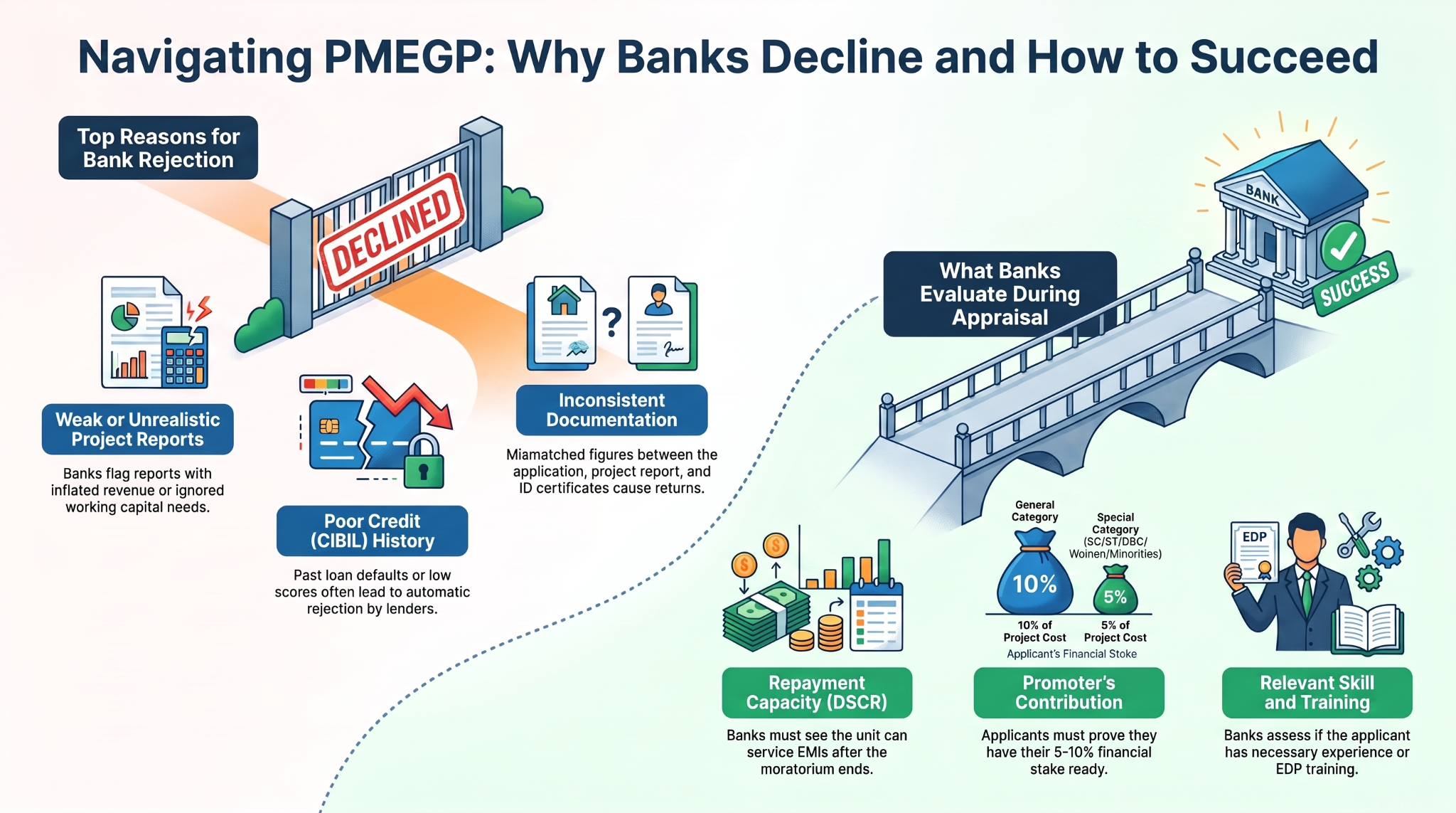
1. Weak or Unrealistic Project Report This is the single biggest reason. Banks want to see how the unit will earn enough to comfortably service the EMI after the loan moratorium ends. Reports that show inflated revenue, ignore working capital needs, or skip demand justification for the specific location get flagged during appraisal.
2. Poor Credit History or CIBIL Score A low CIBIL score, past loan defaults, or unpaid credit card dues make banks cautious, even when the project itself looks reasonable. Public sector banks in particular tend to apply a fairly strict cut-off.
3. Incomplete or Inconsistent Documentation Mismatched figures between the application form, the project report, and supporting documents (identity, address, caste/category certificate, educational qualification, quotations) are a common cause of return.
4. Promoter’s Contribution Not Tied Up If the applicant’s own contribution (10% for general category, 5% for special category) is not clearly demonstrated as available, the bank treats the file as financially incomplete.
5. No Prior Experience or Skill/EDP Training For technical or manufacturing activities, banks are hesitant to fund an applicant with no relevant experience or training, since it directly affects execution risk.
6. Wrong Bank Branch, Category, or Scheme Mismatch Selecting a branch not familiar with PMEGP processing, or a project category (manufacturing vs service, urban vs rural) that doesn’t match the actual activity, often triggers additional scrutiny or a return for correction.
7. Collateral and Guarantee Concerns As per RBI norms, projects up to ₹10 lakh under PMEGP are collateral-free, with CGTMSE-based guarantee cover typically applicable for the ₹10–25 lakh range. Where the sanctioning branch is not fully aligned with this coverage, or the applicant assumes collateral will be waived automatically, delays and disputes can arise.
What Banks Actually Evaluate in a PMEGP File
| What the Bank Checks | Why It Matters |
| Repayment capacity / DSCR | Confirms the unit can service EMI after moratorium |
| Project cost break-up | Checks machinery, working capital, and preliminary expenses are realistic |
| CIBIL score and credit history | Assesses borrower’s repayment discipline |
| Promoter’s contribution | Confirms applicant has genuine financial stake |
| Demand and market justification | Verifies the project is viable in that specific location |
| KYC and category documents | Ensures eligibility matches the claimed subsidy category |
Common Mistakes Applicants Should Avoid
- Submitting a generic, copy-pasted project report not specific to the applicant’s location and activity
- Assuming margin money subsidy is guaranteed once KVIC forwards the file
- Ignoring working capital requirements in the cost estimate
- Applying through a bank branch unfamiliar with PMEGP disbursement procedures
- Not disclosing existing loans or a spouse’s PMEGP/REGP loan, which can lead to rejection under duplication rules
How to Strengthen Your PMEGP Application Before the Bank Stage
A CA-certified project report that realistically projects revenue, working capital, and repayment capacity — rather than one built only to “look good” on paper — significantly improves the chances of the bank’s credit committee clearing the file on the first pass. Sharda Associates prepares project reports and DPRs with this bank-facing appraisal in mind, covering cost break-up, means of finance, projected P&L, cash flow, and DSCR, so the file is ready for scrutiny rather than assembled after a query is raised.
What to Do If Your PMEGP Case Is Rejected
Re-application is generally permitted. It helps to get the bank’s specific rejection reason in writing, revise the project report or documentation accordingly, and, where the issue is project viability or credit-related, address it before resubmitting to the same or a different bank. 📞 Need a CA-certified PMEGP Project Report or DPR?
Contact Sharda Associates: +91 89899 77769
FAQs
1. Does KVIC approval mean my PMEGP loan is guaranteed? No. KVIC/DIC forwarding is an eligibility screening; the bank separately evaluates creditworthiness and project viability before sanctioning.
2. Can a bank reject a PMEGP case even if I meet all scheme eligibility conditions? Yes. Eligibility under the scheme does not override the bank’s own credit appraisal norms.
3. What CIBIL score is generally expected for PMEGP loan approval? There is no single official cut-off under the scheme itself, but most banks are cautious below a score of around 650–700, and this can vary by lender.
4. Is collateral required for a PMEGP loan? As per RBI guidelines, projects up to ₹10 lakh are collateral-free; higher amounts are typically covered under CGTMSE guarantee, subject to the bank’s internal policy.
5. Can I reapply if my PMEGP application is rejected by one bank? Yes, applicants can generally revise the project report or documentation and reapply, either with the same bank or another PMEGP-empanelled bank.
6. Why do banks ask for a project report when the scheme is government-backed? Because the majority of the project cost (90–95%) is the bank’s own lending, not the subsidy amount, so the bank applies standard credit appraisal.
7. Does having no prior business experience disqualify me from PMEGP? Not automatically, but it is a factor banks weigh, especially for technical or manufacturing units; completing EDP training can help.
8. What is the maximum project cost eligible for PMEGP subsidy? Currently up to ₹50 lakh for manufacturing units and ₹20 lakh for service/business units, though applicants should confirm current limits with their bank or KVIC, as these are revised periodically.
9. Can two family members from the same household both avail PMEGP/REGP loans? No; if a spouse has already availed a PMEGP/REGP loan, the second application is typically rejected under duplication rules.
10. How much is the promoter’s own contribution under PMEGP? 10% of project cost for general category applicants and 5% for special category applicants (SC/ST/OBC/women/minorities/ex-servicemen and other specified categories).
11. Can a CA-certified project report improve approval chances? A well-prepared, realistic, bank-appraisal-ready project report addresses the most common rejection reasons — viability, DSCR, and cost justification — though final sanction always rests with the bank’s credit assessment.