
A revenue forecast for investors should explain how your business expects to earn money, not simply show a large turnover figure for the next three or five years. Investors know that future revenue cannot be predicted perfectly; what matters is whether the assumptions behind your projections are logical, measurable and connected to the way the business actually operates.
Sharda Associates helps businesses prepare CA-expert-led financial projections and business plans by connecting expected customers, pricing, sales volumes, operating costs and cash flows rather than creating aggressive growth figures merely to make an investment proposal look attractive.
What Makes a Revenue Forecast for Investors Credible?
An investor looking at a revenue forecast is usually trying to understand the business behind the numbers.
If your presentation says:
Year 1 Revenue – ₹50 lakh
Year 2 Revenue – ₹1.25 crore
Year 3 Revenue – ₹3 crore
the immediate question is likely to be:
What has to happen in the business for revenue to increase from ₹50 lakh to ₹3 crore?
Startup India’s investor guidance specifically identifies sales forecasts, target audiences, product mix, conversion and retention as factors relevant to investor evaluation. It also emphasises that financial model assumptions should be reasonable and clearly stated.
Therefore, credibility comes from explaining the drivers of revenue, not from presenting the largest possible number.
Should You Use a Top-Down or Bottom-Up Revenue Forecast?
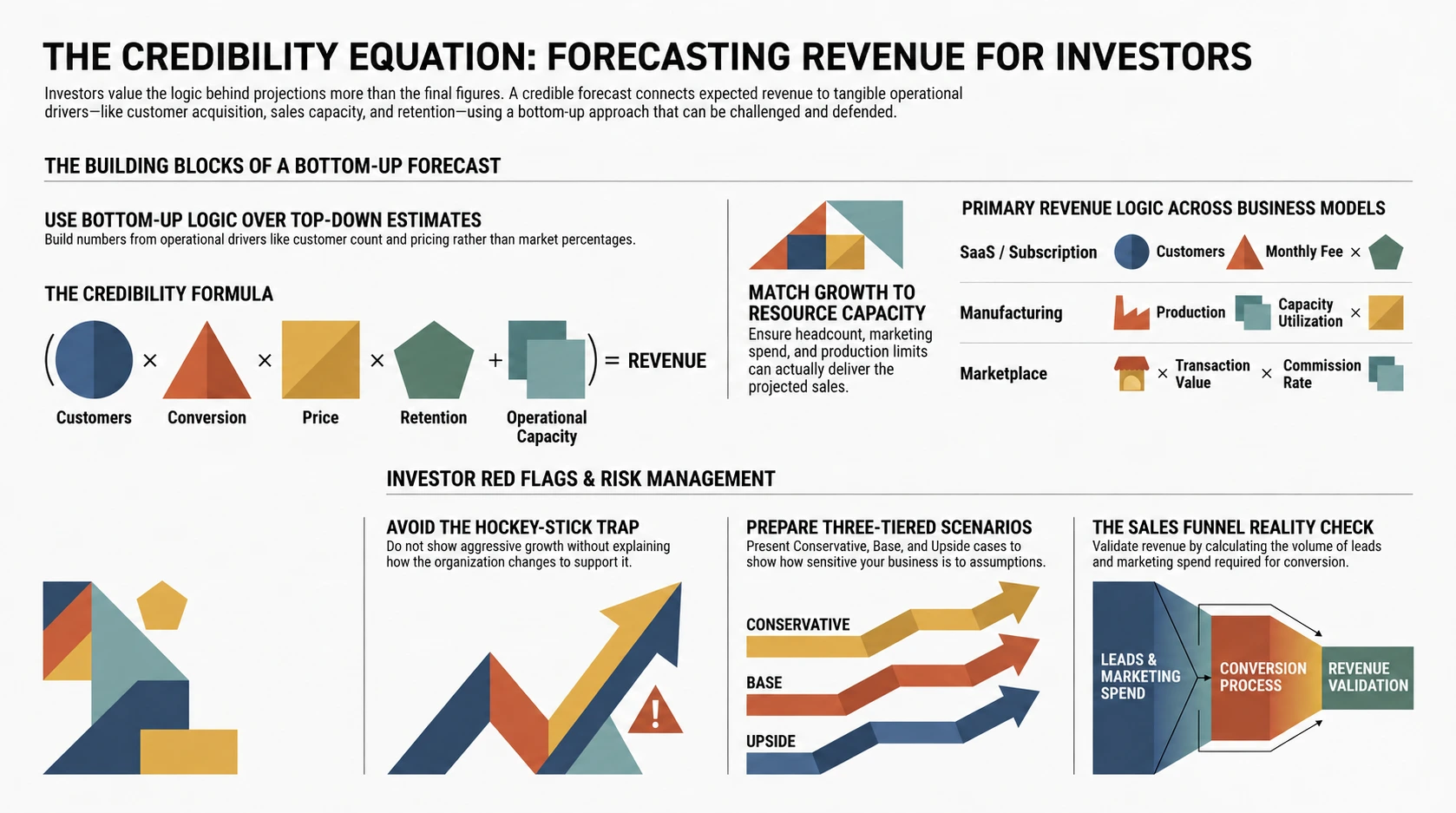
For investor discussions, a bottom-up forecast is often easier to defend because the founder can explain exactly how the number was calculated.
Top-Down Example
Suppose you estimate that the Indian market for your product is ₹1,000 crore and write:
“We expect to capture 1% of the market, giving us ₹10 crore revenue.”
The calculation is easy.
The difficult question is:
Why will your startup capture exactly 1%?
Unless you can connect that market share to customers, sales capacity, distribution and product demand, the forecast remains theoretical.
Bottom-Up Example
Suppose you operate a B2B subscription business.
Your revenue model might be:
Number of Paying Customers × Average Monthly Subscription × Active Months
Now the investor can examine each assumption.
That makes the forecast easier to challenge—and therefore easier to trust.
How Can a Startup Build Revenue When It Has No Historical Sales?
A new business cannot rely on previous turnover, so the forecast should start with the variables that actually create revenue.
Illustrative Example: Subscription Business
| Revenue Driver | Year 1 Assumption |
| Average paying customers | 300 |
| Average monthly fee | ₹2,000 |
| Average active months | 10 |
| Projected Revenue | ₹60 lakh |
The ₹60 lakh forecast is not automatically correct.
But now an investor can ask useful questions:
- How will you acquire 300 customers?
- What is your current pipeline?
- Why will they pay ₹2,000?
- How long are customers expected to stay?
- Does your marketing and sales team have enough capacity?
A forecast becomes more credible when each major assumption can be discussed separately.
Which Revenue Drivers Should You Use for Your Business?
Do not use the same forecasting formula for every industry.
Different businesses earn revenue in different ways.
| Business Model | Useful Revenue Logic |
| SaaS / Subscription | Customers × Monthly fee × Retention |
| Ecommerce | Orders × Average order value |
| Manufacturing | Production × Capacity utilisation × Selling price |
| Restaurant | Customers per day × Average bill × Operating days |
| Consultancy | Billable clients × Average fee |
| Marketplace | Transaction value × Commission rate |
| Retail | Units sold × Selling price |
| Hotel | Available rooms × Occupancy × Average room rate |
The investor should be able to trace the final revenue figure back to operating activity.
How Should You Use Existing Business Data?
If the company is already operating, historical performance becomes one of your strongest sources of credibility.
Suppose revenue has been:
FY 2024 – ₹80 lakh
FY 2025 – ₹1.05 crore
FY 2026 – ₹1.30 crore
and your next-year projection is ₹3 crore.
The investor will naturally want to know what changes.
A reasonable explanation might include:
- A second production line
- New geographic expansion
- More salespeople
- Additional distribution partners
- A new product
- Increased customer retention
- A confirmed enterprise pipeline
Simply saying “the market is growing rapidly” is usually not enough to explain a major change in company revenue.
Your forecast should connect growth to an operational event.
How Should Customer Acquisition Support Your Forecast?
For many startups, projected revenue depends on acquiring new customers.
Therefore, do not forecast revenue without thinking about the sales funnel.
Suppose you expect 1,000 new paying customers.
Ask:
How many leads will be needed?
If your expected conversion rate is 5%, achieving 1,000 customers would require approximately 20,000 qualified opportunities under that simplified assumption.
Then ask:
- Where will those leads come from?
- How much marketing spend is required?
- How many salespeople are needed?
- How long is the sales cycle?
- Can the team handle that volume?
Revenue projections become weak when customer growth increases dramatically but the resources required to acquire those customers remain unchanged.
Why Does Retention Matter as Much as New Sales?
For subscription, membership and repeat-purchase businesses, acquiring customers is only half the forecast.
You also need to consider how many remain active.
Imagine starting Year 2 with 1,000 customers.
If customers leave throughout the year, you cannot calculate revenue as though all 1,000 remain active indefinitely while adding every new customer on top.
Depending on the business model, consider:
- Customer retention
- Churn
- Repeat purchase frequency
- Contract renewals
- Expansion revenue
- Customer downgrades
Startup India specifically identifies conversion and retention among the sales and marketing factors relevant to investor evaluation.
How Should You Forecast Selling Prices?
Avoid increasing prices every year simply because the spreadsheet needs higher revenue.
Ask what actually supports the pricing assumption.
Evidence may include:
- Current customer pricing
- Signed contracts
- Recent invoices
- Competitor positioning
- Product improvements
- Different customer segments
- Subscription upgrades
- Distributor pricing
If you expect the average selling price to increase significantly, explain why customers will accept that increase.
Likewise, if expansion into a mass-market segment reduces pricing, the forecast should reflect it.
Why Should Revenue Match Your Operational Capacity?
Investors may compare your forecast with the resources needed to deliver it.
Suppose a consultancy currently has five professionals and can handle approximately 100 assignments annually.
If the forecast assumes 500 assignments next year but headcount remains five, something is missing.
Either:
- Productivity is increasing
- Technology is automating work
- More employees will be hired,
- Work will be outsourced
- Or the forecast is unrealistic.
The same principle applies to manufacturing.
Projected sales should make sense against machinery capacity, shifts, raw-material supply and working capital.
Your financial model should represent the same business described in the pitch deck.
Why Should You Prepare More Than One Revenue Scenario?
Future performance is uncertain.
Instead of pretending there is only one possible outcome, it can be useful to prepare scenarios.
Illustrative Example
| Scenario | Customers | Average Revenue | Annual Revenue |
| Conservative | 500 | ₹10,000 | ₹50 lakh |
| Base Case | 750 | ₹10,000 | ₹75 lakh |
| Upside Case | 1,000 | ₹10,000 | ₹1 crore |
These are hypothetical figures.
The purpose of scenarios is not to present three random forecasts.
It is to understand:
What happens if customer acquisition is slower than planned?
or
What happens if demand is stronger than expected?
Investors can then see how sensitive your business is to important assumptions.
How Should Revenue Connect With the Rest of Your Financial Projections?
Revenue should never sit alone in the business plan.
Higher revenue may require:
- More inventory
- More employees
- Higher marketing expense
- Additional machinery
- Additional servers or technology
- More office/warehouse capacity
- Higher working capital
Revenue then flows into:
Revenue → Gross Profit → Operating Expenses → EBITDA/Operating Profit → Cash Flow → Funding Requirement
A business can show rapidly increasing revenue and still require substantial external funding if cash is tied up in customer acquisition, inventory or receivables.
Startup India’s funding guidance similarly describes financial forecasting as considering projected sales together with market/economic indicators, production and other business-development costs when determining funding needs.
What Revenue Forecasting Mistakes Can Reduce Investor Confidence?
One common mistake is the hockey-stick forecast:
₹20 lakh → ₹1 crore → ₹5 crore → ₹20 crore
with no explanation of how the organisation changes between those years.
Another is assuming:
“If the market is ₹5,000 crore, getting ₹50 crore should be easy.”
Market size does not automatically create company revenue.
Also avoid:
- Using round numbers without calculations
- Ignoring customer churn
- Increasing revenue without increasing capacity
- Showing sales growth without marketing/sales investment
- Using unsupported price increases
- Confusing orders with recognised revenue
- Ignoring seasonal demand
- Showing different revenue in the pitch deck and financial model
- Presenting assumptions as guaranteed results
A credible forecast can still be ambitious.
It simply needs a clear explanation.
What Should You Be Able to Explain to an Investor?
Before presenting your projections, ask yourself whether you can answer these questions comfortably:
Who is buying?
How many customers do you expect?
How will you acquire them?
What will each customer pay?
How often will they buy?
How many customers will remain?
What capacity is needed to serve them?
What resources are required to achieve the forecast?
Why should revenue increase next year?
If you cannot explain one of these assumptions, that part of the model probably needs more work.
How Can CA or Financial Review Improve Investor Projections?
Professional financial review should not be used to manufacture a larger valuation or attractive revenue curve.
Its real purpose is to ensure that the assumptions flow consistently through the model.
For example:
Customers → Revenue → Cost of Sales → Expenses → Profit → Cash Flow → Funding Requirement
Sharda Associates can help businesses structure financial projections so that revenue, operating costs, working capital, cash flow and investment requirements are financially connected.
The founder should still understand the assumptions. An investor is investing in the business and management team—not simply in the spreadsheet prepared by an advisor.
Final Takeaway
The most credible revenue forecast is not necessarily the most conservative forecast or the most aggressive forecast.
It is the one you can explain logically from the ground up.
Instead of saying:
“We expect ₹10 crore revenue in three years.”
be prepared to explain:
Customers × Conversion × Retention × Price × Capacity = Revenue
Then show what people, marketing, technology, inventory and capital are required to make those numbers possible.
Investors know that actual results will differ from forecasts. What strengthens credibility is demonstrating that you understand which assumptions drive the business and what needs to happen operationally for your forecast to become reality.
Frequently Asked Questions
1. How many years of revenue projections should I show investors?
There is no universal period required for every investor. The forecast should cover enough time to show how the business is expected to scale, use funding and move toward important financial milestones.
2. Should startup revenue projections be conservative?
They should be realistic and defensible. A forecast can be ambitious if the customer, pricing, capacity and growth assumptions reasonably support it.
3. What is a bottom-up revenue forecast?
A bottom-up forecast starts with actual business drivers such as customers, units, pricing, conversion or capacity and builds revenue from those inputs.
4. Can I use market size to forecast revenue?
Market size provides useful context, but company revenue should ideally be connected to an achievable customer-acquisition and operating plan rather than an arbitrary percentage of the total market.
5. What should I do if my startup has no historical revenue?
Use observable drivers such as customer pipeline, expected conversion, pricing, production capacity, sales-team capacity or validated demand.
6. Should revenue projections include customer churn?
For recurring-revenue businesses, expected customer losses or retention should be considered because they directly affect future revenue.
7. Can investors ask how I calculated every revenue figure?
Yes. Founders should understand and be capable of explaining the material assumptions behind their financial model.
8. Should my pitch-deck revenue match my financial model?
Yes. Where both refer to the same period and assumptions, the numbers should be consistent or any difference should be clearly explainable.
9. Should I prepare conservative, base and optimistic scenarios?
Scenario analysis can be useful for showing how financial outcomes change when important assumptions such as customers, pricing or conversion change.
10. Does a strong revenue forecast guarantee investment?
No. Investors consider many factors, including the business model, market, team, traction, scalability, risks and potential returns. A credible forecast supports the discussion but cannot guarantee funding.