
AI and data analytics are making modern feasibility studies faster, more evidence-based and easier to test under different business scenarios, but they do not replace professional judgement. AI can help analyse demand patterns, historical sales, customer behaviour, cost data and multiple financial scenarios, while data analytics can show whether assumptions are supported by available evidence. Sharda Associates uses a CA-expert-led approach to feasibility analysis, where technology can support research and financial modelling while important assumptions relating to project cost, revenue, working capital, cash flow and repayment capacity still require professional review.
How Is a Modern Feasibility Study Different From a Traditional One?
Traditional feasibility studies often depended heavily on static market reports, manual spreadsheets, supplier quotations and the experience of the consultant.
Those sources are still important.
What has changed is the amount of information that can now be processed.
A modern feasibility study may combine:
- Historical business data
- Customer behaviour
- Sales trends
- Geographic information
- Competitor information
- Supplier and cost data
- Economic indicators
- Operational performance
- Digital demand signals
AI and analytics tools can process these datasets much faster than a person manually reviewing individual spreadsheets.
The objective, however, remains the same:
Should the proposed project proceed under the assumptions being considered?
Technology improves the analysis. It does not change the purpose of the feasibility study.
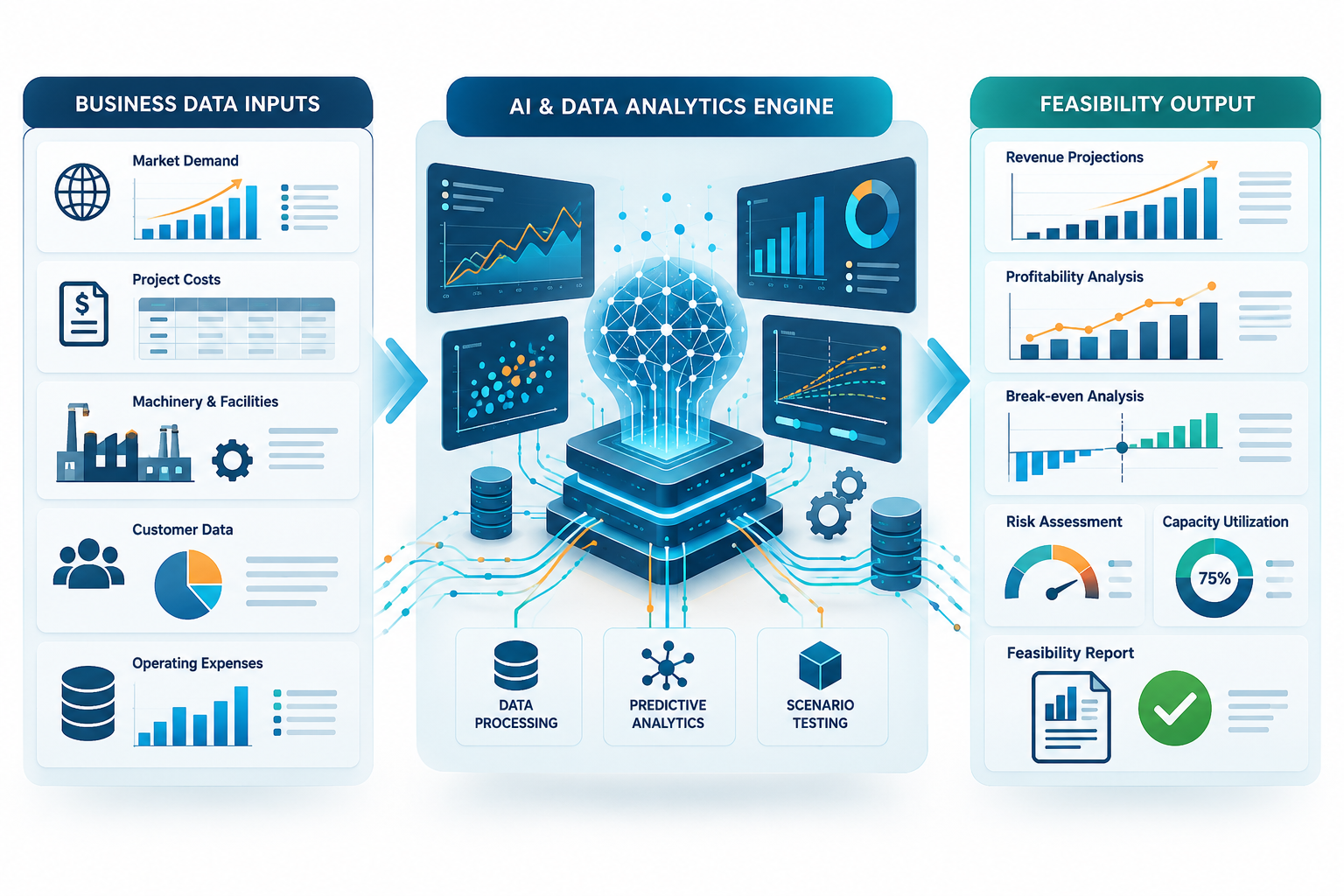
Where Can AI Add the Most Value to a Feasibility Study?
AI is most useful when a project involves large amounts of information or multiple variables that affect each other.
| Feasibility Area | How AI/Data Analytics Can Help |
| Market Feasibility | Analyse demand, customer segments and purchasing patterns |
| Financial Feasibility | Build forecasts and compare scenarios |
| Technical Feasibility | Organise equipment, capacity and operating data |
| Location Feasibility | Analyse demographic, accessibility or geographic information |
| Operational Feasibility | Identify resource and capacity constraints |
| Risk Analysis | Test how results change when assumptions change |
The value comes from improving the quality of questions being asked—not merely producing a longer report.
How Can AI Improve Market Demand Analysis?
Market feasibility has traditionally involved questions such as:
Who will buy the product?
How much demand may exist?
What price can customers reasonably pay?
Who are the competitors?
AI-supported analysis can work with larger and more diverse datasets than a basic manual market review.
Depending on the project and available information, the analysis may consider:
- Historical sales
- Website searches
- Customer enquiries
- Geographic demand
- Seasonal patterns
- Product usage
- Pricing behaviour
- Competitor activity
- Customer reviews
Modern predictive analytics can identify patterns in historical and current data and use them to estimate possible future outcomes.
This can be particularly useful when a business already has meaningful operating data.
However, an AI prediction should not automatically become the sales forecast used in the final feasibility report.
The question should always be:
Does this prediction make commercial sense for this particular project?
How Can Data Analytics Make Revenue Forecasts More Credible?
Consider a proposed restaurant.
A weak feasibility report might simply say:
“Expected monthly sales are ₹20 lakh.”
A data-driven analysis would break this figure into its underlying drivers.
Illustrative Example
| Revenue Driver | Assumption |
| Seats | 80 |
| Average customers per day | 150 |
| Average billing | ₹400 |
| Operating days | 30 |
| Monthly Revenue | ₹18,00,000 |
The figures are illustrative only.
Now the feasibility analyst can test:
- Is 150 customers per day realistic for the location?
- What happens on weekdays versus weekends?
- Is ₹400 average billing reasonable?
- Can the kitchen handle that customer volume?
- Is nearby competition likely to affect demand?
AI can help analyse these relationships and run multiple alternatives quickly.
The important improvement is not automation itself.
It is traceability from an assumption to the final revenue figure.
How Can AI Help Test Different Financial Scenarios?
One of the strongest uses of AI and analytics is scenario analysis.
A traditional feasibility report may contain one financial forecast.
Modern analysis can more easily test:
Base Case
What happens if the project performs broadly according to expectations?
Conservative Case
What if sales are lower, implementation is delayed or costs increase?
Upside Case
What happens if demand is stronger or capacity utilisation improves faster?
Consider an Illustrative Example:
| Scenario | Annual Sales | Operating Cost | Result |
| Conservative | ₹80 lakh | ₹74 lakh | Low operating surplus |
| Base Case | ₹1 crore | ₹85 lakh | Moderate surplus |
| Upside | ₹1.20 crore | ₹97 lakh | Higher surplus |
The purpose is not to generate three arbitrary numbers.
It is to understand:
Which assumptions have the greatest impact on project viability?
This is far more useful than simply saying that a project is “financially feasible.”
How Can AI Improve Project Cost Analysis?
Project cost is another area where analytics can add value.
A manufacturing feasibility study may involve:
- Several supplier quotations
- Building estimates
- Machinery alternatives
- Freight
- Installation
- Utilities
- Electrical infrastructure
- Working capital
AI tools can help organise quotations, classify expenditure and compare alternatives.
Data analysis can also identify unusual differences between supplier quotations.
For example:
Supplier A machine: ₹30 lakh
Supplier B machine: ₹22 lakh
Supplier C machine: ₹45 lakh
The lowest quotation is not automatically the best.
A proper feasibility review still has to examine:
- Capacity
- Technology
- Accessories
- Installation
- Energy use
- Quality
- Supplier reliability
SIDBI’s approach to Techno-Economic Viability assessment specifically includes reviewing the reasonableness of project-cost components as well as technical feasibility, technology and supplier credibility.
AI can organise the evidence.
A qualified person must still interpret it.
How Can Predictive Analytics Improve Capacity Planning?
A project may fail even when demand exists if it cannot deliver the expected volume.
Data analytics can help connect:
Demand → Capacity → Resources → Cost
For example, a manufacturing business may use operating data to study:
- Machine utilisation
- Downtime
- Output per shift
- Wastage
- Energy consumption
- Maintenance
- Inventory
A hotel may analyse occupancy.
A logistics company may analyse trips and vehicle utilisation.
A service business may analyse employee capacity and customer handling.
This allows the feasibility study to move beyond:
“The machine can produce 10,000 units.”
toward:
“How many units can the business realistically produce and sell under normal operating towards:ons?”
Can AI Improve Cash Flow and Working-Capital Analysis?
Yes, particularly where good historical data exists.
AI forecasting can analyse patterns in:
- Sales
- Customer payment periods
- Inventory
- Supplier payments
- Seasonal demand
- Operating expenses
This may help estimate future cash requirements more dynamically than a simple fixed-percentage approach.
For an existing business, predictive analysis may identify periods where cash pressure typically increases.
For a new project, however, there may be little or no historical operating data.
In that case, AI cannot magically discover the correct working-capital requirement.
The model still needs realistic assumptions about:
inventory days + customer credit + supplier credit + operating expenses.
AI is only as useful as the data and assumptions supplied to it.
What Are the Risks of Using AI in a Feasibility Study?
The biggest risk is treating a confident-looking AI output as verified fact.
Poor Data Can Produce Poor Conclusions
If historical records are incomplete or inaccurate, advanced algorithms can still produce misleading forecasts.
IBM’s current AI forecasting guidance similarly highlights data quality, changing market conditions and transparency as important limitations of AI-driven forecasting.
AI Can Invent Missing Information
Generative AI may produce plausible market numbers, licence requirements, costs or industry statements when reliable information has not been supplied.
That information should never automatically enter a professional feasibility report.
Historical Patterns May Change
A model trained on past demand may perform poorly if:
- Regulations change
- A new competitor enters
- Raw-material prices move sharply
- Customer behaviour changes
- Technology changes
Complex Models May Be Difficult to Explain
A feasibility conclusion should be understandable to the entrepreneur, lender or investor.
If nobody can explain why an AI model predicts a particular result, decision-makers may have difficulty relying on it.
Should AI Prepare the Entire Feasibility Report Automatically?
AI can prepare a draft, organise research, analyse datasets and help build scenarios.
But a professional feasibility study should not become:
Enter project name → Click generate → “Project is feasible.”
Even current AI feasibility-study platforms themselves often warn users that AI-generated figures should be independently reviewed before investment decisions are made.
A more reliable workflow is:
Real Data → Data Analysis → AI-Assisted Research → Financial Modelling → Scenario Testing → Professional Review → Feasibility Conclusion
That keeps the efficiency of AI without allowing technology to become the sole decision-maker.
What Is the Role of a CA or Feasibility Consultant When AI Is Available?
Professional expertise becomes more important, not less, when more data is available.
A CA or financial analyst may need to decide:
- Which assumptions are reasonable
- Whether project cost is complete
- Whether sales flow correctly into P&L
- Whether working capital is adequate
- Whether cash flow supports debt
- Whether the sensitivity analysis is meaningful
- Whether financial statements reconcile
A technical expert may separately evaluate machinery, process and capacity.
A market specialist may assess customer demand.
AI can help each professional work faster, but it should not blur the responsibility for validating the underlying assumptions.
What Does the Future of Feasibility Analysis Look Like?
Modern feasibility studies are likely to become increasingly dynamic rather than static.
Instead of preparing one report and never updating it, businesses may increasingly use live data to compare:
Forecast vs Actual
Expected Cost vs Actual Cost
Projected Demand vs Real Demand
Expected Capacity vs Actual Utilisation
AI-enabled forecasting can update projections as new information becomes available, allowing decision-makers to identify risks earlier.
That can turn feasibility from a one-time pre-investment exercise into an ongoing decision-support process.
Frequently Asked Questions
1. Can AI prepare a feasibility study?
AI can assist with research, forecasting, scenario analysis and drafting, but important market, technical and financial assumptions should still be independently verified.
2. How is data analytics used in feasibility studies?
It can analyse historical performance, customer behaviour, demand patterns, costs, operational capacity and financial trends.
3. Can AI predict whether a business will succeed?
No. AI can estimate potential outcomes based on available data and assumptions but cannot guarantee future business performance.
4. Can AI improve sales forecasting?
Yes. AI can identify patterns across larger datasets and incorporate multiple demand drivers, but forecast quality depends heavily on data quality and changing market conditions.
5. Is AI useful for a new business with no historical data?
It can still support research and scenario modelling, but predictive accuracy may be more limited because business-specific historical information is unavailable.
6. Can AI calculate financial feasibility?
It can help calculate profitability, cash flow, break-even and scenarios, but the underlying project-cost and revenue assumptions still require verification.
7. Can AI replace a feasibility consultant?
Not completely. AI is a decision-support tool; multidisciplinary professional judgement may still be required for financial, technical, regulatory and market questions.
8. How can AI help with risk analysis?
AI and analytics can test different assumptions quickly and show which variables have the greatest effect on project outcomes.
9. Is an AI-generated feasibility report acceptable for a bank or investor?
Requirements vary. A generated report should not be assumed to satisfy a lender or investor merely because AI created it. The underlying information, analysis and supporting evidence matter.
10. What is the biggest risk of AI-based feasibility analysis?
Treating generated or predicted information as factual without checking the quality of the source data and assumptions.