
Interest rates play an important role in deciding whether a debt-funded business project remains financially comfortable or becomes difficult to manage. A change in borrowing cost can directly affect loan repayment, cash flow availability, profitability and the overall feasibility of a project.
When a business takes a loan for setting up a new plant, expanding operations, purchasing machinery or starting a new venture, the interest rates impact becomes a critical assumption in the financial model. A higher interest rates increases finance costs, reduces cash available after debt servicing and can lower the Debt Service Coverage Ratio (DSCR).
This is why a detailed project report and financial feasibility study should not consider interest rates as an isolated figure. The impact of interest should be evaluated along with project cost, debt structure, repayment period, projected revenue, working capital requirements and cash flow projections.
Why Are Interest Rates Important in Project Feasibility?
Two businesses may have the same:
- Machinery
- Production capacity
- Sales assumptions
- Operating expenses
- Project cost
However, their financial position can be different if their borrowing costs are different.
For example, one business may receive finance at a lower interest rate, while another may borrow at a higher rate. Even though their operations are identical, the second business may have:
- Higher EMI burden
- Lower available cash surplus
- Reduced profitability
- Lower DSCR
Interest rate directly affects the relationship between:
Business Operations → Cash Generation → Loan Repayment → Financial Stability
Therefore, a feasibility report must evaluate whether the project can generate sufficient cash after considering debt obligations.
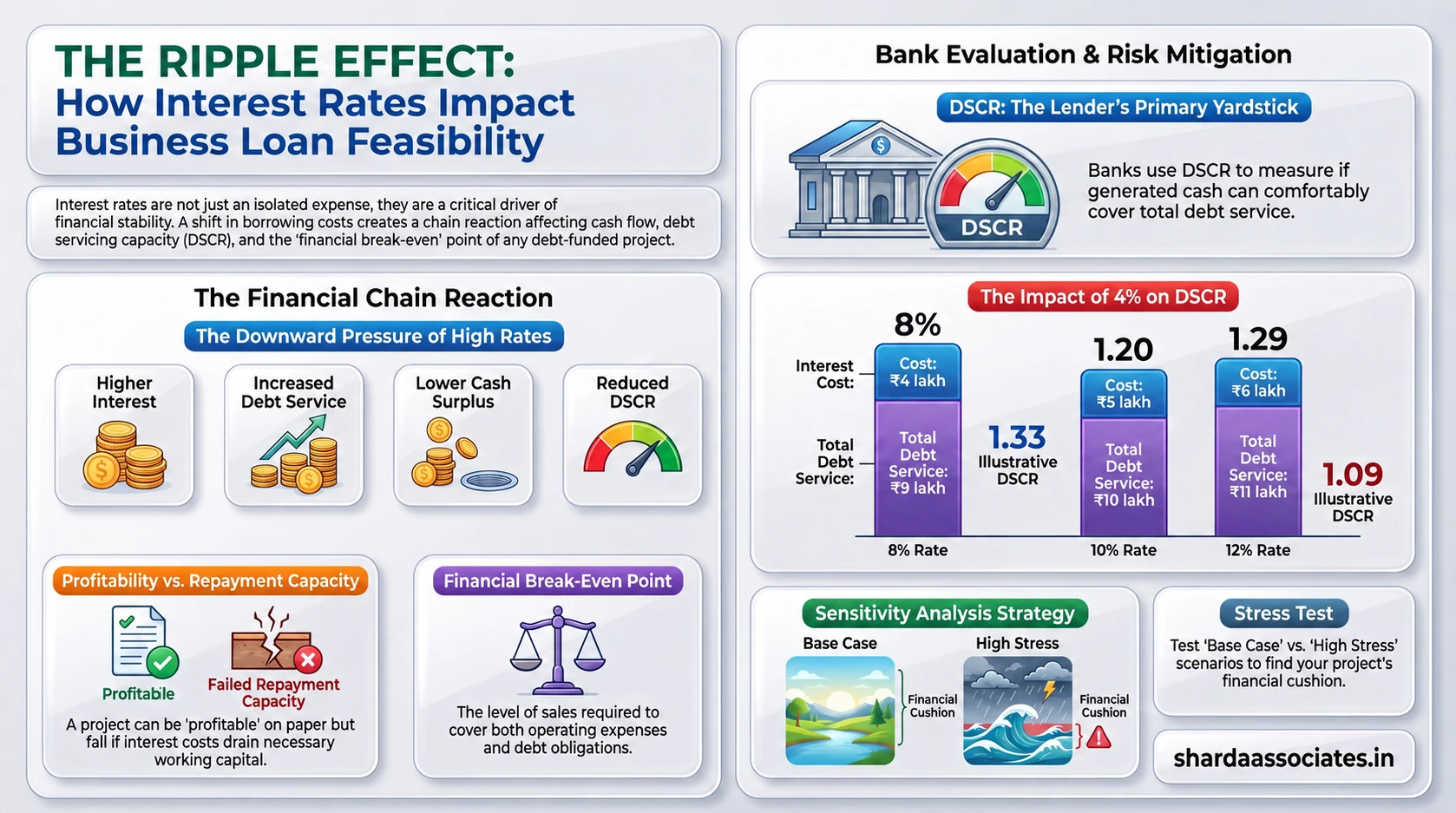
How Do Interest Rates Impact Business Loan Repayment?
The most immediate impact of higher interest rates is an increase in loan repayment burden.
When interest rates increase:
Higher Interest Cost → Higher Debt Service → Lower Cash Available for Business
For a business, this can affect:
- Monthly EMI payments
- Annual debt obligations
- Working capital availability
- Expansion plans
- Future investment decisions
A project may appear profitable on paper, but higher financing costs can reduce the actual cash available for repayment.
This is why loan repayment capacity should always be evaluated while preparing financial projections for a bank loan.
How Do Interest Rates Affect DSCR?
DSCR (Debt Service Coverage Ratio) measures whether the cash generated by a business is sufficient to meet its debt repayment obligations.
A simplified formula:
DSCR = Cash Available for Debt Service ÷ Total Debt Service
When interest rates increase:
- Interest expense increases
- Total debt service increases
- DSCR generally decreases
A lower DSCR indicates higher repayment pressure.
For example:
A business may have strong sales and profitability, but if loan repayment obligations increase significantly due to higher interest rates, the repayment comfort may reduce.
Therefore, interest rate assumptions are an important part of DSCR calculation in a project report or CMA data.
Illustrative Example: Impact of Interest Rate on DSCR
Assume a business has:
- Term Loan: ₹50 lakh
- Annual cash available for debt service: ₹12 lakh
- Principal repayment during the year: ₹5 lakh
For illustration purposes:
|
Interest Rate |
Interest Cost |
Total Debt Service |
Illustrative DSCR |
|
8% |
₹4 lakh |
₹9 lakh |
1.33 |
|
10% |
₹5 lakh |
₹10 lakh |
1.20 |
|
12% |
₹6 lakh |
₹11 lakh |
1.09 |
These figures are only for understanding. Actual repayment depends on loan terms, outstanding balance, repayment schedule and sanction conditions.
The example shows that even when business operations remain unchanged, an increase in interest cost can reduce repayment comfort.
How Do Banks Evaluate Interest Rate Impact While Approving Business Loans?
Banks do not only check whether a business is profitable. They evaluate whether the borrower can comfortably repay the loan.
While reviewing a project report, banks generally analyse:
1. Debt Repayment Capacity
Banks evaluate:
- Expected cash flow
- Profitability
- DSCR
- Loan tenure
- Repayment schedule
A project with insufficient cash generation may face difficulty in loan approval.
2. Financial Projections
Banks review whether projected:
- Sales
- Expenses
- Profit margins
- Cash flows
are realistic.
Higher interest assumptions can significantly affect these projections.
3. Working Capital Requirement
Higher interest costs can increase financial pressure, especially when a business already requires funds for:
- Inventory
- Receivables
- Daily operations
4. Sensitivity of the Project
Banks and lenders may consider how the project performs if assumptions change, such as:
- Increase in interest rate
- Lower sales than expected
- Higher operating costs
A strong project report should demonstrate that the business has considered these risks.
Should You Use the Current Interest Rate for the Entire Loan Period?
Not always.
Before finalising financial assumptions, it is important to understand whether the proposed loan is:
- Fixed interest rate
- Floating interest rate
For floating-rate loans, interest rates may change during the loan tenure depending on applicable lending terms.
Therefore, a feasibility study should avoid assuming that today’s interest rate will remain unchanged for the entire repayment period.
A better approach is:
Base Interest Assumption + Sensitivity Analysis
This helps evaluate how the project performs if borrowing costs increase.
How Can Higher Interest Rates Affect Financial Statements?
Interest affects multiple areas of financial analysis.
The direct impact is:
Higher Interest Expense → Lower Profit Before Tax
However, the impact continues:
Higher Interest → Higher Loan Repayment → Lower Cash Surplus → Lower DSCR
Therefore, simply increasing interest expense in the Profit & Loss Account is not enough.
A proper financial feasibility analysis should update:
- Profit & Loss Statement
- Cash Flow Statement
- Loan repayment schedule
- DSCR calculation
How Can Interest Rates Affect Project Cost?
Interest rates can also influence project cost, especially for large projects.
During project implementation, delays in:
- Construction
- Machinery installation
- Commercial production
can increase the period before revenue generation begins.
This may result in:
Longer Implementation Period → Additional Financing Cost → Higher Funding Requirement
This is especially important for:
- Manufacturing projects
- Hotels
- Hospitals
- Infrastructure projects
- Renewable energy projects
How Do Interest Rates Affect Break-Even Analysis?
Businesses often focus only on operating profitability. However, financing cost can change the level of sales required to comfortably repay debt.
Two concepts should be understood:
Operating Break-Even
This considers whether revenue covers operating expenses.
Financial Break-Even
This considers whether the business can also meet:
- Interest obligations
- Loan repayment
- Financial commitments
A business can be profitable but still face cash flow pressure if borrowing costs increase.
Can Higher Interest Rates Increase Promoter Contribution Requirements?
Yes, in some situations.
If higher borrowing costs make debt repayment difficult, the financing structure may need to be adjusted.
Example:
Original Structure
Project Cost: ₹1 crore
Promoter Contribution: ₹25 lakh
Loan: ₹75 lakh
Revised Structure
Project Cost: ₹1 crore
Promoter Contribution: ₹40 lakh
Loan: ₹60 lakh
The second structure reduces debt burden but requires higher promoter investment.
The right financing structure depends on:
- Business cash flow
- Expected returns
- Repayment capacity
- Risk level
Should Interest Rate Sensitivity Be Included in a Feasibility Report?
Yes, especially when the project depends significantly on borrowed funds.
A sensitivity analysis can evaluate:
Base Case
Expected interest rate and operating assumptions.
Moderate Stress Case
Slight increase in borrowing cost.
Higher Stress Case
Significant increase in financing expenses.
The purpose is not to predict the future perfectly but to understand how much financial cushion the project has.
Why Interest Rate Analysis Matters Even When Sales Are Strong
A business may have strong market demand but still face financial pressure due to borrowing costs.
For example:
A company may have:
- Good sales
- Strong margins
- Growing demand
but customers may pay after 90 days.
If the business also faces:
- Higher term loan interest
- Higher working capital interest
- Delayed collections
the issue becomes a cash flow challenge.
Therefore, feasibility analysis should evaluate:
Sales + Profitability + Working Capital + Debt Repayment + Interest Cost
together.
What Should a Good Feasibility Report Mention About Interest Assumptions?
A professionally prepared feasibility report should clearly mention:
- Assumed interest rate
- Loan amount
- Fixed or floating rate assumption
- Repayment tenure
- Moratorium period (if applicable)
- Interest calculation approach
- Sensitivity analysis
This makes the financial projections easier to understand and defend before banks or investors.
What Should You Check Before Finalising Interest Assumptions?
Before submitting a project report, check:
- Is the interest rate based on realistic borrowing terms?
- Is the loan fixed-rate or floating-rate?
- Has the repayment schedule been considered?
- Does the interest assumption affect DSCR correctly?
- Have stress scenarios been evaluated?
- Are sales projections realistic even after considering higher financing costs?
A realistic interest assumption improves the credibility of a project report.
Frequently Asked Questions
Q1. Does a higher interest rate reduce project feasibility?
Yes. Higher interest rates increase borrowing costs, increase debt repayment obligations and can reduce DSCR and cash flow availability.
Q2. How do interest rates affect DSCR?
When interest rates increase, debt servicing requirements generally increase, which can reduce DSCR if cash generation remains unchanged.
Q3. Should interest rate changes be considered in a project report?
Yes. Interest rate sensitivity helps evaluate whether a project remains financially viable under changing financing conditions.
Q4. Can a profitable business still face repayment problems?
Yes. Profitability and cash flow availability are different. A business can be profitable but still struggle with loan repayment due to higher debt obligations.
Q5. Does interest rate affect bank loan approval?
Yes. Banks consider repayment capacity, DSCR, cash flow projections and overall financial feasibility while evaluating loan proposals.
Q6. Should entrepreneurs increase sales projections to cover higher interest costs?
No. Sales projections should be based on realistic market assumptions, not adjusted artificially to improve financial ratios.
Q7. Is lower interest rate always better for a project?
A lower interest rate reduces financing cost, but the overall loan structure, repayment terms and business cash flow should also be considered.