
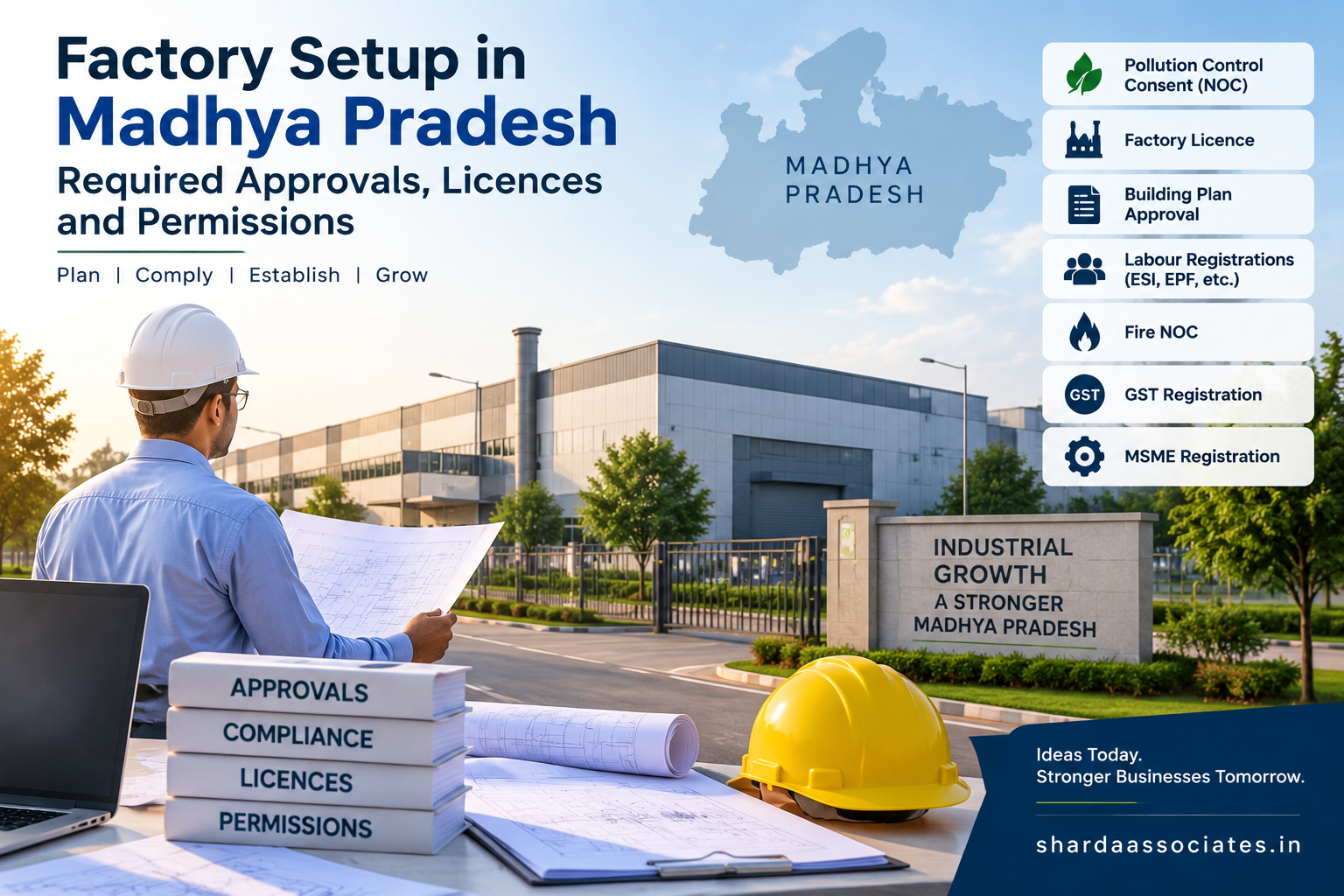
Setting up a manufacturing or industrial project in Bhopal or elsewhere in Madhya Pradesh usually involves more than registering a company and arranging a bank loan. Before construction and commercial production, the entrepreneur may need to deal with industrial land, land-use and building requirements, Madhya Pradesh Pollution Control Board permissions, factory-plan approval and factory registration/licensing. The exact approvals depend on the location, manufacturing process, pollution category, investment, power usage and nature of the unit.
Sharda Associates can assist with the project report, project cost, means of finance and financial-documentation side, while engineering drawings, environmental systems and statutory technical certifications should be prepared by the relevant qualified professionals.
Which Approvals Should You Check Before Starting an Industrial Project?
There is no single approval list that applies identically to every business.
A small non-manufacturing office in Bhopal may require very different permissions from a food-processing plant, chemical unit or engineering factory.
For an industrial project, the approval journey commonly revolves around these areas:
| Project Stage | Permission to Check |
| Selecting the site | Industrial land / permitted land use |
| Planning the plant | Layout and building/factory-plan approval |
| Before establishing pollution-generating activity | Consent to Establish, where applicable |
| Installing machinery | Compliance with approved layout and pollution systems |
| Before factory operations | Factory registration/licence, where applicable |
| Before commercial operation | Consent to Operate, where applicable |
| Special activities | Environmental/waste/groundwater/fire or sector-specific approvals |
The order matters because one permission may require information from another.
How Does Industrial Land Allotment Work in Madhya Pradesh?
For businesses looking for land in MPIDC industrial areas, the Invest MP portal provides an online land-bank and allotment system.
The portal allows investors to search available industrial land and apply online. Current MPIDC instructions state that simply booking a plot does not itself create a right to allotment. The competent authority can assess whether the land requested is reasonable for the proposed project.
This is why a land-allotment application should be supported by a realistic project.
For example, if you request a large plot, your project documentation should reasonably explain the requirement through:
- Production area
- Machinery layout
- Raw-material storage
- Finished-goods storage
- Utility area
- Loading and unloading
- Internal movement
- Office/laboratory
- Pollution-control facilities
- Required open/setback space
Bhopal district currently includes industrial locations such as Acharpura and Bagroda, among others listed through Invest MP resources.
What If You Are Using Private Land Instead of MPIDC Land?
Private land should not automatically be assumed to be usable for industrial activity merely because you own or lease it.
Depending on the location and existing land use, questions relating to land diversion, development permission, town-and-country-planning requirements and local building permissions may arise.
The current Invest MP policy portal itself lists the Madhya Pradesh Town & Country Planning framework and separate instructions relating to diversion of land.
Therefore, before purchasing private land for a factory, check:
Can the proposed activity legally operate on this land?
This should ideally be answered before major investment is committed.
When Is Pollution Control Board Consent Required?
Manufacturing activities that fall within the applicable environmental-consent framework may need approval from the Madhya Pradesh Pollution Control Board (MPPCB).
Two terms are particularly important:
Consent to Establish — CTE
CTE is associated with establishing the proposed industry or taking steps toward establishing the applicable pollution-generating operation.
MPPCB’s current document checklist for CTE includes items such as:
- Land allotment/possession information
- Project layout
- Project report
- Manufacturing process
- Raw materials
- Proposed project investment
- Local-body/Gram Sabha NOC where applicable
- Pollution-control arrangements
- ETP/STP details where applicable
- Groundwater permission where applicable
- Environmental Clearance where applicable
- Hazardous-waste information, where relevant
This shows why the project report and pollution application should contain consistent information.
If your DPR says the project costs ₹2 crore but your pollution application shows ₹80 lakh without a valid reason, the mismatch can create unnecessary questions.
What Is Consent to Operate?
Obtaining CTE does not necessarily mean the unit is ready to begin commercial operations.
After the unit is established and the required pollution-control systems are installed, the applicable industry may need Consent to Operate (CTO).
MPPCB’s current CTO documentation includes compliance with CTE conditions, details and photographs of installed pollution-control systems and information relating to actual gross capital investment, among other applicable documents.
A simple way to understand the difference is:
CTE → permission connected with establishing the applicable unit
CTO → consent connected with operating the established unit
The exact environmental requirements depend on the industry category and activity.
Does Every Project Need Environmental Clearance?
No.
Environmental Clearance (EC) and Pollution Control Board consent are not automatically the same thing.
Certain projects covered by the applicable environmental-impact-assessment framework may require Environmental Clearance separately.
MPPCB’s own checklist asks for a copy of Environmental Clearance if applicable, which is an important distinction.
Therefore, do not assume that receiving CTE automatically satisfies every environmental approval applicable to a large or specially regulated project.
What Factory Permissions Are Required in Madhya Pradesh?
Where the applicable factory-law requirements are triggered, Madhya Pradesh currently operates a dedicated Factory Services Portal through MPOnline.
The portal provides separate services for:
- Factory plan approval
- Factory registration
- Factory licence
- Renewal
- Amendments
- Hazardous and non-hazardous category processes
The current portal specifically shows Plan Approval through Form 1A and Factory Registration through Form 4 under the Factories Act framework.
This distinction is important.
An entrepreneur should not construct the factory layout first and assume that registration can solve every design issue later.
Where factory-plan approval applies, layout and safety requirements should be considered during the planning stage.
Is Factory Plan Approval the Same as Building Permission?
Not necessarily.
Factory-plan approval focuses on requirements under the applicable factory/industrial-safety framework.
Local or development-authority building permissions may deal with planning, construction and land-development issues.
Depending on the location, a project may therefore need to consider both.
A factory in an MPIDC industrial area can also have a different land/building route from a project established on private land within another planning jurisdiction.
This is why approval mapping should be done site by site, rather than copying the permission list from another factory.
What Is the Practical Approval Sequence?
For many new industrial projects, a useful planning sequence is:
1. Finalise the Business and Site
Determine the proposed product, manufacturing process, machinery, land requirement and project cost.
2. Verify the Land
Confirm whether the unit will use MPIDC industrial land or private land and whether the proposed industrial activity is permitted.
3. Prepare the Layout and Project Information
Coordinate machinery placement, production process, utilities, storage and pollution-control requirements.
4. Apply for Establishment-Level Permissions
Depending on applicability, this can include CTE and factory-plan approval.
5. Construct and Install the Project
The actual unit should broadly follow the approved project and technical conditions.
6. Obtain Operating-Level Permissions
Before operations, check factory registration/licensing and CTO requirements.
7. Check Additional Sector-Specific Permissions
Food, pharmaceuticals, hazardous chemicals, boilers, fire-risk operations, groundwater use and other sectors can require additional approvals.
This sequence is indicative rather than universal.
Can Madhya Pradesh Businesses Use a Single-Window System?
Madhya Pradesh currently positions MPIDC as the Single Window Secretariat for investment promotion and facilitation, and Invest MP provides a “Know Your Approvals”/service-wizard approach to identify clearances based on project characteristics.
The portal also states that applications are handled through departmental online systems at the state level rather than requiring separate district-level approval systems.
However, “single window” should not be interpreted as:
“One application automatically gives every permission.”
Different departments remain responsible for their respective statutory approvals.
What About Madhya Pradesh’s 3-Year Approval Exemptions?
Madhya Pradesh has introduced establishment-facilitation measures under the Madhya Pradesh Udyogon ki Sthapna Evam Parichalan ka Saralikaran Adhiniyam, 2023.
Current Invest MP material states that 3-year exemptions are available in specified notified industrial areas for identified approvals.
However, entrepreneurs should not assume that every unit in Bhopal or Madhya Pradesh automatically receives a three-year exemption from every approval.
You should check:
- Whether your location is a notified area
- Whether your particular approval is included
- Whether your activity qualifies
- What conditions still apply
What Is the Biggest Approval Mistake to Avoid?
The biggest mistake is treating every permission as a separate paperwork exercise.
Your:
Project Report → Land Requirement → Factory Layout → Pollution Application → Machinery → Project Cost → Factory Registration
should all describe the same project.
For example, if your DPR says the unit produces 10 tonnes per day but the pollution application says 25 tonnes, or the machinery layout cannot support either figure, the documents become difficult to defend.
Plan the project once, then use consistent information across approvals.
Frequently Asked Questions
Q1. Do I need MPIDC land to start a factory in Bhopal?
No. A factory may also operate on other legally permissible land, but land-use, development and other applicable permissions should be checked.
Q2. Is CTE required before starting factory construction?
Where MPPCB consent applies, Consent to Establish should be addressed at the establishment stage. Confirm the requirement for your specific industry before proceeding.
Q3. Is CTE the same as CTO?
No. CTE relates to establishment, while CTO relates to operation after applicable conditions have been complied with.
Q4. Does every factory need MPPCB approval?
Environmental requirements depend on the nature and categorisation of the activity. Check the current MPPCB categorisation and consent requirements.
Q5. Where is factory registration done in Madhya Pradesh?
Madhya Pradesh currently provides factory-plan approval and factory-registration/licensing services through its MPOnline Factory Services Portal.
Q6. Does land allotment guarantee permission to operate the factory?
No. Land allotment and operating/statutory permissions are separate processes.
Q7. Can a project report be used for MPIDC and pollution applications?
The underlying project information can support multiple applications, but each authority may require its own forms, details and supporting documents.
Q8. Are all approvals available through Invest MP?
Invest MP provides investment facilitation and approval-identification tools, but the relevant departments remain responsible for individual statutory services.