
A project report tells the bank what you say is true about your business. Verification is the separate process of checking whether it actually is. Applicants often assume the report itself is the deciding document — in reality, it’s the starting claim, and a bank runs several independent checks before deciding how much of it to believe. At Sharda Associates, every CA-certified project report we prepare is built with this verification process in mind, precisely because a report that can’t survive these checks doesn’t matter how well it reads on paper.
Desk-Level Cross-Verification Happens First
Before anyone visits your premises, your figures are checked against records the bank can pull independently:
| What’s Claimed in the Report | What Gets Cross-Checked |
| Business turnover and profitability | ITR filings and GST returns for the same period |
| Business registration and scale | Udyam Registration details |
| Promoter’s creditworthiness | CIBIL/CIC report — score, repayment history, existing exposure |
| Bank account activity | Actual bank statements against reported cash flow |
A mismatch at this stage — turnover claimed in the report running well ahead of what GST filings show, for instance — gets flagged before anyone leaves the branch.
Vendor and Quotation Verification
Machinery and equipment costs quoted in the report aren’t taken at face value. Banks (or their appraisers) commonly:
- Call the listed vendor directly to confirm the quotation is genuine and current
- Check whether the quoted price is broadly consistent with market rates for similar equipment
- Verify the vendor is a real, traceable business — not a name attached to an inflated or fabricated quote
A machinery cost with no traceable vendor behind it is one of the fastest ways a project cost estimate gets challenged.
The Site Visit
A credit officer or appraiser typically visits the actual business premises or proposed project site to confirm what the report describes matches reality — the physical location, available space, existing infrastructure, and, for an operating business, whether it looks genuinely active rather than dormant. This step exists specifically to catch reports describing a business or site that doesn’t quite match what’s actually there.
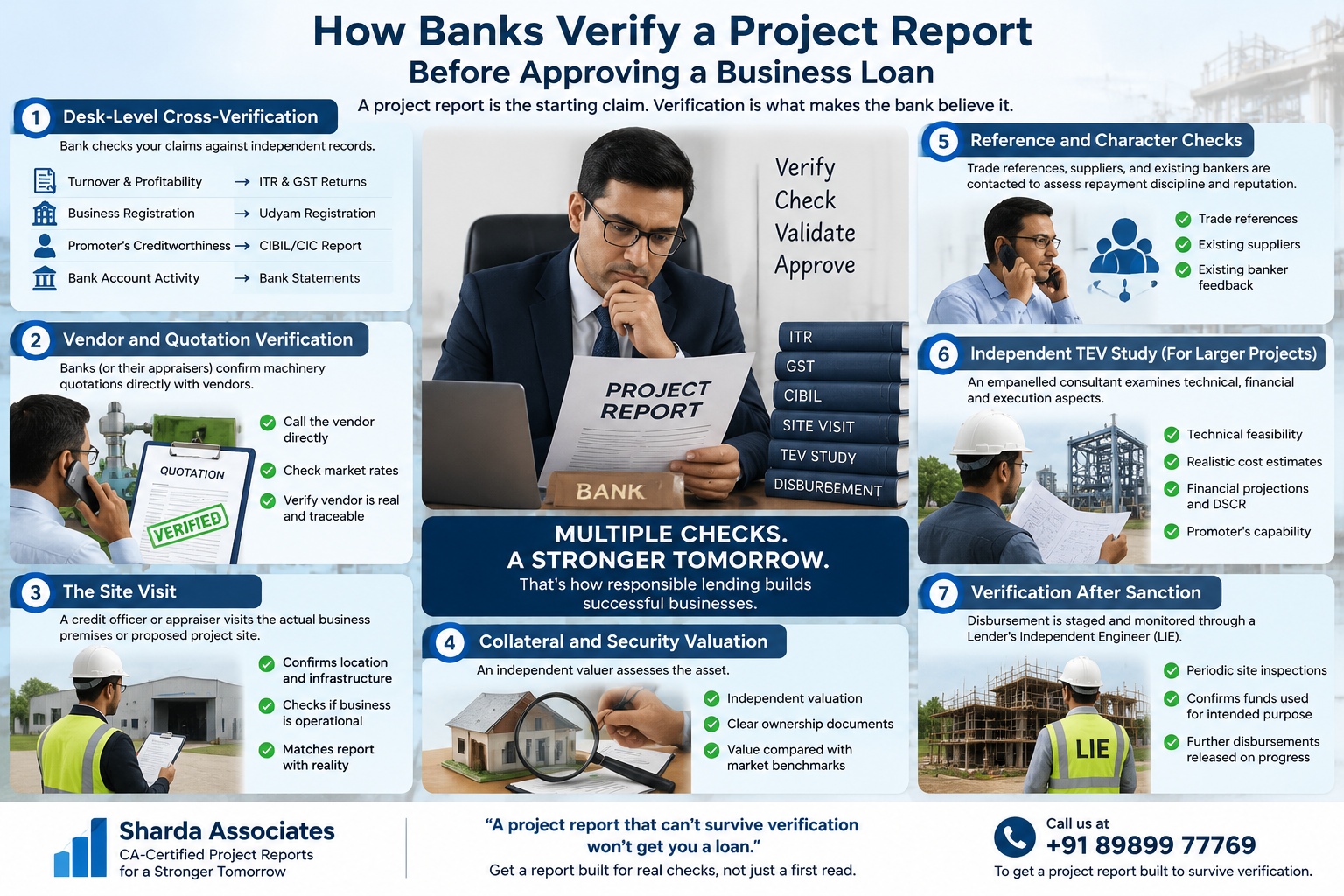
Collateral and Security Valuation
Where the loan involves collateral, the bank doesn’t rely on the value stated in the application:
- An independent valuer is typically commissioned to appraise the asset
- Ownership documents are checked for clear, encumbrance-free title
- The assessed value is compared against comparable assets or industry benchmarks, not accepted as self-reported
Reference and Character Checks
Trade references, existing suppliers, and sometimes the applicant’s existing banker are contacted to build a picture of repayment discipline and business reputation that doesn’t come from the applicant’s own documents. This is a softer check than the financial ones, but it still factors into the overall credit decision.
For Larger Projects: An Independent TEV Study
Beyond a certain loan size — commonly for term loans and project finance above thresholds set by the individual bank — the appraisal isn’t done in-house at all. The bank commissions a Techno-Economic Viability (TEV) Study from an empanelled independent consultant, who separately examines:
- Whether the project is technically feasible with the proposed technology and layout
- Whether the capital cost estimate is realistic and properly sourced
- Whether the financial projections, DSCR, and sensitivity analysis hold up independently
- Whether the promoter has the technical and managerial capability to execute
A TEV study exists precisely because a bank has no independent way to validate cost estimates, technology choices, or revenue projections from the DPR alone — for large proposals, an internal review isn’t considered sufficient on its own.
Verification Doesn’t Stop at Sanction
Once a term loan is approved, disbursement is typically staged against actual project progress, monitored through a Lender’s Independent Engineer (LIE), who conducts periodic site inspections to confirm How Banks Verify Project Report funds already released were genuinely used for the project as described — not just that the original report looked credible at the start.
What This Means for How a Report Should Be Built
A project report that’s built to survive verification looks different from one built only to look convincing:
- Every quoted cost traceable to a real, contactable vendor
- Financial figures that reconcile with the applicant’s actual ITR, GST, and Udyam records, not aspirational numbers layered on top
- A site and business description that matches what a visit will actually find
- Projections and DSCR workings detailed enough to hold up under a TEV study, not just a first read
Conclusion
Every claim in a project report eventually meets a check — a portal cross-reference, a vendor phone call, a site visit, or an independent study — and a report built without this in mind tends to unravel exactly where it’s checked hardest. The stronger approach is building the report to already match what verification will find, not hoping the verification stage goes lightly. At Sharda Associates, our CA-certified project reports are built to hold up against exactly this process, because that’s the standard a bank actually applies. Call us at +91 89899 77769 to get a project report built to survive verification, not just a first read.
FAQs
Question 1. Does a bank always visit the business site before approving a loan?
For most business and project loans, yes — a site visit is a standard part of verifying that the application matches the actual business or proposed project location.
Question 2. Can a bank really tell if a machinery quotation is fake?
Often, yes — appraisers commonly contact the listed vendor directly to confirm the quotation is genuine, current, and consistent with market rates.
Question 3. What is a TEV study, and does every loan require one?
It’s an independent techno-economic viability review by an empanelled consultant, typically required only for larger term loans or project finance proposals, not for smaller working capital or standard business loans.
Question 4. How does a bank check if my reported turnover is accurate?
Primarily by cross-referencing it against your ITR filings, GST returns, and actual bank statement activity for the corresponding period.
Question 5. Does verification continue after the loan is disbursed?
For staged term loans, yes — a Lender’s Independent Engineer typically monitors project progress and confirms disbursed funds were used for the project before releasing further tranches.
Question 6. What’s the most common reason a project report fails verification?
A mismatch between what the report claims and what independent records (ITR, GST, vendor quotations) or a physical site visit actually show.