
Not having a filed ITR is a common situation, not a disqualifying one — new businesses, cash-heavy trades, and service providers who’ve only recently registered often don’t have a tax filing history yet, even while the business itself is genuinely active and earning. Lenders have built specific products around exactly this gap, evaluating the business through other financial evidence instead of tax returns. At Sharda Associates, we regularly help clients in this position put together the alternative documentation — CA-certified financial statements, GST reconciliation, and cash flow summaries — that lenders actually accept in place of ITR.
First, an Important Distinction: “No ITR” Is Not “No Income Proof”
Lenders draw a clear line between these two situations, and it changes what’s possible:
| Situation | What It Means for Lending |
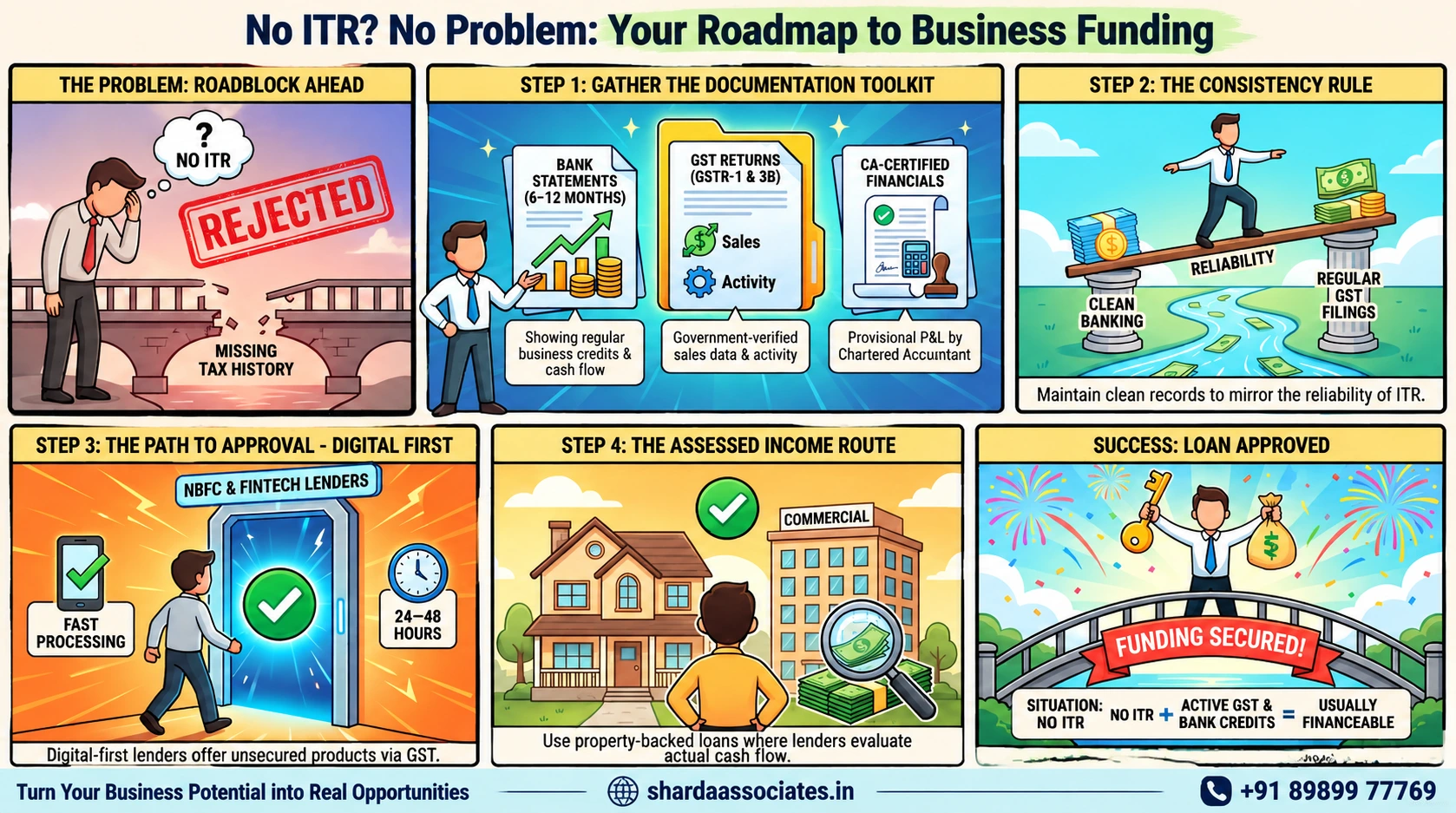
| No ITR, but active GST filings, consistent bank credits, invoices | Usually financeable — the absence of ITR shifts focus to these instead |
| No ITR and no other financial trail at all | Very limited options, since there’s little for a lender to assess |
The goal isn’t to have “no documents”—it”‘s to have the right alternative ones.
What Lenders Accept Instead of ITR
- Bank statements (6–12 months) — the single most heavily weighted substitute; regular, predictable credits carry real weight
- GST returns (GSTR-1, GSTR-3B) — government-verified sales data, especially valuable where filings are consistent over time
- Udyam Registration Certificate — confirms business existence and MSME classification
- CA-certified financial statements — a provisional or audited P&L and balance sheet prepared by a Chartered Accountant, even without a corresponding ITR filed yet
- Sales invoices and purchase orders — direct evidence of business activity and transaction volume
- UPI/merchant settlement history — increasingly used by digital-first lenders for retail and service businesses
Where to Actually Apply
1. NBFCs and Fintech Lenders Several RBI-registered NBFCs specifically design unsecured business loan products around GST returns, bank statements, and Udyam registration rather than ITR — often with faster digital processing (in some cases 24–48 hours) than traditional bank channels.
2. Loan Against Property (Assessed Income Route) Housing finance companies and some banks offer an “assessed income” approach for property-backed loans — the lender evaluates actual cash flow through bank statements and GST records, with the property itself anchoring the loan amount, rather than relying on filed ITR.
3. Gold Loans and Asset-Backed Credit Loans secured directly against gold, machinery, or other tangible assets rely primarily on the asset’s value, making them accessible regardless of ITR history.
4. GST-Based Working Capital Lines Some lenders extend working capital specifically against GST-verified turnover, which works well for GST-registered businesses without a income tax filing history.
Who This Typically Works For
- Small retailers, traders, and distributors
- Service-based businesses and freelancers with digital payment records
- Startups with under 2–3 years of operating history
- Businesses that are GST-registered but haven’t yet built up an ITR track record
What Doesn’t Change Just Because ITR Is Missing
Absence of ITR shifts the basis of evaluation — it doesn’t reduce the scrutiny itself. Lenders still check:
- Credit score and repayment history (CIBIL/CIC)
- Cash flow consistency through bank statement analysis
- Business vintage and continuity
- GST filing regularity, where applicable
A weak credit score or erratic banking pattern will still work against an application, ITR or no ITR.
How to Strengthen Your Application Before Applying
- Keep 6–12 months of clean, consistent business banking activity — irregular or unexplained deposits work against you here just as much as anywhere else
- Register for GST if your turnover qualifies, and file consistently even if the amounts are modest
- Get provisional financial statements prepared and CA-certified — this substitutes meaningfully for a missing ITR in a lender’s eyes
- Maintain organised sales invoices and purchase records rather than informal, undocumented transactions
- Consider starting to file ITR going forward — even a modest declared income builds a track record that widens your options and generally improves terms on future borrowing
Conclusion
A missing ITR narrows your lending options — it doesn’t close them. Bank statements, GST filings, Udyam registration, and CA-certified financials collectively tell a lender the same story an ITR would, and a growing number of NBFCs and housing finance companies have built products specifically around this. The stronger and more consistent that alternative paper trail is, the closer your terms will look to what an ITR-backed application would get. At Sharda Associates, we help clients assemble exactly this kind of documentation — CA-certified statements, GST reconciliation, and cash flow summaries — so a missing ITR doesn’t become a missing loan. Call us at +91 89899 77769 to get your documentation ready.
Frequently Asked Questions
Q1. Can I really get a business loan in India without any ITR at all?
Yes — several NBFCs and housing finance companies specifically evaluate applications using bank statements, GST filings, and Udyam registration instead of ITR.
Q2. What’s the minimum banking history most lenders expect without an ITR?
Commonly 6 to 12 months of consistent business account activity, though this varies by lender and loan type.
Q3. Will I get as large a loan amount without ITR as with one?
Often somewhat lower, since ITR is generally viewed as a stronger income proof — but a strong GST and banking history can substantially close this gap.
Q4. Does GST registration alone help if I have no ITR?
Yes, considerably — consistent GST filings are treated as government-verified sales data and are one of the most accepted substitutes for ITR.
Q5. Can a CA-certified financial statement really replace an ITR for loan purposes?
It’s widely accepted as supporting documentation, especially alongside bank statements and GST data, though it doesn’t carry identical legal weight to a filed tax return.
Q6. Is it better to start filing ITR even with modest income, rather than continuing without one?
Generally yes — even a modest, consistent filing history builds a track record that improves future loan access and terms.
Q7. Do secured loans (gold, property) still require ITR?
Not necessarily — many lenders offer assessed-income or asset-backed routes for exactly these products where ITR isn’t available.
Q8. Can a new business get a loan without having any ITR history?
Yes, in some cases. New businesses may be assessed using promoter credit history, bank statements, business registration, GST records where available, project viability and other financial or supporting documents.
Q9. Can I get a Mudra loan without ITR?
ITR may not always be required for every Mudra application, particularly for smaller or newer businesses, but documentation requirements vary by lender and applicant profile. The bank may request alternative evidence of business activity and repayment capacity.
Q10. Can I get a PMEGP loan without filing ITR?
A new applicant may not have previous ITRs, but the application still requires the documents and financial information prescribed under the scheme and by the implementing bank. A project report and evidence supporting the proposed business are important.
Q11. Can bank statements compensate for missing ITR when applying for a business loan?
Bank statements can provide evidence of business cash flow and transaction history, but they do not automatically replace ITR. The lender decides which combination of documents is sufficient for income and repayment assessment.
Q12. How can I prove my income if I have never filed an ITR?
Depending on the lender, income may be supported through bank statements, GST returns, financial statements, business records, invoices and other acceptable documents. Requirements differ according to the loan product and applicant profile.