
When a business applies for a loan, banks do not only look at the business idea or projected profits. The most important question for a lender is — “Will this business generate enough cash flow to repay the loan on time?” A business may have strong growth potential, but banks evaluate loan repayment ability through multiple factors such as cash flow, existing liabilities, profitability, financial statements, DSCR, business stability and the promoter’s financial profile.
Before approving a loan, banks analyse whether the proposed borrowing is suitable for the business size and whether the expected income can comfortably cover future repayment obligations. This assessment helps lenders understand the level of risk involved in financing the project.
At Sharda Associates, we help businesses prepare bank-focused project reports, CMA data and financial feasibility reports by analysing project costs, revenue projections, cash flow requirements and repayment capacity. Our CA-led team focuses on creating realistic financial projections that help entrepreneurs present a clear and structured loan proposal while understanding the key factors banks consider during loan appraisal.
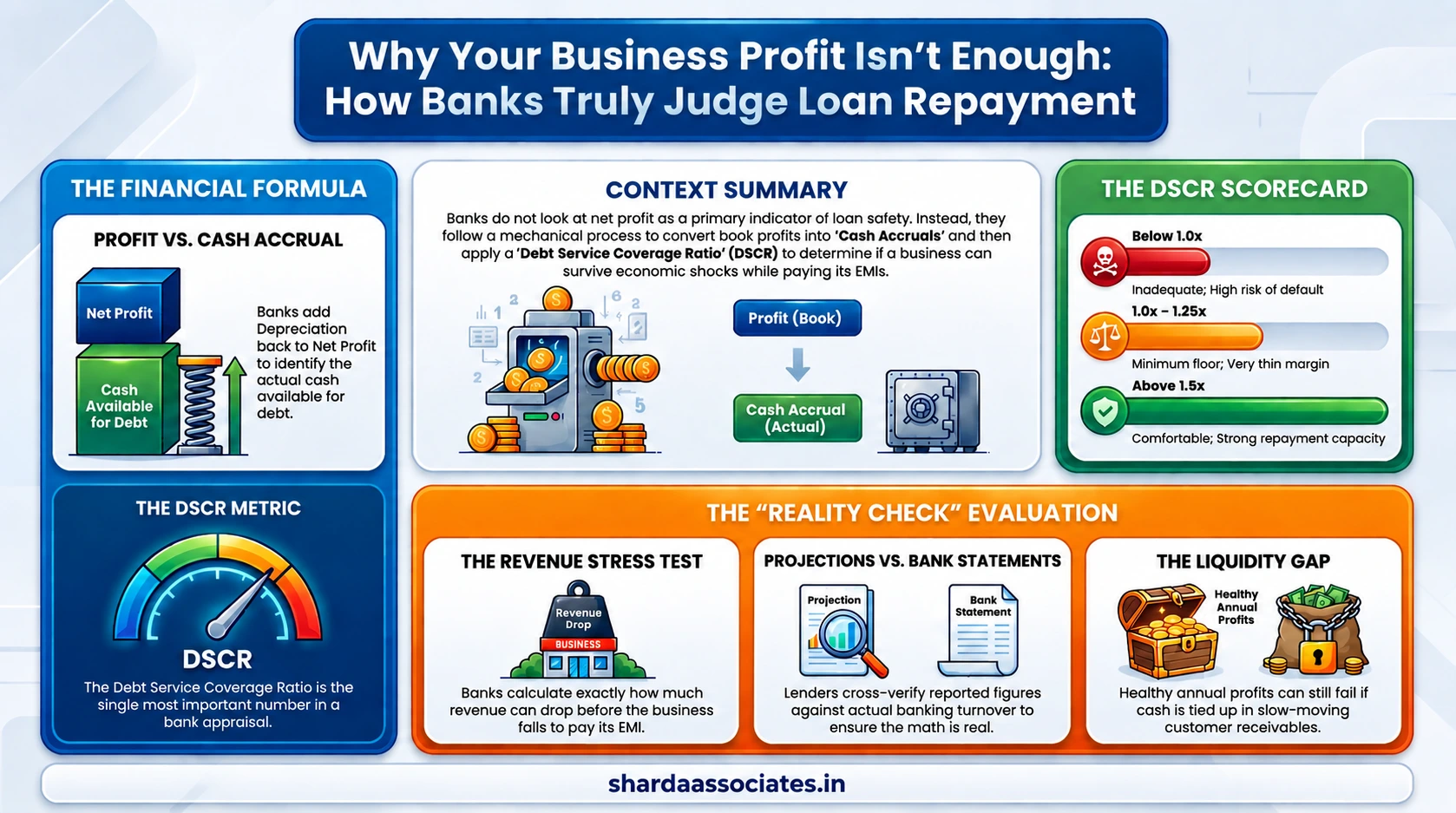
Step 1: Profit Gets Converted Into Cash Accruals First
The starting number isn’t net profit — it’s cash accrual, and the two are rarely the same figure.
Cash Accrual = Profit After Tax + Depreciation + Other Non-Cash Charges
Depreciation is added back because it reduces book profit without actually consuming cash. This adjusted figure is what a bank treats as money genuinely available to service debt — a business can look profitable on paper while generating far less real cash than that profit suggests, especially where depreciation is high relative to earnings.
Step 2: DSCR Is Where the Actual Judgment Happens
Once cash accrual is established, it’s measured against what the business owes annually — this ratio is the single most-relied-on number in the entire appraisal.
DSCR = Cash Available for Debt Service ÷ Total Annual Debt Obligation (Principal + Interest)
| DSCR Level | What It Signals |
| Below 1.0x | Cash accruals don’t cover obligations — repayment capacity is inadequate |
| 1.0x – 1.25x | Thin margin; many lenders treat this as the minimum acceptable floor |
| 1.25x – 1.5x | Workable, but limited room to absorb a bad quarter |
| Above 1.5x | Generally viewed as comfortable repayment capacity |
A DSCR of 2.0x means the business generates roughly twice the cash it needs to meet obligations — this is what “strong repayment capacity” actually looks like in numbers, not just in narrative.
Step 3: It’s Checked Across Years, Not Just One
A single strong year doesn’t satisfy this test on its own. Appraisers look at the DSCR trend across the repayment period, because a business with a good current year but a weak or volatile history reads as unpredictable — and unpredictability is treated the same as weakness, even if the average looks fine.
Step 4: The Number Gets Stress-Tested
This is the step applicants are least prepared for. Banks don’t just accept the base-case DSCR — they ask what happens to it under pressure:
- If revenue drops 10–15%, does DSCR still stay above 1.0x?
- If raw material costs rise, how much margin absorbs it before repayment capacity breaks?
- At what point does DSCR actually fall to 1.00x—and is that point close or far from the base-case assumption?
A well-prepared file answers this directly: “Revenue can decline up to X% before DSCR reaches 1.00x.” That single sentence tells a credit committee exactly how much room for error the business actually has — which is a very different thing from simply presenting one optimistic projection.
Step 5: Short-Term Liquidity Gets Checked Separately
DSCR answers whether annual cash flow covers annual obligations. It doesn’t answer whether that cash is available when the EMI actually falls due. This is where working capital metrics come in:
- Current ratio — current assets against current liabilities
- Debtor turnover — how fast the business actually collects what it’s owed
- The gap between when the business pays its suppliers and when it collects from its own customers
A business can have a healthy annual DSCR and still stumble on a specific month’s EMI if its cash is tied up in slow-moving receivables — this is a separate failure mode from weak profitability, and banks check for it separately.
Step 6: The Paper Numbers Get Checked Against Real Transactions
Projections and past financials describe the business as reported. Bank statements describe the business as it actually behaves — and appraisers compare the two. A business whose banking turnover doesn’t resemble its reported figures raises doubt about whether the DSCR calculation is even built on real numbers, independent of whether the math itself is correct.
Step 7: Character and Conditions Sit on Top of All of This
Even a strong DSCR doesn’t stand alone. Banks weigh it alongside the promoter’s credit history and repayment track record (character), the industry’s current conditions and risk category, and how much of the promoter’s own capital is genuinely at stake in the business (capital). Collateral, notably, tends to function as the last consideration, not the first — a secondary recovery route if the cash-flow-based case doesn’t hold, not a substitute for it.
What This Means for How You Present a Loan Case
The single most useful thing an applicant can do is stop leading with profit and start leading with cash accrual, DSCR, and a stress-tested margin of safety — because that’s the actual language the appraisal is conducted in. At Sharda Associates, when we build a project report or CMA data for a bank loan, the DSCR and sensitivity workings are constructed to reconcile fully back to the underlying financial model, since a credit committee checks exactly that link before trusting the rest of the report.
Conclusion
Banks do not judge loan repayment capacity on sales figures alone. They look at cash flow, existing liabilities, profitability, banking transactions, credit history, DSCR, promoter contribution, and whether the projected business income is realistic. A strong and consistent financial story gives lenders greater confidence that the business can generate enough cash to repay the proposed loan on time.
Before applying, borrowers should therefore identify weak financial ratios, unrealistic projections, incomplete documentation, or gaps between the project report and actual business performance. A professionally prepared Project Report for a bank loan can help present the business model, funding requirement, projected cash flows, profitability, and repayment capacity in a clear, bank-friendly format.
Sharda Associates helps businesses prepare CA-certified project reports and financial documentation aligned with bank and loan requirements. For assistance with your project report or business loan documentation, contact Sharda Associates at +918989977769.
Frequently Asked Questions
Q1. Why would a profitable business still fail a bank’s repayment assessment?
Because profit and cash accrual aren’t the same figure — high depreciation, working capital lock-up, or existing debt can mean strong reported profit converts into weak actual repayment capacity.
Q2. What DSCR do banks typically look for?
Practices vary by lender and loan type, but a minimum around 1.25x is common, with anything above 1.5x generally viewed as comfortable; below 1.0x usually signals inadequate capacity.
Q3. Does a good DSCR guarantee loan approval?
No — it’s the core financial metric, but character, banking conduct, industry conditions, and documentation consistency are all weighed alongside it.
Q4. What is a stress test in this context, and why does it matter?
It’s a check of how much revenue or cost shock the business can absorb before DSCR falls below 1.0x — it shows the bank the margin of safety, not just the best-case number.
Q5. How do banks calculate a business’s repayment capacity?
Banks generally assess projected cash flows against existing and proposed debt obligations. They may consider operating profit, cash accruals, interest, principal repayments, working capital requirements, and other liabilities.
Q6. Why is cash flow important for business loan approval?
Loan instalments are repaid from available cash, not accounting profit alone. A business can report profits but still struggle to repay if cash is tied up in inventory, receivables, or other working capital requirements.
Q7. Can existing loans reduce my eligibility for a new business loan?
Yes. Existing EMIs and debt obligations reduce the cash available for servicing additional borrowing. Banks therefore include current liabilities when evaluating overall repayment capacity.
Q8. Does turnover matter when banks assess loan repayment?
Yes, but turnover alone does not prove repayment ability. Banks also examine margins, operating expenses, cash generation, existing debt, banking transactions, and the sustainability of the business’s revenue.
Q9. Can a new business get a loan without an established repayment history?
Yes, depending on the loan scheme and lender. For new businesses, banks may place greater emphasis on the promoter’s profile, contribution, business viability, projected cash flows, collateral where applicable, and the quality of the project report.
Q10. How do unrealistic projections affect business loan approval?
If projected sales or profits appear significantly higher than industry conditions, existing performance, or the proposed capacity, the bank may consider the repayment assessment unreliable. Conservative and well-supported projections are generally more credible.
Q11. Does a project report affect the bank’s repayment assessment?
Yes. A well-prepared project report explains the proposed investment, revenue assumptions, operating costs, profitability, cash flows, funding requirement, and repayment capacity, helping the lender evaluate whether the projections are financially reasonable.
Q12. Can poor banking transactions affect repayment assessment?
Yes. Frequent cheque returns, irregular credits, unexplained transactions, excessive cash withdrawals, or persistent overdrawing can raise concerns about financial discipline even when the business reports adequate profits.