
A business bank loan is a long-term commitment, and rushing into one with an incomplete picture of repayment capacity, documentation requirements or true project cost is one of the most common reasons businesses face repayment stress later. Before applying, a few checks make the difference between a smooth sanction process and repeated queries or an unsustainable repayment burden. Sharda Associates prepares the CA-certified project reports and CMA data that most of these checks rely on, so getting them right upfront saves time at the bank stage.
Understand Why You Need the Loan
Before applying for a business loan, entrepreneurs should clearly identify the purpose of borrowing and how the funds will be utilised. Taking a loan without a proper plan can create unnecessary financial pressure and increase repayment burden.
The loan requirement should be linked with a specific business objective, such as setting up a new unit, purchasing machinery, expanding operations, managing working capital or increasing production capacity.
Before applying, businesses should evaluate:
- Actual funding requirement
- Total project cost
- Own contribution available
- Expected business growth from the investment
- Repayment capacity after taking the loan
A clear understanding of the loan purpose helps entrepreneurs choose the right loan amount and avoid borrowing more than the business can comfortably repay.
Compare Interest Rates and Loan Terms
Interest rate is an important factor while selecting a business loan, but entrepreneurs should not consider only the interest percentage. The complete loan structure should be evaluated before making a decision.
Different lenders may offer different terms based on business profile, loan amount, repayment capacity and security requirements.
Before finalising a loan, businesses should compare:
- Interest rate and type of interest (fixed or floating)
- Loan tenure
- Monthly EMI obligation
- Processing charges
- Prepayment or foreclosure conditions
- Collateral and security requirements
- Other applicable charges
A loan with a slightly lower interest rate may not always be the best option if it includes higher charges or unsuitable repayment conditions. Entrepreneurs should select a loan structure that matches their business cash flow and repayment ability.
Check Your Actual Repayment Capacity First
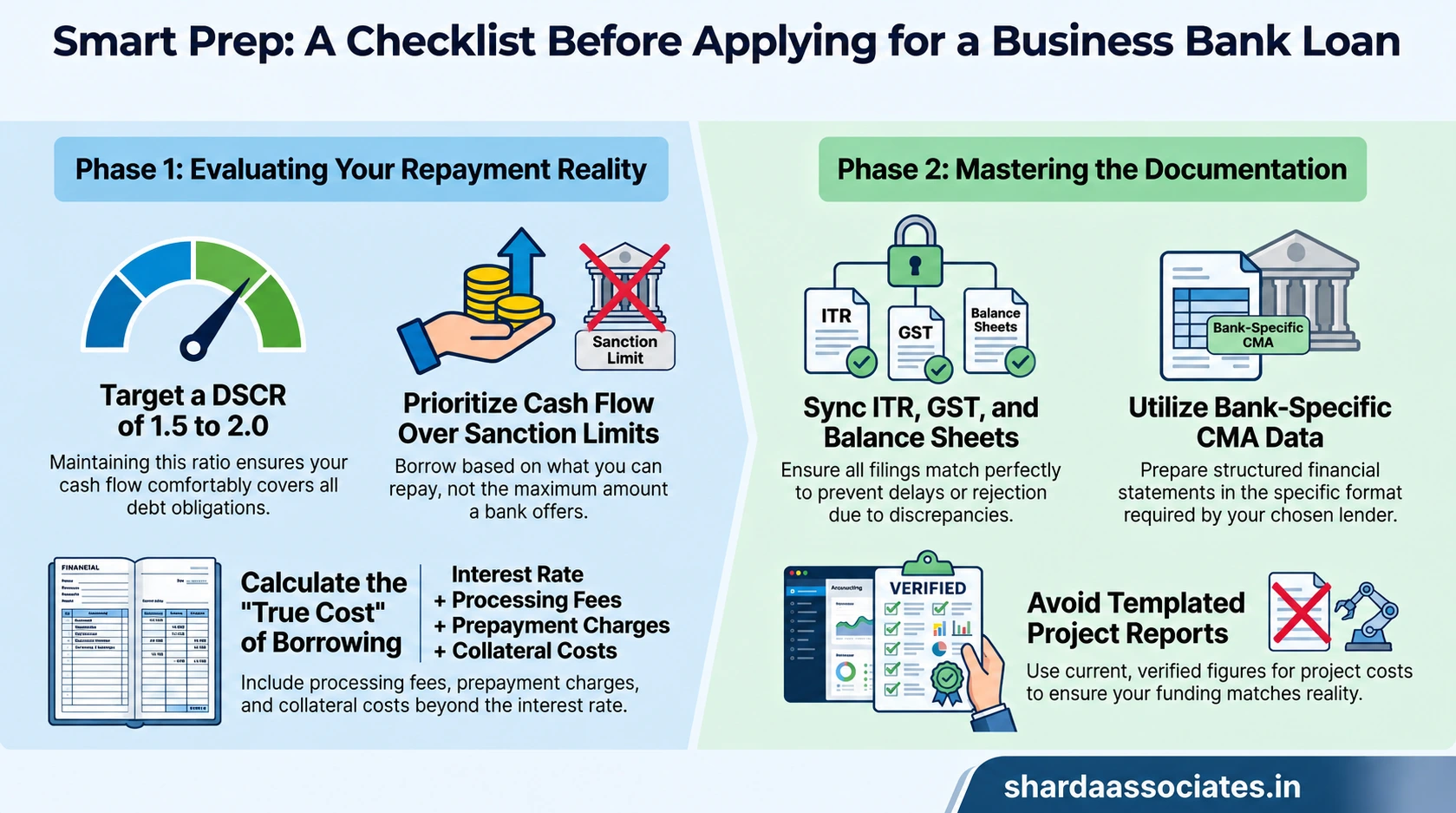
Before looking at how much a bank might sanction, work out how much the business can actually repay without straining operations.
-
Calculate projected DSCR across the loan tenure, not just for a single year, since cash flow can vary year to year
- Build in a realistic margin for lower-than-expected sales or cost overruns, rather than assuming best-case numbers throughout
- Compare the EMI burden against realistic monthly cash flow, not just annual profitability
Why This Matters More Than the Sanctioned Amount
A bank may sanction more than what the business can comfortably repay, since sanction is based on eligibility criteria and collateral, not solely on operational cash flow, so the borrower’s own repayment check should be more conservative than the bank’s assessment.
Get Your Documentation and Financials in Order
Most delays in loan processing come from incomplete or inconsistent documentation rather than the business idea itself.
- Ensure past balance sheets, if any, match ITR filings and GST returns without discrepancies
- Prepare CMA data in the format the specific bank expects, since requirements can vary slightly between lenders
- Keep KYC, business registration, and collateral documents ready before applying, rather than gathering them after the bank raises a query
Understand the True Cost of the Loan
The headline interest rate is rarely the full picture of what a business loan actually costs.
- Processing fees, prepayment charges and collateral-related costs add to the effective cost of borrowing
- Fixed versus floating interest rate structures carry different long-term risk, especially for loans with longer tenure
- Check whether the loan is secured or unsecured, since this affects both the interest rate and the collateral requirement
Comparing Loan Offers Properly
Comparing only the interest rate across lenders can be misleading if processing fees, margin money requirements and prepayment terms differ significantly between offers.
Confirm the Project Report Reflects Reality
A project report built on outdated cost assumptions, incorrect subsidy rates, or optimistic capacity utilisation figures can lead to a sanctioned amount that does not match what the project actually needs or a repayment schedule the business cannot sustain. Before submission, confirm the project cost, means of finance and DSCR calculations are based on current, verified figures rather than templated assumptions.
Prepare a Strong Project Report/DPR
For new businesses, expansion projects or large funding requirements, a well-prepared Detailed Project Report (DPR) plays an important role in explaining the business proposal to lenders.
A strong DPR helps banks understand:
- Business model and project objective
- Total investment requirement
- Machinery and infrastructure details
- Market opportunity
- Revenue projections
- Profitability analysis
- Loan repayment capacity
Banks use the project report along with financial documents to evaluate whether the proposed project is practical and capable of generating sufficient cash flow.
A realistic DPR should be based on proper assumptions and should clearly explain how the loan amount will be utilised and repaid. Unrealistic projections or unsupported estimates can reduce the credibility of the loan proposal.
Conclusion
Taking a business loan is an important financial decision that requires proper planning. Before applying, entrepreneurs should understand the purpose of the loan, compare available loan terms and prepare a structured project report that clearly explains the business plan. A properly planned loan application helps businesses avoid unnecessary financial burden and improves clarity during the bank evaluation process.
At Sharda Associates, we help businesses prepare DPRs, CMA data, financial analysis and loan-related documentation by evaluating project costs, financial projections and repayment capacity. Our CA-led approach helps entrepreneurs present a structured and realistic proposal for bank finance. For assistance with business loan project reports and financial planning, you can connect with Sharda Associates at 📞 +918989977769.
Frequently Asked Questions
1. What is the most common reason business loan applications get rejected?
Weak or inconsistent financial documentation, and DSCR or repayment projections that do not hold up to the bank’s scrutiny, are among the most common reasons.
2. Should I apply for the maximum loan amount I am eligible for?
Not necessarily. Borrowing based on actual repayment capacity, rather than the maximum sanctioned amount, reduces long-term financial stress.
3. What is CMA data and why do banks ask for it?
CMA data is a structured financial statement format banks use to assess a business’s credit worthiness and repayment capacity over the loan tenure.
4. Does a good project report guarantee loan approval?
No project report can guarantee approval, since banks also assess promoter’s credit history, collateral and other factors, but a well-prepared report reduces the chance of rejection due to documentation gaps.
5. Should I choose a fixed or floating interest rate?
This depends on the loan tenure and the business’s risk tolerance for interest rate changes, and should be evaluated case by case rather than assumed.
6. What documents are typically needed for a business bank loan?
KYC documents, business registration, past financials or ITR filings, GST returns, project report or CMA data, and collateral documents where applicable.
7. How does DSCR affect the loan I can get approved?
A DSCR below the bank’s threshold, commonly around 1.5 to 2 for term loans, can lead to a reduced sanctioned amount or additional collateral requirements.
8. Are processing fees negotiable?
This varies by bank and loan scheme, and is worth discussing directly with the lender rather than assuming a fixed, non-negotiable fee.
9. Can I revise my project report if my initial cost estimates change?
Yes, project reports can and should be updated if project cost, subsidy eligibility or other key assumptions change before final submission.
10. Does Sharda Associates help prepare both the project report and CMA data?
Yes, both CA-certified project reports and CMA data are prepared to match the specific bank’s documentation requirements.