
You apply for ₹15 lakh and the sanction letter shows ₹9 lakh. Why Banks Approve Lower Loan Amount is one of the most common — and most confusing — outcomes in Indian business lending, and it doesn’t necessarily mean your application was weak. Banks don’t sanction based only on the amount you request; they sanction what their internal assessment says your business can safely repay, considering your projected income, existing obligations, repayment capacity, and the quality of documentation supporting your request.
At Sharda Associates, a large share of the loan-enhancement cases we handle involve exactly this — a business with a genuinely viable project that received a reduced sanction simply because the project report or DPR didn’t present the numbers the way the bank’s credit process expects. Here’s what actually drives the cut and what you can do about it.
1. DSCR Doesn’t Support the Full Amount
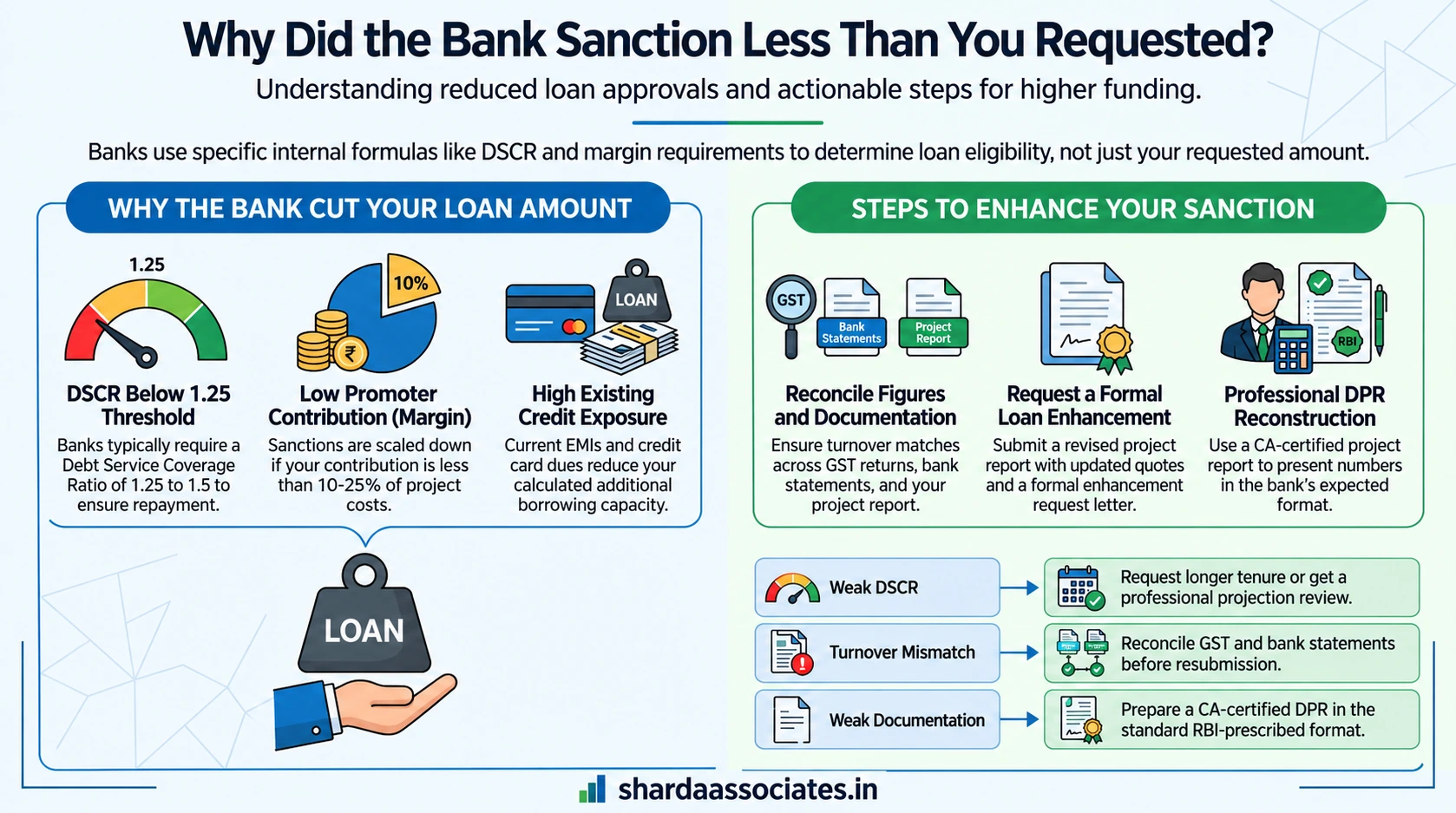
The Debt Service Coverage Ratio (DSCR)—projected net operating income divided by total annual debt obligations—is the single biggest lever here. Most Indian banks require a DSCR of at least 1.25 for the loan they sanction (some push this to 1.5 for manufacturing units). If your requested amount would push the DSCR below this floor, the bank doesn’t reject the file outright — it simply reduces the loan amount to a level where the DSCR clears the threshold.
2. Margin Money / Promoter Contribution Is Too Low
Banks rarely finance 100% of a project’s cost. Depending on the loan type, the promoter is typically expected to contribute anywhere from 10% to 25% (and sometimes more) of the total project cost as margin money. If your own contribution shown in the application is lower than the bank’s norm for that loan category, the sanctioned amount is scaled down to match an acceptable margin ratio rather than being rejected entirely.
3. Existing EMIs and Credit Exposure
If you already have running EMIs, credit card dues, or other loans, the bank factors this into your total repayment obligation before approving anything new. A high existing debt load reduces your assessed additional borrowing capacity — even if your business income looks healthy on paper — because the bank is calculating what’s left over after your current commitments.
4. Inflated or Unrealistic Project Cost
If machinery quotations, working capital estimates, or other project cost figures appear padded — sometimes to reach a higher loan slab — credit officers who review these files regularly can usually tell. Once flagged, the bank often revises the project cost downward internally, which mechanically reduces the loan amount as well.
5. Turnover or Bank Statement Mismatch
When the turnover shown in your project report doesn’t align with what your bank statements or GST returns actually show, the bank tends to anchor its assessment to the verified figure — usually the lower one — rather than the projected number in your report.
6. Credit Score or Repayment History Concerns
A lower CIBIL score, cheque bounces, or an irregular repayment history on existing facilities pushes the bank towards a more conservative sanction, even when the business case itself looks sound.
7. Limited Business or Industry Experience
A first-time entrepreneur or a business moving into an entirely new line of activity is generally seen as higher risk than someone with a proven track record in the same field — this often results in a more conservative loan amount, particularly for larger project sizes.
8. Weak or Generic Documentation
A copy-paste project report with unrealistic sales projections, or CMA data that doesn’t follow the standard RBI-prescribed format, gives the credit officer less confidence in the numbers overall — leading to a lower sanction as a risk-mitigation step, even when the underlying business is fundamentally viable.
What to Do When Banks Approve Lower Loan Amount Than Requested
| Cause | What Helps |
| Weak DSCR | Get projections professionally reviewed; consider a longer tenure to ease the ratio |
| Low margin money | Arrange additional promoter contribution or a co-applicant |
| High existing EMIs | Close small existing loans first, or apply for a lower amount initially |
| Inflated project cost | Use realistic, verifiable quotations and a properly reviewed cost estimate |
| Turnover mismatch | Reconcile GST, bank statement and project report figures before resubmission. |
| Documentation quality | Get a CA-certified project report/DPR prepared in the bank’s expected format. |
If your sanctioned amount is genuinely insufficient for the project, most banks allow you to apply for an enhancement — this typically means submitting a revised project report with corrected figures, updated quotations, and a one-page enhancement request, then following up with the branch or credit manager.
Conclusion
A reduced loan amount is almost always the bank’s formula reacting to something specific in your file — DSCR, margin, existing debt, or documentation quality — rather than a rejection of your business idea. The fix is usually a properly reconciled, realistic project report or DPR that presents your numbers the way the bank’s credit process expects. Our CA team at Sharda Associates regularly reviews and rebuilds project reports for exactly this situation, correcting DSCR, margin and cost assumptions before resubmission or enhancement requests. Call or WhatsApp us at +9189899 77769 for a same-day review of your sanction letter and project report.
Frequently Asked Questions
1. Can I request an enhancement after a reduced sanction?
Yes — most banks allow a formal enhancement request with a revised project report and updated documents, though this extends the overall timeline.
2. Does a good CIBIL score guarantee the full requested amount?
No — CIBIL score is one factor among several; DSCR, margin money, existing EMIs and documentation quality all independently affect the sanctioned amount.
3. What DSCR do most Indian banks require?
Most public sector banks look for a DSCR of at least 1.25 for trading and service businesses, and often 1.5 or higher for manufacturing units, though this varies by lender.
4. Is margin money the same for every loan type?
No — the required promoter contribution varies by loan category and lender, commonly ranging from around 10% to 25% or more of project cost.
5. Can existing personal loans affect my business loan amount?
Yes — banks look at your total repayment obligations across all credit facilities, not just business-related debt, when calculating how much additional loan you can service.
6. Will improving my project report help get the full amount on reapplication?
It can — a realistic, professionally reviewed report that reconciles turnover, cost and DSCR figures gives the credit officer more confidence, which often supports a higher sanction.
7. Does the bank explain why they reduced the loan amount?
Not always in detail — you can request an explanation from the branch, but banks aren’t obligated to provide a full breakdown of their internal credit assessment.
8. Can a co-applicant help increase the sanctioned amount?
Yes, particularly if the co-applicant has strong income, credit history or can contribute to the margin money requirement.
9. Is it better to accept a reduced amount or reapply elsewhere?
This depends on your urgency and project needs — an enhancement request with the same bank is often faster than starting fresh with a new lender, but comparing both is reasonable.
10. How long does an enhancement request typically take?
Timelines vary by bank and documentation readiness, but it generally follows a similar review cycle to the original application rather than being instant.