
Repeated additional documents requests usually mean one of two things: either the file genuinely has a gap or inconsistency that hasn’t been fully resolved yet, or the branch didn’t share a complete checklist upfront and is asking for what it needs one item at a time. It’s rarely random — banks don’t ask for extra paperwork for its own sake, since every additional request also slows down their own processing. Sharda Associates, a CA-certified project report and financial documentation provider, prepares loan documentation designed to minimise these repeated queries in the first place.
Why Does This Happen So Often With MSME and Business Loans?
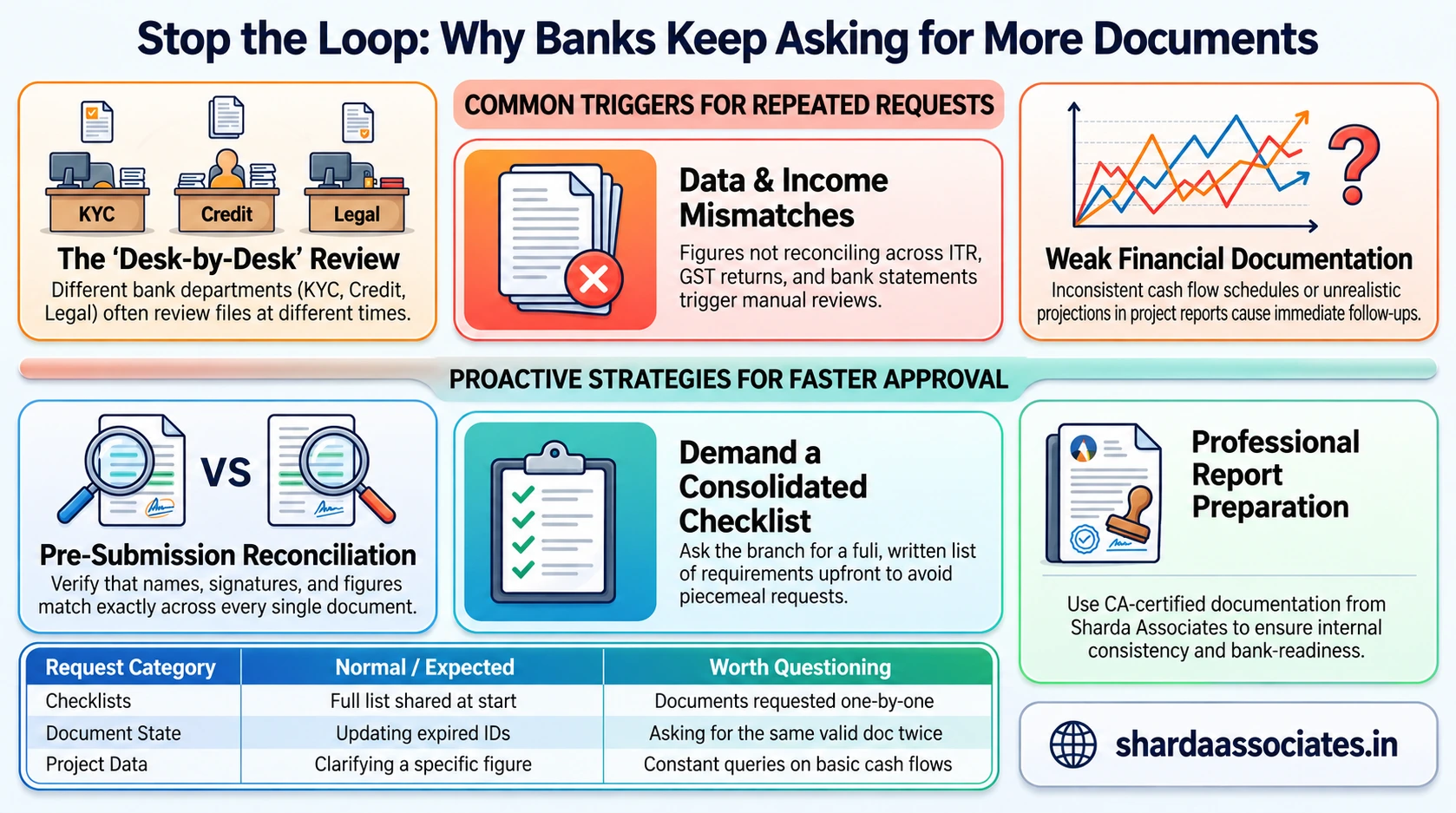
Business loan files have more moving parts than a simple personal loan — income proof alone isn’t enough; the bank also needs to verify the business itself, the project report or CMA data, KYC of all promoters, collateral or guarantor documents (where applicable), and often a site inspection. Each of these is typically checked by a different desk or person within the bank, and if any single one of them is incomplete, unclear, or raises a question, that specific desk sends the file back with a fresh request — even if every other part of the file is in order.
What Are the Most Common Reasons Banks Ask for More Documents?
- Incomplete or unclear documents — expired IDs, faded scans, missing pages in bank statements, or documents that don’t match across submissions
- Name or signature mismatches — small inconsistencies between PAN, Aadhaar, business registration, and bank account records
- Income or turnover inconsistencies — declared income or turnover not matching bank statements, GST returns, or ITR filings
- Project report or CMA data doubts — weak financial projections, missing cash flow schedules, or figures in the report that don’t reconcile with the financial statements
- Missing documents for joint applicants — co-applicants’ or guarantors’ KYC not submitted alongside the primary applicant’s
- No consolidated checklist given upfront — the branch requests documents one at a time as different desks review the file, rather than sharing everything needed at once
- Site inspection or field verification pending — especially for rural or remote locations, verification delays can trigger additional document requests to bridge the gap while inspection is scheduled
- Internal credit risk checks — a borderline credit score or unusual transaction pattern can trigger a manual review that asks for explanatory documents
How Is This Different from a “Formal Objection” on a Project Report?
A specific objection on a project report (for example, a DSCR concern or an inconsistent projection) is usually a one-time, well-defined query tied to a particular figure. Repeated general document requests are broader — they can come from multiple desks within the bank at different stages of processing (KYC verification, credit appraisal, legal/technical scrutiny, sanctioning authority), each with its own checklist. The two overlap sometimes — an unclear project report can itself trigger a document request — but general repeated requests are often more about process sequencing within the bank than a single substantive problem.
Which Requests Are Normal, and Which Aren’t?
Generally normal:
- A request for a document genuinely missing from the original submission
- A request to clarify or update an expired or outdated document
- A follow-up request after a genuine correction is made elsewhere in the file
- Additional KYC for a co-applicant or guarantor added later in the process
Worth questioning:
- The branch asking for the same document multiple times without explaining why the earlier submission wasn’t accepted
- Repeated requests without ever sharing a full, consolidated checklist
- Requests for documents that aren’t actually required for the loan category or amount in question
- No update on the file’s status despite repeated document submissions over a long period
How to Reduce Repeated Document Requests
- Ask for a complete checklist upfront, in writing, rather than waiting for requests to trickle in one at a time
- Submit everything in one go, properly organised, rather than piecemeal
- Check internal consistency before submitting — names, signatures, and figures should match exactly across every document
- Reconcile income/turnover figures across ITR, GST returns, and bank statements before submission, so any genuine variation can be explained upfront with supporting notes
- Respond quickly — every day a query sits unanswered adds to the overall delay, since the file typically doesn’t move forward until it’s resolved
- Keep a copy of everything submitted, with dates, so you can point to what’s already been provided if a document is requested again
What If the Requests Genuinely Seem Excessive or Repetitive Without Reason?
If the same document keeps getting requested without a clear explanation of what was wrong with the earlier submission, it’s reasonable to politely ask the branch for a written, consolidated list of everything still pending so the file can be completed in one round rather than several. For loans processed under specific government schemes, borrowers also have access to escalation channels (branch manager, then the bank’s grievance redressal mechanism, and ultimately the Banking Ombudsman) if a file appears to be stuck without genuine cause — though this is a last resort after direct follow-up hasn’t resolved things.
How Does a Well-Prepared Project Report Help Reduce This?
Since project report or CMA data doubts are one of the recurring causes of repeated queries, starting with a report that’s internally consistent, realistic, and formatted to match the bank’s expectations removes one whole category of potential follow-up requests. This doesn’t eliminate every possible document request — KYC, income verification, and site inspection are separate processes — but it does prevent the loan file from bouncing back and forth over the financial documentation itself.
Frequently Asked Questions
1. Why is the bank asking for additional documents again and again?
Usually either because the original submission had a genuine gap, inconsistency, or unclear document, or because the branch is requesting items one at a time across different internal desks rather than sharing a full checklist upfront.
2. Is it normal for a bank to ask for documents more than once?
A single follow-up request to clarify or complete a missing item is normal; repeated requests for the same document without explanation, or no consolidated checklist ever being shared, is less typical and worth questioning.
3. Can I ask the bank for a complete checklist instead of responding to requests one at a time?
Yes — politely requesting a full, written checklist upfront is a reasonable and common way to avoid multiple rounds of document requests.
4. Does a weak project report cause repeated document requests?
Yes — inconsistent figures, missing cash flow schedules, or unclear projections in a project report or CMA data are a common trigger for follow-up queries.
5. How long can a bank keep asking for documents before deciding on a loan?
There’s no fixed universal timeline, and it varies by loan type, scheme, and bank — but an unreasonably prolonged, unexplained cycle of requests can be raised with the branch manager or the bank’s grievance redressal channel.
6. Does a mismatch between my ITR, GST returns, and bank statements cause repeated queries?
Yes — income or turnover inconsistencies across these documents are one of the most common reasons banks pause a file and request clarification or additional records.
7. Should I resubmit the same document if the bank asks for it again?
First check whether the earlier submission was acknowledged — if it genuinely wasn’t received or was unclear, resubmit; if it was already accepted, it’s reasonable to point that out and ask why it’s being requested again.
8. Can I escalate if I feel the bank is unreasonably delaying my loan with repeated requests?
Yes — after direct follow-up with the branch doesn’t resolve things, escalation options include the bank’s internal grievance redressal mechanism and, as a last resort, the Banking Ombudsman.
9. Does field verification or site inspection cause additional document requests?
It can — delays in scheduling inspection, especially in rural or remote areas, sometimes lead to additional documents being requested to bridge the gap while verification is pending.
10. Can a professionally prepared project report and documentation reduce repeated bank queries?
Yes — a report that is internally consistent, realistic, and formatted to the bank’s expectations removes one of the most common sources of repeated follow-up requests, though it doesn’t eliminate KYC or verification-related queries.