
If your MSME loan got rejected, the business is probably fine. MSME loan rejection reasons usually come down to one of a handful of fixable issues that quietly gets in the way, and most owners never find out which one until it happens to them. We’ve seen this pattern play out often enough at Sharda Associates that we now check for it before a client’s file ever reaches a bank. Our project reports and CMA data are CA-certified, which matters more than it sounds like it should: a certified report tells the bank someone qualified has already checked the numbers, and that alone can help move a borderline file forward. If any of the five reasons below sound familiar, it’s worth having your documentation looked at properly before you reapply. You can call us or fill out our contact form, and we’ll walk through your specific file with you.
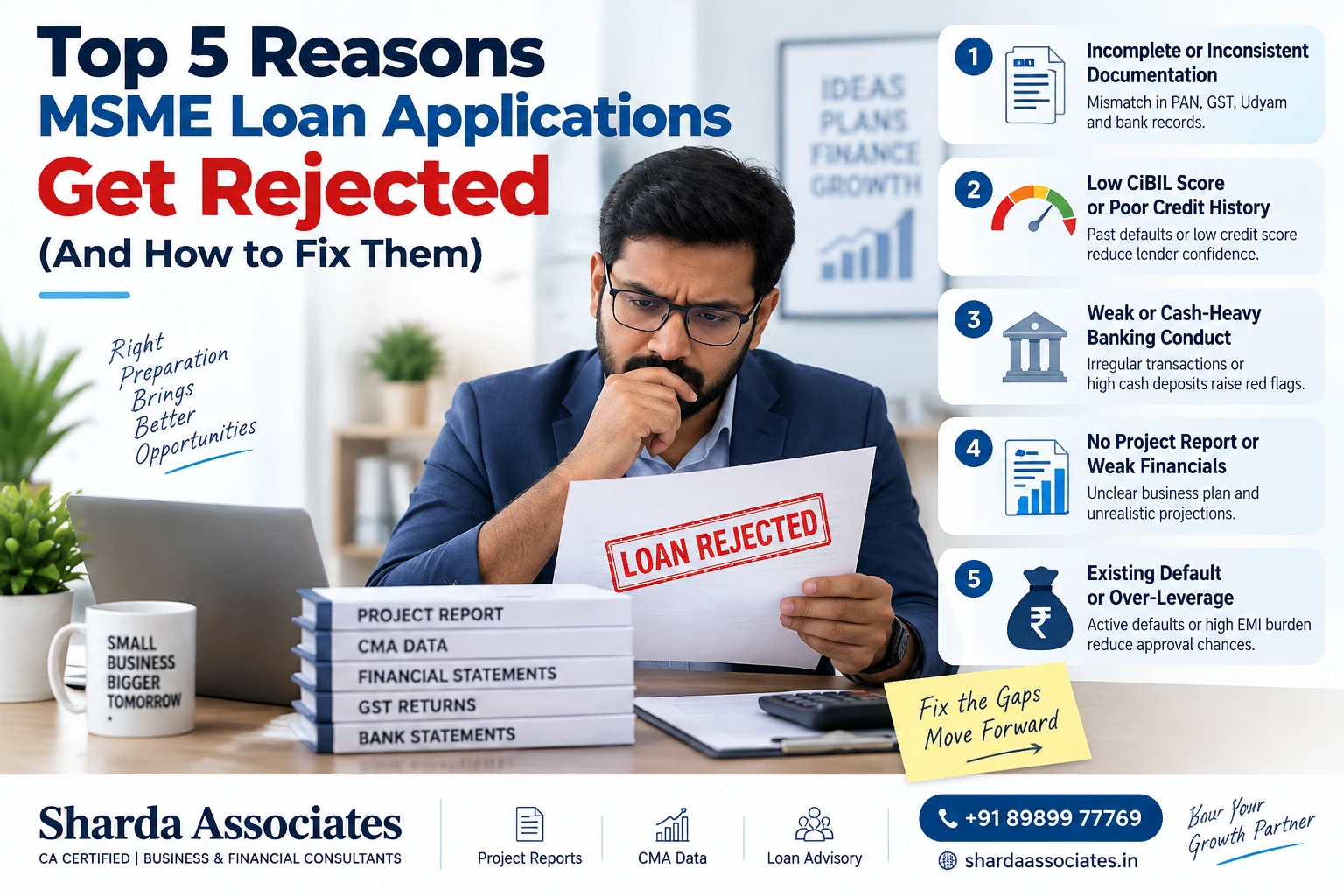
Top 5 MSME Loan Rejection Reasons are as follows:
1. Incomplete or Inconsistent Documentation Across PAN, GST, Udyam, and Bank Records
This is the one that catches almost everyone at least once. Lenders cross-check your PAN, your GST returns, your Udyam Registration, and your bank records against each other, and even a small mismatch, a different registered address, a name spelt slightly differently, or turnover figures that don’t quite line up can create doubt before the underwriter has even looked at your business case properly.
How to fix it
- Confirm your Udyam registration is active and current. Without it, most government-linked MSME benefits, CGTMSE guarantee cover, PMEGP, Mudra, simply aren’t on the table
- Reconcile your GST turnover against your ITR-reported income before you apply, not after a query comes back asking why they don’t match
- Keep your registered business name, address, and PAN details identical across every single document
2. Low CIBIL Score or Poor Credit History
Your credit history gets checked before anyone reads your business case, and it applies to every promoter and guarantor on the file, not just the company. A missed EMI, a settled credit card default from years ago, an old bounced cheque – any one of these can be enough on its own to stall things.
| CIBIL Score | What It Typically Means |
| 750+ | Strong approval probability |
| 700 to 749 | Acceptable, generally approvable |
| 650 to 699 | Borderline, higher interest likely |
| Below 650 | Difficult through mainstream banks |
How to fix it
- Clear overdue balances and settle disputes before applying, not after
- Keep credit utilisation under roughly 30% of your available limit
- Avoid applying to several lenders in a short window since each inquiry costs you a few points
- Pull your own credit report at least twice a year and dispute genuine errors directly with the bureau
3. Weak or Cash-Heavy Banking Conduct
Your bank statement is read as evidence of how the business actually runs, not as a box to tick. Irregular deposits, a low average monthly balance, a sudden large unexplained credit right before you apply, a business that’s mostly cash with barely anything showing in the account – all of this signals risk regardless of how good your revenue numbers look on paper.
How to fix it
- Push more collections through UPI, POS, or bank transfer rather than cash
- Deposit collections consistently, weekly if not daily, rather than in one lump sum every so often
- Keep a steadier average balance instead of drawing the account down to near zero between cycles
- Clear up any cheque or NACH bounces sitting on record before you apply again
4. No Project Report, or One That Doesn’t Justify the Loan Amount
A lot of MSME applicants either skip a proper project report altogether or hand over something generic that doesn’t actually reflect their business, their costs, or what they can realistically repay. Banks want a clearly stated purpose, a project cost that holds up, and a loan amount that matches your turnover and cash flow, not a number picked because it sounded reasonable.
How to fix it
- Get a CA-certified project report built around your actual business, not a template someone reused from another client
- Make sure DSCR, cash flow, and means of finance in the report reconcile properly with your GST and ITR figures, not just with each other
- Size the loan to what your cash flow genuinely supports. Asking for more than that gets flagged on its own, independent of anything else in the file
If you’re unclear on which kind of report your loan actually needs, our breakdown of project report types for bank loans or the difference between a project report, DPR, and CMA data is a good place to start.
5. Existing Default, NPA Status, or Over-Leverage
Being marked NPA with any bank, carrying an old unresolved default, or already running several EMIs that eat up most of your income gets treated seriously on its own, separate from how well the actual business is doing. Even under CGTMSE, where the government guarantees a large chunk of the loan to the bank, this doesn’t remove the bank’s own credit checks. CGTMSE files still go through the same internal scoring as any other application.
How to fix it
- Regularise any overdue loan before applying for a new one. Don’t assume a guarantee scheme will quietly cover for it
- Work out your actual obligation-to-income ratio honestly before deciding how much more to ask for
- If an old default is resolved but still showing on your report, get it updated with the bureau before you apply again
Quick Reference: Reason and Fix
| Rejection Reason | Core Fix |
| Documentation mismatch | Reconcile PAN, GST, Udyam, and bank records before applying. |
| Weak credit history | Clear dues, reduce utilisation, avoid multiple applications |
| Poor banking conduct | Shift to digital collections, maintain a steadier balance |
| No or weak project report | Get a CA-certified, business-specific report with DSCR |
| Existing default or over-leverage | Regularise old loans before requesting new credit |
Conclusion
Most MSME rejections aren’t really about the business. They come down to one or two of these five things going unfixed before the application went in, and every one of them is something an applicant can actually do something about. Fixing it before you apply again is a lot faster than trying to appeal after the fact.
.At Sharda Associates, this is exactly what we help with: CA-certified project reports, CMA data, and getting your documentation to actually agree with itself before your file goes anywhere near a bank. Call us at +91 89899 77769 or fill out our contact form, and we’ll take it from there.
Frequently Asked Questions
Q1, What is the single most common reason MSME loans get rejected?
Documentation inconsistency across PAN, GST, Udyam, and bank records is the most frequent one, with a low or poor credit score close behind.
Q2. Does a CGTMSE guarantee protect me from rejection due to credit history?
Not really. Banks still run CGTMSE-backed applications through their standard credit scoring, and a CIBIL score below roughly 650 can still get you rejected even with the guarantee sitting there.
Q3. Can a new business with no credit history get an MSME loan?
It’s harder. Most lenders want to see 6 months to 2 years of operating history before they can judge repayment capacity, though schemes like Mudra are built with newer businesses in mind.
Q4. Is Udyam Registration mandatory for an MSME loan?
Not legally mandatory for every private loan, but it’s required for most government-linked schemes and benefits, CGTMSE included, and not having it is a common, completely avoidable reason for rejection.
Q5. How long should I wait after a rejection before reapplying?
There’s no fixed waiting period, but reapplying without fixing the actual reason, whatever it was, usually just gets you the same result. Deal with the real cause first.
Q6. Can I fix my banking conduct quickly before applying?
Some of it, yes. Digital collections and a steadier balance can show up within a few months. A weak average-balance history built up over a year takes longer to turn around, so start 3 to 6 months before you plan to apply.
Q7. How much does a weak project report actually affect approval?
More than people expect. Even a genuinely viable business can get turned down if the report doesn’t justify the loan amount with realistic numbers and DSCR, since that’s one of the first things a credit officer looks at.