
A large number of small businesses in India run without a formally audited balance sheet or profit and loss statement. That’s not unusual, and it’s not a sign of anything being wrong with the business. It simply used to mean formal credit was harder to reach, since almost every bank wanted the same paperwork trail before they’d even consider a loan.
That’s genuinely changed over the last few years. Banks and NBFCs now assess a large share of MSME loan applications using GST returns alone, treating your GSTR filings as proof of revenue and business activity in place of a balance sheet.
At Sharda Associates, we work with clients in exactly this situation often, first-time borrowers, small traders, and service businesses that haven’t formalised their books yet, and this route tends to be the fastest way to get them in front of a lender with something credible to show. If you’re unsure whether your GST history is strong enough to qualify or what a lender will actually check, it’s worth having someone look at your filings before you approach a bank, and we’re happy to walk through that with you.
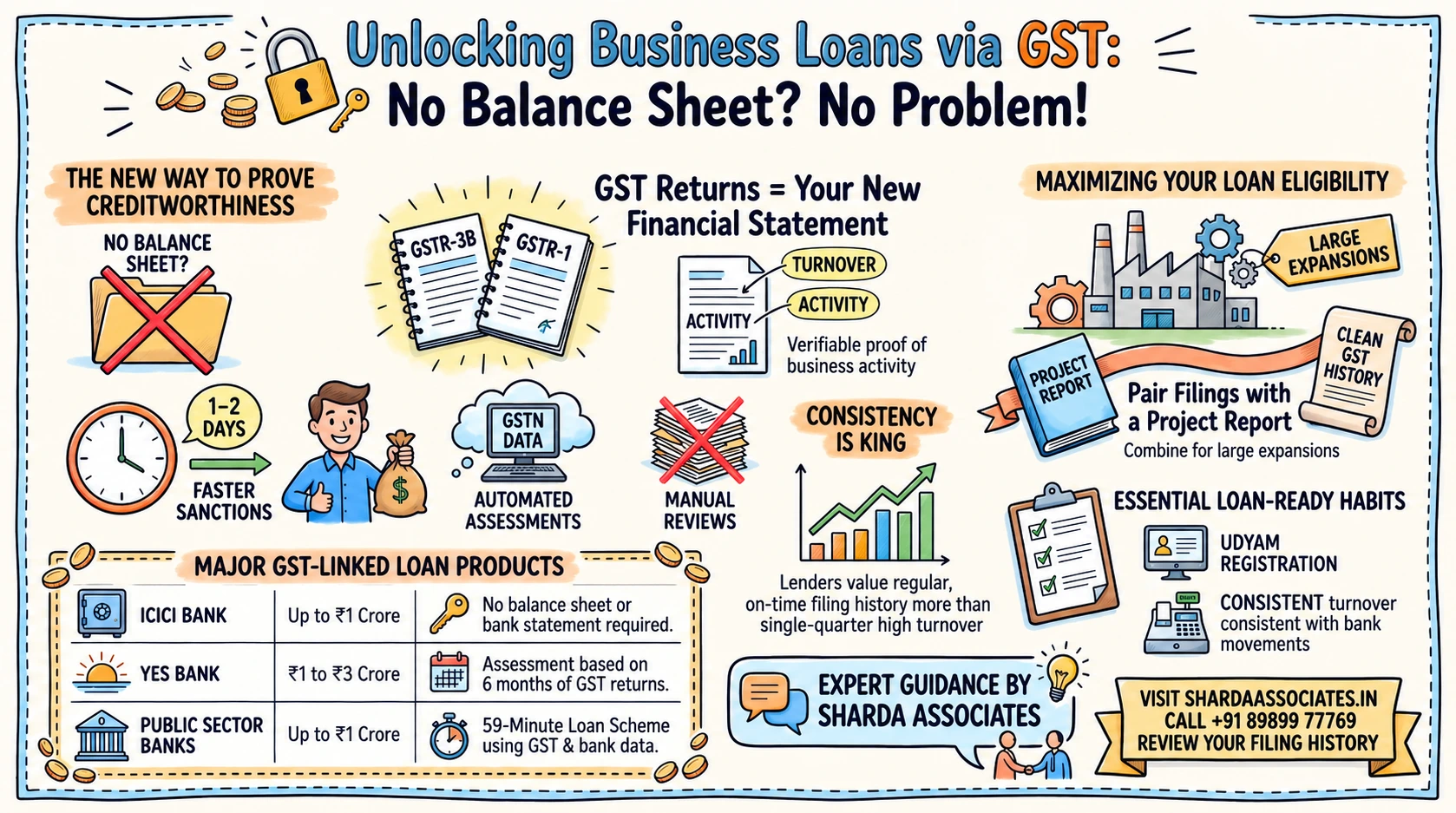
What GST-Based Lending Actually Means
A GST business loan is a credit facility, usually an overdraft or working capital line, where the lender assesses eligibility using your GST returns instead of traditional financial documents. Your GSTR-1 and GSTR-3B filings already show turnover, filing consistency, and business activity over time, which is exactly what a lender would otherwise have to extract from a balance sheet.
This isn’t a small or experimental niche anymore. Several major banks now run named products built specifically around this.
| Lender | Product | Loan Amount | Key Feature |
| ICICI Bank | GST Business Loan (OD) | Up to ₹1 crore | No balance sheet or bank statement assessment required |
| YES Bank | YES GST | ₹1 to 2 crore | Assessed on 6 months of GST returns, secured against property, approval as fast as 1 day |
| YES Bank | Smart Edge for MSMEs | ₹1 to 3 crore | Uses both GST returns and bank statements together |
| Public sector banks | 59-Minute Loan Scheme | Up to ₹1 crore | Government-backed online platform using GST and bank statement data |
Worth noting: not every GST-based product is fully unsecured. YES Bank’s GST overdraft, for instance, is still taken against a mortgage of residential or commercial property, even though the assessment itself skips the balance sheet. Read the fine print on each product rather than assuming “no financial statements” also means “no security”.
How Lenders Actually Read Your GST Returns
Lenders aren’t just glancing at a turnover figure and moving on. They’re checking:
- Turnover consistency across filing periods, not just the total
- Regularity of tax payments, since gaps here are treated as a discipline issue
- Input tax credit patterns
- Invoice-level data and how diversified your customer base is
- The overall growth trend across recent quarters
A business that files on time every period, with turnover that holds steady or grows, reads as considerably lower risk than one with sporadic or declining filings. This is really the core of it: the pattern in your GST history usually carries more weight than any single quarter’s number.
What Replaces the Missing Financial Statements
| Instead of This | Lenders Use This |
| Balance sheet | GSTR-3B turnover trend |
| Profit & Loss statement | GST-reported revenue consistency |
| Audited financials | Udyam Registration and PAN-linked filing history |
| Asset-based collateral | Turnover-linked credit limit, sometimes still property-backed |
The process is also just faster. What once took a bank three to four days of scrutinising financial documents can now be sanctioned in a day or two, since a lot of the assessment runs directly off GSTN data rather than manual document review.
Where a Project Report Still Matters
GST-based lending is genuinely strong for working capital and smaller unsecured or semi-secured limits. It doesn’t fully replace the need for a proper project report once you’re looking at a larger term loan, a new project, or expansion financing, since those decisions need projected numbers, not just a record of what’s already happened.
This is usually where Sharda Associates gets involved. We help clients pair a clean GST-backed filing history with a CA-certified project report, so a lender sees both a verifiable track record and a realistic forward plan for what the loan is actually funding. For a new unit, a large term loan, or expansion, that combination tends to move through appraisal noticeably faster than GST data on its own.
The Limits Worth Knowing
Some products still ask for financial statements or bank statements alongside GST returns, particularly at higher loan amounts, so this isn’t a universal, paperwork-free path for every product or every lender. It also depends heavily on how clean your filing history actually is. A business with irregular or delayed GST returns doesn’t benefit much here, since the same data that helps a consistent filer works against one that isn’t.
Keeping Your GST Records Loan-Ready
A few habits genuinely make a difference:
- File GSTR-1 and GSTR-3B on time, every period, without exception
- Keep turnover reported to GST consistent with what actually moves through your bank account
- Avoid large, unexplained swings in reported turnover from one quarter to the next
- Complete Udyam Registration if you haven’t already, since several GST-linked products are tied to it
If you’d also like to understand how your GST filings affect your broader loan eligibility, not just this specific no-financial-statement route, our other piece on how GST returns impact your business loan eligibility covers that ground in more depth.
Conclusion
GST-based lending has genuinely opened up formal credit for MSMEs that don’t maintain audited books, and products like YES GST and ICICI’s GST overdraft show this isn’t a fringe option anymore; it’s a real, named category most major lenders now offer. It works best for working capital and moderate-sized limits.
For anything larger, pairing it with a proper project report still makes the strongest case a lender can act on. At Sharda Associates, we help clients bring both pieces together, a clean GST-backed credit history and a CA-certified project report, so the complete picture works in their favour. Call us at +91 89899 77769 or reach out through our contact form to get started.
Frequently Asked Questions
1. What is a GST-based business loan?
It’s a credit facility, usually an overdraft or working capital line, where the lender assesses your eligibility using GST returns instead of a balance sheet or profit and loss statement.
2. Are GST-based business loans fully unsecured?
Not always. Some, like YES Bank’s YES GST, still require property as security even though the assessment itself skips financial statements. Confirm this with the specific lender rather than assuming.
3. Which banks offer GST-based lending in India?
ICICI Bank and YES Bank both run named GST-linked products, and several public sector banks offer similar assessment through the government-backed 59-Minute Loan Scheme.
4. How much can I borrow using just my GST returns?
This varies by lender. ICICI’s GST OD goes up to ₹1 crore, while YES Bank’s products range from ₹1 crore to ₹3 crore depending on which facility you apply for.
5. What if my GST filings are irregular?
Irregular or delayed filings work against you here, since lenders are specifically checking consistency. Regular, on-time filing matters more than the size of any single quarter’s turnover.
6. Is Udyam Registration required for a GST-based loan?
It’s not always mandatory, but it’s tied to several GST-linked products and schemes and generally strengthens your application.
7. Can I use GST-based lending for a new business project, not just working capital?
Usually not on its own. New projects and term loans need forward-looking financial projections, which GST returns alone don’t provide, so a project report is generally still required.
8. Does GST-based lending mean I don’t need a CA-certified project report at all?
Not for larger loans. GST data proves your current turnover and filing discipline, but a project report shows a lender where the business is actually headed, which GST filings can’t demonstrate on their own.