
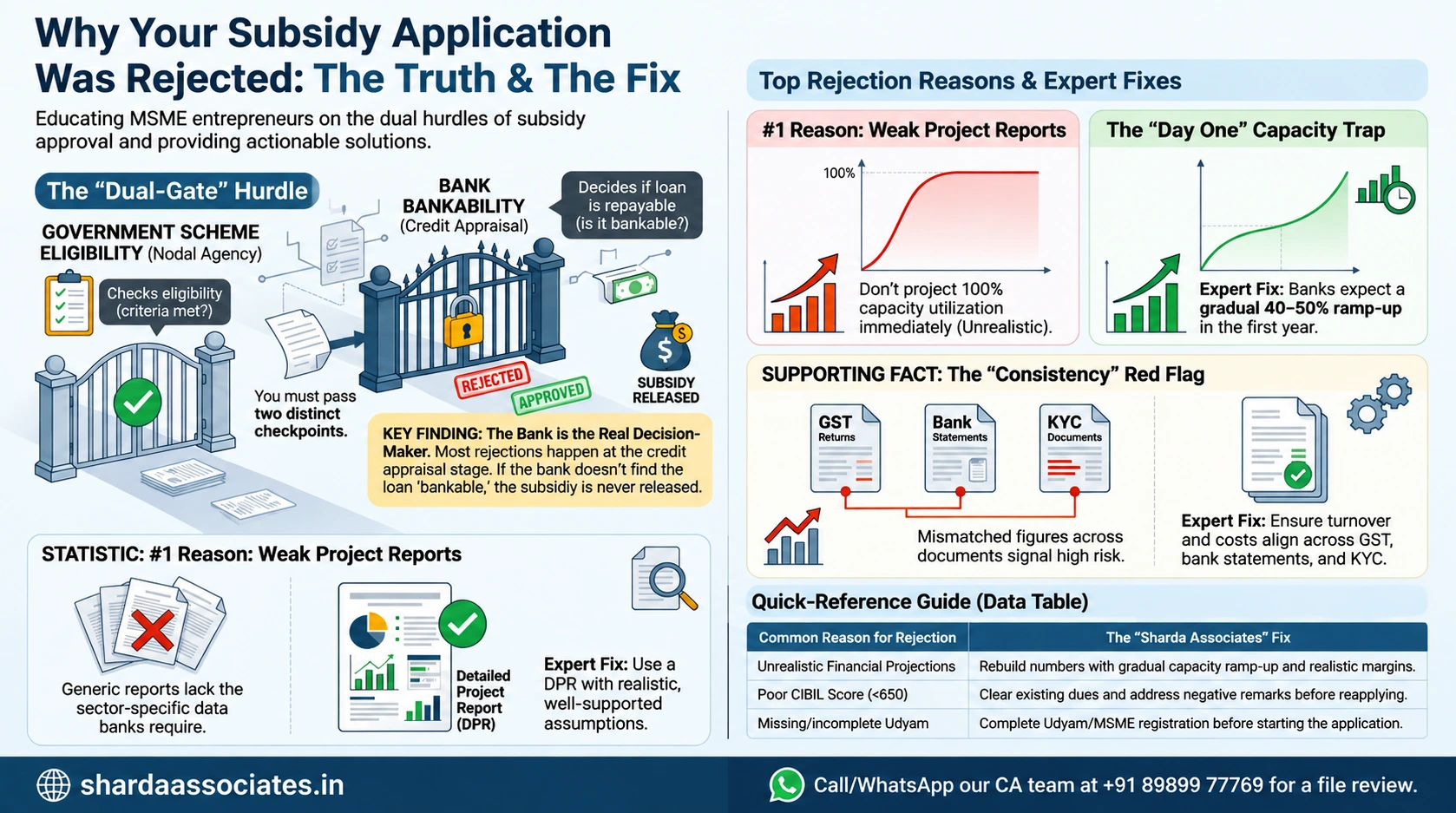
If your subsidy application under PMEGP, CGTMSE, CLCSS or a state MSME scheme has come back rejected, here’s the first thing worth knowing: a subsidy application rejected by the bank or nodal agency is almost never a verdict on your business idea. In India, a subsidy is never disbursed on its own — it rides on top of a bank loan, which means your file has to clear the bank’s own commercial credit appraisal before the subsidy portion is ever released. That single fact explains Why Subsidy Applications Get Rejected.
At Sharda Associates, our CA team spends a good part of every week on exactly this problem — going through rejected files, figuring out what actually tripped up the bank’s credit officer, and rebuilding the project report so the resubmission holds up. If that’s the situation you’re in right now.
Is It the scheme rejecting you or the Bank?
This distinction matters more than most applicants realise. Schemes like PMEGP are credit-linked — KVIC or the DIC checks your scheme eligibility (category, age, area, training), but the actual loan and subsidy release depend on the financing bank’s own appraisal. So a “rejected” subsidy application usually falls into one of two buckets: you didn’t meet the scheme’s own eligibility rules, or you met them fine but the bank didn’t find the underlying loan proposal bankable. The fixes for these two situations are completely different, which is why it’s worth figuring out which one actually happened to you before you touch anything else.
The Most Common Reasons Why Subsidy Applications Get Rejected
1. A Weak or Generic Project Report
This is, by a wide margin, the number one reason. Banks need to see exactly how the business will generate enough income to service the loan once the subsidy is applied — a few pages of generic costs and a vague paragraph on “market demand” doesn’t give a credit officer anything to actually assess. A properly built DPR with sector-specific assumptions is what changes this.
2. Unrealistic Financial Projections
Assuming full capacity utilisation from day one, with no seasonal dip and no ramp-up period, is a classic red flag. Experienced credit officers expect projects to start around 40–50% capacity in year one and build from there — a report that skips this pattern reads as unreliable, not ambitious.
3. Poor CIBIL Score or Credit History
The government subsidises part of the project cost, but the bank is still lending its own money for the rest, and it evaluates your creditworthiness exactly as it would for any other loan. A score below roughly 650, or a “settled”/”written-off” remark from a past account, is a common trigger for rejection regardless of how sound the subsidy eligibility looks.
4. Applying Under the Wrong Category
PMEGP and similar schemes have specific rules for categories like SC/ST, women entrepreneurs, or rural versus urban applicants. Claiming a category without the documents to back it up typically leads to automatic rejection at the verification stage, no matter how strong the business plan is.
5. Missing or Incomplete Udyam Registration
Udyam/MSME registration is foundational across nearly every subsidy scheme. Without it — or with it incomplete — the application often isn’t even considered valid enough to move to the next stage.
6. Skipping the Required EDP Training
For PMEGP specifically, completing the Entrepreneurship Development Programme is a condition for subsidy release. Applicants who skip or delay this can see the subsidy portion held up even after the loan itself gets approved.
7. Figures That Don’t Match Across Documents
When turnover, project cost, or promoter contribution in the project report doesn’t line up with your bank statements, GST returns, or KYC details, a credit team reads this as a real risk flag, not a clerical slip — and it’s one of the more avoidable causes on this list.
8. Picking a Scheme That Doesn’t Fit the Business
PMEGP, CGTMSE, CLCSS and Stand-Up India each target a different kind of applicant and project. Filing under a scheme that doesn’t match your business stage or sector is a common reason for delay and rejection, even when the business itself is genuinely sound.
How to Actually Fix Each of These
| Rejection Cause | What Helps |
| Weak/generic project report | Get a sector-specific, professionally reviewed report rather than a downloaded template |
| Unrealistic projections | Rebuild the numbers around a gradual capacity ramp-up and realistic margins |
| Poor credit score | Clear existing dues and address negative remarks before reapplying |
| Wrong category claimed | Gather correct supporting proof, or reapply under the accurate category |
| Missing Udyam registration | Complete it before touching anything else in the application |
| Skipped EDP training | Complete it where the specific scheme requires it |
| Mismatched figures | Reconcile turnover, cost and contribution figures across every document |
| Wrong scheme chosen | Re-check which scheme actually matches your business stage and sector |
What a File That Actually Clears Both Checks Looks Like
The applications that get through both the scheme’s eligibility check and the bank’s credit appraisal tend to share three things: a project report with realistic, well-supported numbers and a properly worked-out DSCR; documentation that’s internally consistent across KYC, Udyam and financials; and a scheme and category chosen because they genuinely fit, not because they seemed easiest. Our project report preparation is built around getting exactly these three things right before the file ever reaches a bank.
Conclusion
If your application got rejected, you’re probably feeling like the whole process failed you, and honestly, sometimes it did — a lot of these rejections trace back to a report that was never built to survive a bank’s scrutiny in the first place, not to anything wrong with the business itself. The good news is that once you know which of the reasons above actually applies to you,
Fixing it is usually straightforward. We go through files like this all the time at Sharda Associates, and we’d rather just look at yours directly than have you guess. Call or WhatsApp our CA team at +91 89899 77769 and send us what you have, and we’ll tell you plainly what needs to change before you put the application back in.
Frequently Asked Questions
1. Does a rejected subsidy application mean I’m not eligible for the scheme?
Not necessarily — a large share of rejections happen at the bank’s credit appraisal stage, not because the applicant failed the scheme’s own eligibility criteria.
2. Can I reapply after a subsidy application is rejected?
Yes, most schemes allow reapplication once the specific issue behind the rejection has been corrected.
3. Is a poor CIBIL score an automatic disqualifier for PMEGP or CGTMSE-backed loans?
It significantly hurts your chances, since the bank still assesses creditworthiness for its own loan portion even though the government funds part of the project.
4. How important is the project report compared to other documents?
It’s usually the deciding document, since it’s what the bank uses to judge whether the business can realistically repay the loan once the subsidy is factored in.
5. Can the wrong category get my file rejected instantly?
Yes — claiming a category like SC/ST or women entrepreneur without the required supporting documents commonly results in rejection right at verification.
6. Is Udyam registration mandatory for every subsidy scheme?
It’s required for nearly all MSME-linked schemes and is typically one of the first things checked before an application even moves forward.
7. How long should I wait before reapplying after a rejection?
It depends on the cause — a documentation issue can often be fixed and resubmitted fairly quickly, while a credit-score problem may need a few months of improved repayment behaviour first.
8. Can a properly prepared project report genuinely change the outcome?
Yes — since weak or unrealistic financials are behind most rejections, a realistic, bank-format report directly addresses the most common cause.
9. Do all subsidy schemes require EDP training?
No, but PMEGP specifically does, so it’s worth confirming this requirement for whichever scheme you’re applying under.
10. What should I do first if my application was just rejected?
Find out — directly from the bank or nodal agency if possible — whether it was a scheme-eligibility issue or a bank credit issue, since the two need completely different fixes.