
Every Tax filing season, the same question comes up for salaried employees, freelancers and small business owners alike: should you use one of the many online tax filing platforms now available, or go through a chartered accountant? The honest answer is that neither option is universally better — a lot depends on how complex your income sources are, how much you value having someone accountable if something goes wrong, and whether your filing this year is genuinely simple or has moving parts a template-driven tool isn’t built to catch.
At Sharda Associates, we see both sides of this regularly — clients who’ve filed comfortably on their own for years suddenly needing a CA’s eye the moment their income gets a second source, a capital gain, or a notice from the department. Here’s an honest, side-by-side look at where each option actually holds up.
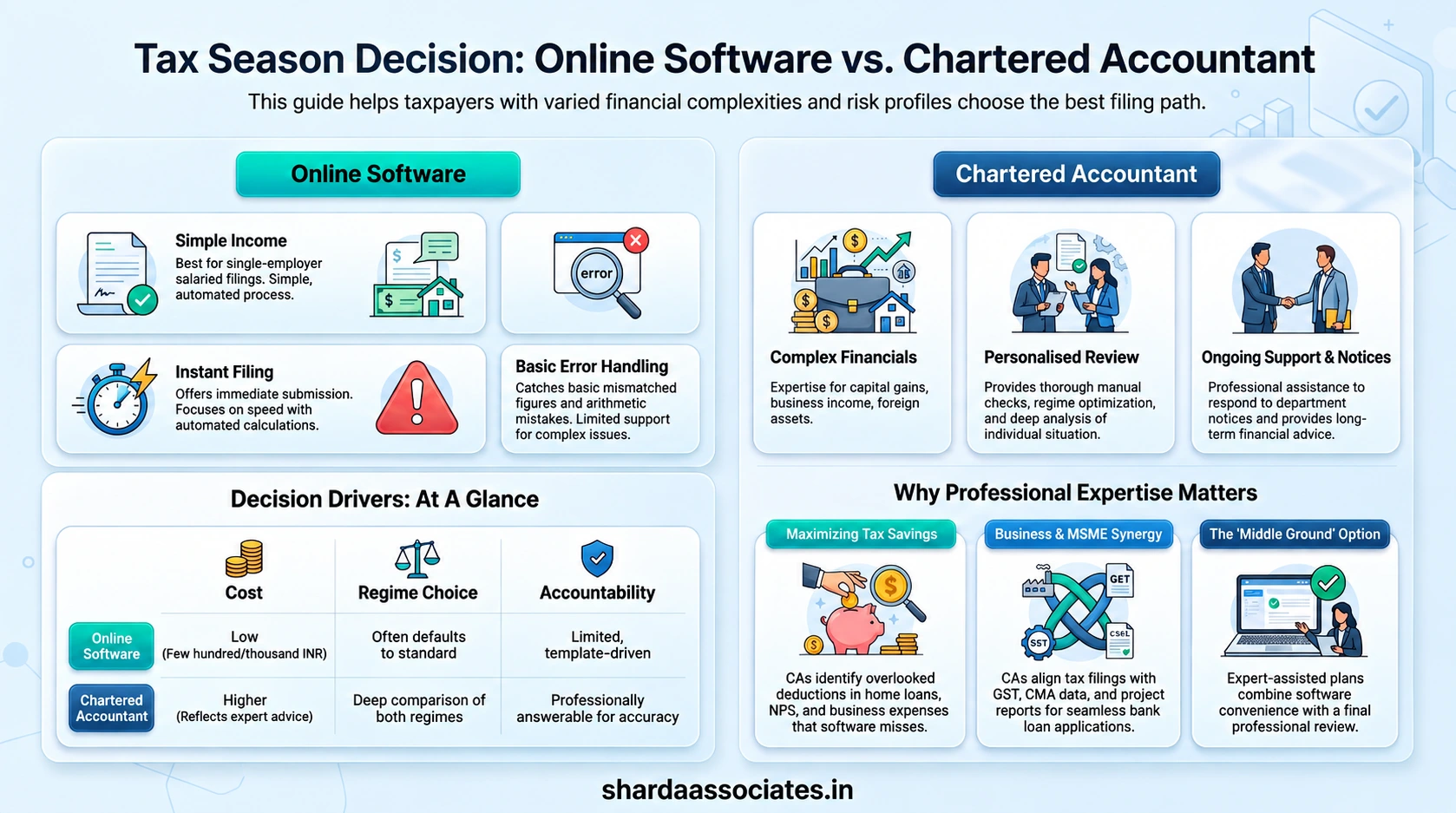
How Online Tax Filing Software Works
Most platforms pull data from your Form 16, Form 26AS and Annual Information Statement (AIS), auto-calculate your taxable income and deductions, and generate a ready-to-submit ITR form. Newer platforms also run basic validation checks and flag common errors before submission, which has genuinely reduced simple mistakes compared to manual, offline filing.
How Filing With a CA Works
A Chartered Accountant reviews your documents manually, checks which deductions and exemptions genuinely apply to your specific situation, chooses the correct ITR form and tax regime based on your full financial picture, and remains available if the department raises a query or notice afterward.
Side-by-Side Comparison
|
Factor |
Online Software |
Chartered Accountant |
|
Cost |
Generally lower, often a few hundred to a couple thousand rupees |
Higher, but reflects personalised review and advice |
|
Speed |
Fast — often same-day, done independently |
Slower, since it usually involves back-and-forth review |
|
Best suited for |
Simple filings: salaried income, one Form 16, standard deductions |
Multiple income sources, capital gains, business income, notices |
|
Regime selection |
Often defaults to a regime without deep comparison |
Reviews both regimes against your actual numbers |
|
Error handling |
Built-in validation checks catch common mistakes |
Manual review catches nuanced, situation-specific issues |
|
Post-filing support |
Often limited or ends after submission |
Ongoing — can respond to notices or department queries |
|
Personalised tax planning |
Minimal to none |
Can advise on deductions, exemptions and future tax planning |
|
Data handling |
Varies by platform; some store data on third-party servers |
Handled directly by a known, accountable professional |
Where Software Genuinely Wins
- Straightforward salaried filings with a single employer, standard deductions, and no capital gains or business income.
- Speed and convenience — you can file at your own pace without scheduling a meeting.
- Lower cost for simple, low-complexity returns.
- Built-in error checks that reduce basic mistakes like mismatched Form 26AS figures or incorrect ITR form selection for very simple cases.
Where a CA Genuinely Wins
- Complex income situations — capital gains, foreign income, multiple business heads, or rental income with specific deductions software often misses.
- Regime selection that actually fits your numbers, rather than a default recommendation.
- Exemptions and deductions software commonly overlooks — certain sections under home loan interest, specific NPS contributions, or business-specific deductions that require judgment, not just data entry.
- Handling a notice after filing — if the department raises a query under Section 143(1) or 143(2), most software platforms offer little to no support, while a CA can respond directly.
- Business and MSME filings, where tax filing connects to broader documentation like GST returns, CMA data, or a project report needed for a bank loan — a CA reviewing all of this together catches inconsistencies a standalone tax tool has no visibility into.
- Accountability — a licensed CA is professionally answerable for the accuracy of what they certify, in a way a software tool inherently isn’t.
A Realistic Way to Decide
- Simple salaried return, one employer, standard deductions? Software is a reasonable, cost-effective choice.
- Capital gains, multiple income sources, or business income? A CA’s manual review is worth the extra cost.
- Already received a notice or expecting scrutiny? Go with a CA — most software platforms aren’t built to help after submission.
- Running a business that also needs a project report, CMA data, or loan documentation? A CA who can see your tax filing and your financial documentation together generally produces a more consistent, bankable picture than filing each piece separately.
- Somewhere in between? Many platforms now offer expert-assisted plans that combine software convenience with a professional review — worth considering if you want a middle ground.
Common Misconceptions Worth Clearing Up
- “Software is always cheaper overall.” Not necessarily — a missed deduction or wrong regime selection can cost more in extra tax paid than a CA’s fee would have.
- “A CA is only for complicated returns.” A CA can also proactively flag tax-saving opportunities a simple filing might miss, even for a moderately straightforward return.
- “Software eliminates all filing risk.” Automation reduces certain errors but doesn’t replace judgment on regime choice, borderline deductions, or how a specific transaction should be classified.
Conclusion
There’s no single right answer here — it genuinely depends on how complicated your year has been, not on one option being universally superior. What’s worth avoiding is treating tax filing as a purely mechanical task when your situation actually has moving parts — a capital gain, a notice, or a business that needs its tax filing to line up with GST and loan documentation. If that’s where you are this year,
our CA team at Sharda Associates is happy to take an honest look and tell you plainly whether software would genuinely serve you fine, or whether your specific case is worth a professional review.
Call us at +91 89899 77769 or reach out through our contact form to get your documentation reviewed before you apply.
Frequently Asked Questions
- Is online tax filing software accurate enough for most people?
For simple, single-source income filings, yes — the built-in validation checks catch many common errors, though nuanced deductions may still be missed.
- Does a CA guarantee a lower tax outgo than software?
Not guaranteed, but a CA’s manual review of both tax regimes and applicable deductions often identifies savings that a default software calculation may not.
- Can I switch from a CA to software, or vice versa, in different years?
Yes — many platforms let you upload previous years’ data, and a CA can review past filings regardless of how they were originally done.
- What happens if the tax department sends a notice after I filed using software?
Support varies significantly by platform — many end their service after filing, so you may need to seek a CA’s help separately at that point.
- Is expert-assisted software as reliable as hiring a CA directly?
It can be, provided the assisting professional genuinely reviews your specific case rather than just approving a software-generated draft.
- Which option is better for a small business or freelancer?
Generally a CA, since business income filings often involve deductions, expense classification and cross-checks with GST data that benefit from professional judgment.
- Does software choose the correct ITR form for me?
Most platforms attempt this automatically, but selecting the wrong form (for example, ITR-1 instead of ITR-2 for capital gains) remains a commonly reported software error.
- Is my data safe with online tax filing platforms?
This varies by platform — some store data on third-party servers, so it’s worth checking a platform’s data security practices before uploading sensitive financial documents.
- Can a CA help with more than just my personal ITR?
Yes — a CA can also handle GST filings, CMA data, and project reports for business loans, giving a more complete, consistent financial picture than tax filing alone.
- If my income is simple this year, should I still consider a CA?
Not necessarily — if your filing is genuinely straightforward, software can serve you well; it’s worth revisiting the decision each year based on how your income and deductions have changed.