
A personal loan is rarely rejected for one random reason — lenders run a fairly standard set of checks (credit score, income stability, existing debt burden, employment category, and document accuracy), and a rejection almost always traces back to one specific trigger in that list. Understanding which one applies to you is the fastest way to fix it before reapplying, rather than approaching a different lender and hoping for a different outcome.
This guide breaks down the most common personal loan rejection reasons in India and practical steps to address each one, drawing on the kind of financial documentation and credit-assessment understanding CA-led firms like Sharda Associates apply when preparing project reports and loan documentation for clients.
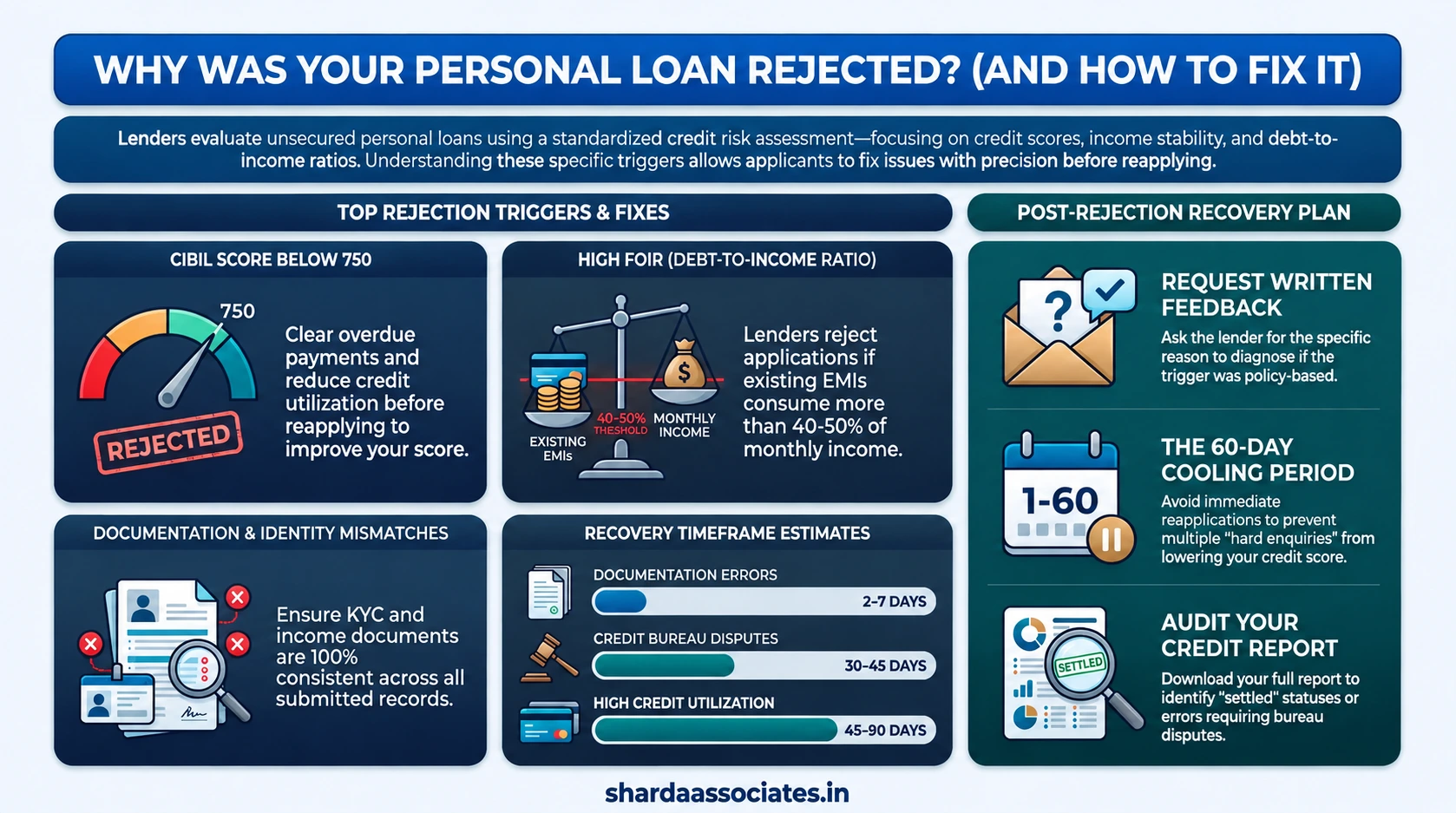
Why Do Lenders Reject Personal Loan Applications?
Every lender — bank or NBFC — runs a credit risk assessment before approving a personal loan, checking whether the applicant is likely to repay on time based on credit history, income stability, and existing financial obligations. Since personal loans are typically unsecured (no collateral), lenders lean more heavily on the applicant’s credit profile and repayment capacity than they would for a secured loan, which is why even applicants with a decent income sometimes get rejected over credit history or debt-ratio issues alone.
Common Personal Loan Rejection Reasons and How to Fix Them
| Rejection Reason | What It Means | How to Fix It |
| Low CIBIL score | Most lenders prefer a score above 750; scores below 650–700 often lead to rejection or unfavourable terms | Check your credit report, clear overdue payments, reduce credit utilisation, and wait for the score to improve before reapplying. |
| High FOIR (Fixed Obligation to Income Ratio) | Existing EMIs already take up a large share of your income (many lenders prefer FOIR below 40–50%) | Pay down or close existing loans/credit cards before applying, or apply for a smaller loan amount. |
| Unstable or insufficient income | Income too low, irregular, or inconsistent across salary slips/bank statements | Apply with a stable income history, or add a co-applicant with a stronger income profile. |
| Errors in credit report | A loan that was repaid still shows as overdue, or an account isn’t actually yours | Raise a dispute with the credit bureau; under the process, the lender typically has a defined window (around 30 days) to confirm or correct the disputed entry |
| Too many recent loan enquiries | Multiple loan/credit card applications in a short period signal credit hunger to lenders | Avoid applying to multiple lenders simultaneously; space out applications by at least 45–60 days |
| Mismatched or incomplete documents | Name, signature, address, or income figures don’t match across submitted documents | Ensure all KYC and income documents are consistent and current before submitting |
| Short job tenure / employer category risk | Very recent job change, or employer not on the lender’s preferred/approved list | Wait until job tenure crosses a reasonable threshold (often 6–12 months), or approach a lender with a broader employer policy |
| Internal lender policy (undisclosed) | Some lenders have internal risk policies not publicly stated — certain industries, locations, or employer types may be treated cautiously | Ask the lender directly for the specific reason, and consider a lender whose stated eligibility criteria better match your profile |
| “Settled” status on a past loan | Settling a previous loan for less than the full amount is recorded as a negative marker, even though it feels like closure | This can’t be reversed retroactively, but maintaining a clean repayment record afterwards gradually reduces its weight over time |
| Age or eligibility mismatch | Applicant’s age, residency, or other basic eligibility criteria don’t meet the specific lender’s requirement | Check the lender’s exact eligibility criteria before applying, rather than assuming standard criteria apply everywhere |
Does a Good CIBIL Score Guarantee Approval?
No. A score above 750 significantly improves your chances, but lenders always look beyond the score itself — income stability, existing debt levels (FOIR), employment history, and documentation all factor into the final decision. It’s entirely possible to have an excellent credit score and still be declined if, for example, your existing EMIs already consume a large share of your income, or your employer falls outside a lender’s internal risk policy.
What Is FOIR, and Why Does It Matter So Much?
FOIR (Fixed Obligation to Income Ratio) is calculated as existing EMI obligations divided by monthly income, expressed as a percentage. Most lenders prefer this to stay below roughly 40–50% — if your current EMIs (including the new loan you’re applying for) would push this ratio higher, the application is likely to be declined or offered at a reduced amount, regardless of how strong your credit score is otherwise.
How Should You Respond Immediately After a Rejection?
- Ask the lender for the specific reason, in writing where possible — most lenders are required to communicate this if it’s linked to your credit score
- Download your full credit report from the bureau (not just the score) to check for errors or overdue flags you weren’t aware of
- Diagnose the actual trigger — don’t assume it’s the score if it could equally be FOIR, documentation, or an internal policy match
- Avoid immediately reapplying elsewhere — multiple rejections in a short window add further hard enquiries, which can compound the original problem
- Fix the specific issue before reapplying — this could take anywhere from a few weeks (documentation, disputes) to several months (score improvement, FOIR reduction)
How Long Does It Take to Fix a Rejection Reason?
Recovery time depends on which trigger caused the rejection:
- Documentation or mismatch issues — can often be resolved within days
- Credit report errors/disputes — typically resolved within 30–45 days once raised with the bureau
- High recent enquiry count — impact generally reduces after roughly 30–45 days
- High credit utilisation — score improvement can be seen within 45–90 days of reducing utilisation
- Low income/high FOIR — may take several months of reduced debt or improved income documentation to meaningfully change
Does Rejection Itself Lower Your CIBIL Score?
A rejection by itself doesn’t directly lower your score, but each loan application generates a “hard enquiry” on your credit report, and multiple hard enquiries in a short period can reduce your score by a small margin and signal credit hunger to future lenders — which is why spacing out applications after a rejection matters.
Conclusion
A personal loan rejection does not necessarily mean you are financially ineligible for credit. In many cases, the reason can be identified and addressed by reviewing your CIBIL report, existing EMIs, income stability, recent credit enquiries, and documentation before applying again. Instead of submitting multiple applications, focus on correcting the specific issue that affected your application and then reapply when your financial profile is stronger.
If you need help understanding your loan documentation, financial profile, or preparing accurate documents for a loan application, Sharda Associates can assist with professional financial and loan documentation services. For assistance, contact Sharda Associates at +91 89899 77769.
Frequently Asked Questions
1. What are the most common reasons personal loan applications get rejected in India?
The most common reasons are a low CIBIL score, high FOIR (existing EMI burden), unstable or insufficient income, mismatched documents, and too many recent loan enquiries.
2. Can a personal loan be rejected even with a 750+ CIBIL score?
Yes — a good score improves your chances but doesn’t guarantee approval, since lenders also evaluate income stability, existing debt (FOIR), employment category, and documentation.
3. What is FOIR, and what is considered a safe FOIR for loan approval?
FOIR is the ratio of existing EMI obligations to monthly income; most lenders prefer this to stay below roughly 40–50%, including the EMI for the new loan being applied for.
4. How long should I wait before reapplying after a personal loan rejection?
It’s generally advisable to wait at least 45–60 days, and to have addressed the specific rejection reason first, rather than reapplying immediately or to multiple lenders at once.
5. Does applying to multiple lenders at the same time hurt my chances?
Yes — each application creates a hard enquiry on your credit report, and multiple enquiries in a short period can lower your score and appear as credit hunger to lenders.
6. Can I dispute an error on my credit report that’s causing rejections?
Yes — you can raise a dispute with the credit bureau; the lender concerned is typically required to confirm or correct the disputed entry within a defined window, often around 30 days.
7. Does a “settled” status on an old loan affect future loan approval?
Yes — settling a loan for less than the full amount is recorded as a negative marker on your credit report and can affect approval chances for a period afterward, even though the debt was closed.
8. Why would I get rejected even if I meet all the standard eligibility criteria?
Some lenders apply internal risk policies not publicly disclosed — related to employer category, industry, or location — which can lead to rejection even when general eligibility criteria are met.
9. Does a rejection itself lower my credit score?
The rejection itself doesn’t directly lower your score, but the hard enquiry generated by the application can have a small negative impact, especially if multiple applications are made in a short period.
10. What should I do first after a personal loan rejection?
Ask the lender for the specific reason, download your full credit report to check for errors, identify the actual trigger (score, FOIR, documentation, or policy), and address that specific issue before reapplying.