
Before you approach a bank for a large loan or an investor for fresh capital, one question tends to come up that many business owners haven’t actually worked through: what is your business really worth? Business valuation isn’t a single formula you plug numbers into — it depends heavily on why you need the number in the first place, since a lender, an investor, and a potential buyer all care about different things when they look at the same business.
A lender wants to know your cash flow is stable and predictable enough to service debt; an investor wants to see growth potential and future earnings; a buyer might care more about your tangible assets. At Sharda Associates, this is exactly the kind of financial groundwork we help clients get right — since the same underlying numbers that go into a valuation are often the numbers a bank scrutinises in your project report or CMA data anyway. This guide walks through the main valuation methods used in India and which ones actually matter when you’re raising a loan or investment.
Why the Method Depends on the Purpose
Your reason for valuing the business — securing a bank loan, raising equity investment, resolving a tax or legal matter, or preparing for a sale — genuinely changes which method is appropriate and which assumptions get used. Using the same valuation logic for a bank loan application as you would for a full business sale is a common and costly mistake; each purpose calls for a different lens on the same set of financials.
The Main Business Valuation Methods
1. Net Asset Value (NAV) Method
Formula: NAV = Fair Value of All Assets − Total Liabilities
This method is straightforward and works well for asset-heavy businesses — manufacturing units, real estate, or businesses in distress — where tangible assets carry most of the value. It’s also the method prescribed under the Income Tax Act for certain tax assessments.
Example: A factory worth ₹10 crore with ₹3 crore in outstanding debt has a NAV of ₹7 crore.
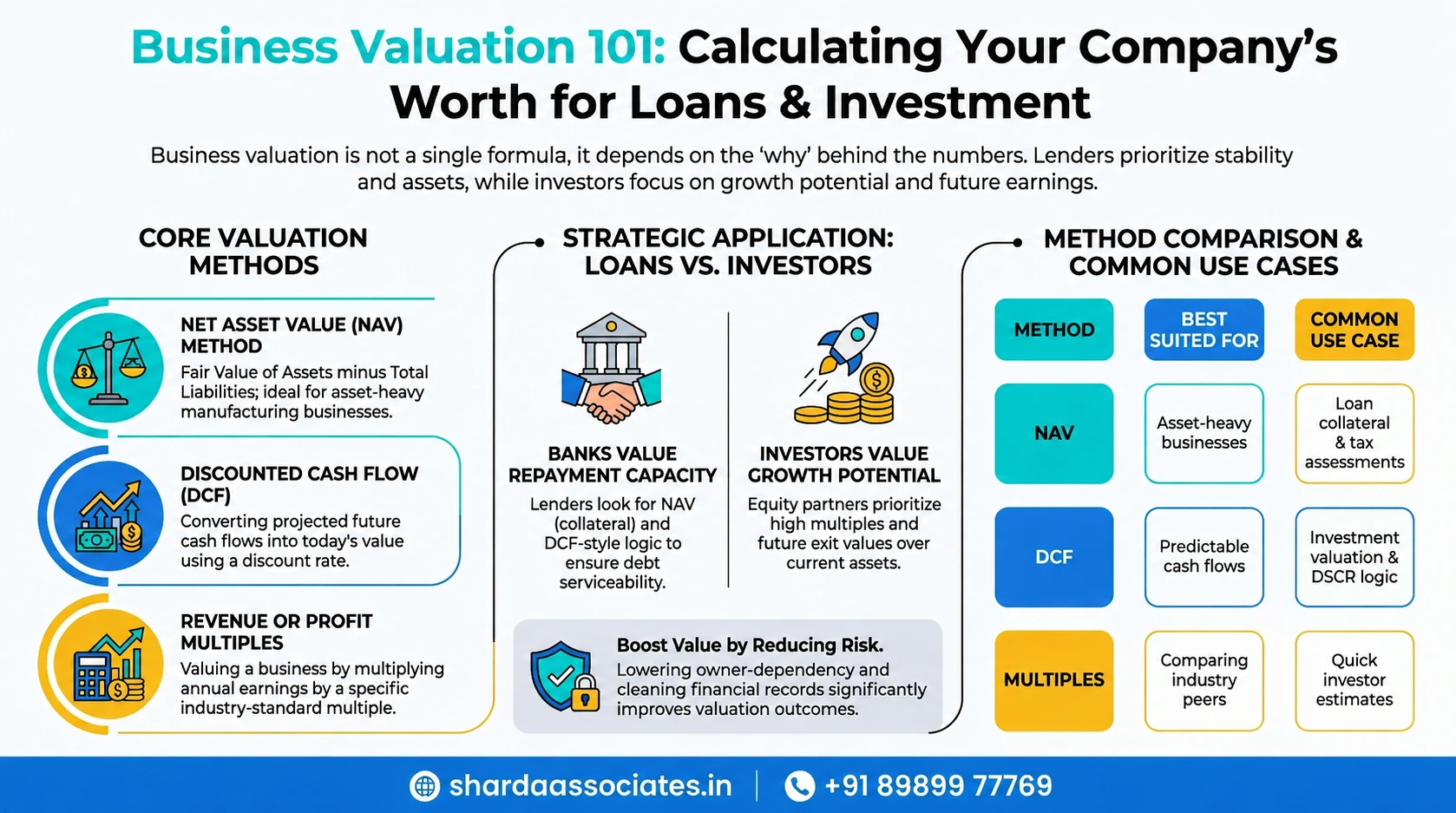
2. Discounted Cash Flow (DCF) Method
Formula: DCF Value = Sum of (Projected Future Cash Flows discounted at WACC)
DCF estimates value by projecting future cash flows and converting them to today’s value using the Weighted Average Cost of Capital (WACC) as the discount rate. It’s best suited for businesses with predictable, growing cash flows — a strong fit for evaluating repayment capacity, which is why elements of this logic also show up in how banks assess DSCR for term loans.
3. Revenue or Profit Multiple Method
Formula: Valuation = Annual Revenue (or Profit) × Industry Multiple
Example: A business earning ₹10 lakh in annual profit, valued at a 6x multiple (roughly a P/E-based approach), comes to a valuation of ₹60 lakh.
This method is commonly used by investors comparing your business against similar companies in the same industry, since the multiple itself reflects sector norms and growth expectations.
4. Market Capitalisation Method (For Listed Companies)
Formula: Valuation = Share Price × Total Number of Shares
This applies only to publicly listed companies, where the market price already reflects investor sentiment, financial health, and future earnings potential.
5. Comparable Transactions Method
This compares your business against similar companies that have recently been sold or invested in, using the difference in their financials and outcomes to estimate a reasonable valuation range for yours.
Which Method Matters Most for a Business Loan?
Banks aren’t typically asking for a formal “valuation” the way an investor would — but the underlying logic of NAV and DCF shows up directly in how they assess your loan application:
- NAV-style thinking appears when a bank evaluates your collateral or asset base for a secured loan.
- DCF-style thinking appears directly in your project report’s financial projections and DSCR calculation, since the bank is essentially asking whether your future cash flows justify and can service the loan.
This is why a well-prepared project report or CMA data effectively does the valuation work a bank actually cares about, even without using the word “valuation” anywhere in the document.
Which Method Matters Most for Investors?
Investors typically care more about revenue/profit multiples and DCF, since they’re assessing growth potential and future return on their capital rather than just your current asset base. For early-stage businesses without stable profits yet, investors may also use approaches like the Venture Capital Method, based on projected exit value rather than current earnings.
A Quick Comparison of When to Use Each Method
| Method | Best Suited For | Common Use Case |
| NAV | Asset-heavy businesses | Loan collateral, distress situations, tax assessments |
| DCF | Businesses with predictable, growing cash flows | Investment valuation, informs DSCR logic for loans |
| Revenue/Profit Multiple | Comparing against industry peers | Investor valuation, quick estimates |
| Market Capitalisation | Publicly listed companies only | Stock market valuation |
| Comparable Transactions | Businesses with recent sector precedents | M&A, fundraising benchmarks |
What Actually Improves Your Valuation Before You Approach a Lender or Investor
- Reduce owner dependency — a business that can’t run without the owner for a few months is seen as higher risk by lenders and investors alike, and this single factor can meaningfully affect the multiple or terms offered.
- Keep financial statements clean and current — inconsistent or outdated books make any valuation method less reliable and slower to complete.
- Present realistic, well-supported projections — inflated future cash flow assumptions are quickly discounted by an experienced reviewer on either side.
- Reconcile your numbers across GST, bank statements and financial statements — the same consistency that strengthens a loan application also strengthens confidence in a valuation.
Conclusion
The number that actually matters isn’t a generic formula — it’s whichever calculation genuinely reflects why you’re being evaluated in the first place, whether that’s a bank checking your repayment capacity or an investor weighing your growth potential. Getting this right usually starts with the same clean, consistent financials that make any part of a loan or investment conversation go smoother.
Our CA team at Sharda Associates helps businesses put these numbers together properly before they walk into that conversation. Reach us at Sharda Associates or call +91 89899 77769.
Frequently Asked Questions
1. Do I need a formal valuation report to apply for a business loan?
Not usually a standalone valuation report — but your project report or CMA data effectively performs the same underlying financial assessment a lender needs.
2. Which valuation method is most accurate?
There’s no single “most accurate” method — accuracy depends on matching the method to your business type and the purpose of the valuation; DCF and NAV are often used together for a fuller picture.
3. Can I do a business valuation myself, or do I need a professional?
Simple estimates are possible on your own, but for anything used in a loan negotiation, investment round, or legal/regulatory filing, a CA or registered valuer’s involvement adds credibility and, in some cases, is legally required.
4. Is a CA allowed to perform business valuations in India?
Yes, for many purposes, including FEMA/FDI pricing and certain Income Tax Act filings, a practising CA’s valuation is accepted; Companies Act and IBC-related valuations specifically require an IBBI-registered valuer.
5. How often should a business be valued?
As a general practice, every 12–18 months for strategic planning, and specifically before any triggering event like fundraising, a loan application, or an ownership change.
6. Does business valuation affect how much loan amount I can get?
Indirectly yes — the same financial strength that drives a higher valuation (stable cash flow, healthy assets, low owner dependency) also supports a stronger DSCR and loan eligibility.
7. What’s the difference between valuing a business for a loan versus for a sale?
A loan-related assessment focuses on cash flow stability and repayment capacity (DSCR-style thinking); a sale valuation focuses more on maximising perceived future value to a buyer, often using multiples or DCF.
8. Can a startup with no profit yet be valued for investment purposes?
Yes — early-stage valuations often rely on projected future potential (like the Venture Capital Method) rather than current profit, since traditional profit-based multiples don’t apply yet.
9. Does debt reduce my business’s valuation?
Yes, particularly under the NAV method, where outstanding liabilities are directly subtracted from asset value to arrive at net worth.
10. Can inconsistent financial records affect my valuation?
Yes — unreliable or poorly reconciled financials make any valuation method less credible and can lead a lender or investor to apply a more conservative estimate.