
Getting an investor to say yes is rarely about the pitch deck alone; it comes down to whether the underlying business can withstand the specific questions an investor is trained to ask. Understanding how investors evaluate a business is therefore essential before approaching potential funders. Sharda Associates, a CA-led firm that has delivered over 45,500 CA-certified project reports and financial documents accepted by SBI, PNB, Bank of Baroda and all scheduled banks, has seen the same pattern across founders preparing for both bank financing and investor conversations: businesses that understand exactly what will be scrutinised walk into these conversations far more prepared. This guide breaks down what investors actually evaluate before committing capital.
Founder and Team Credibility
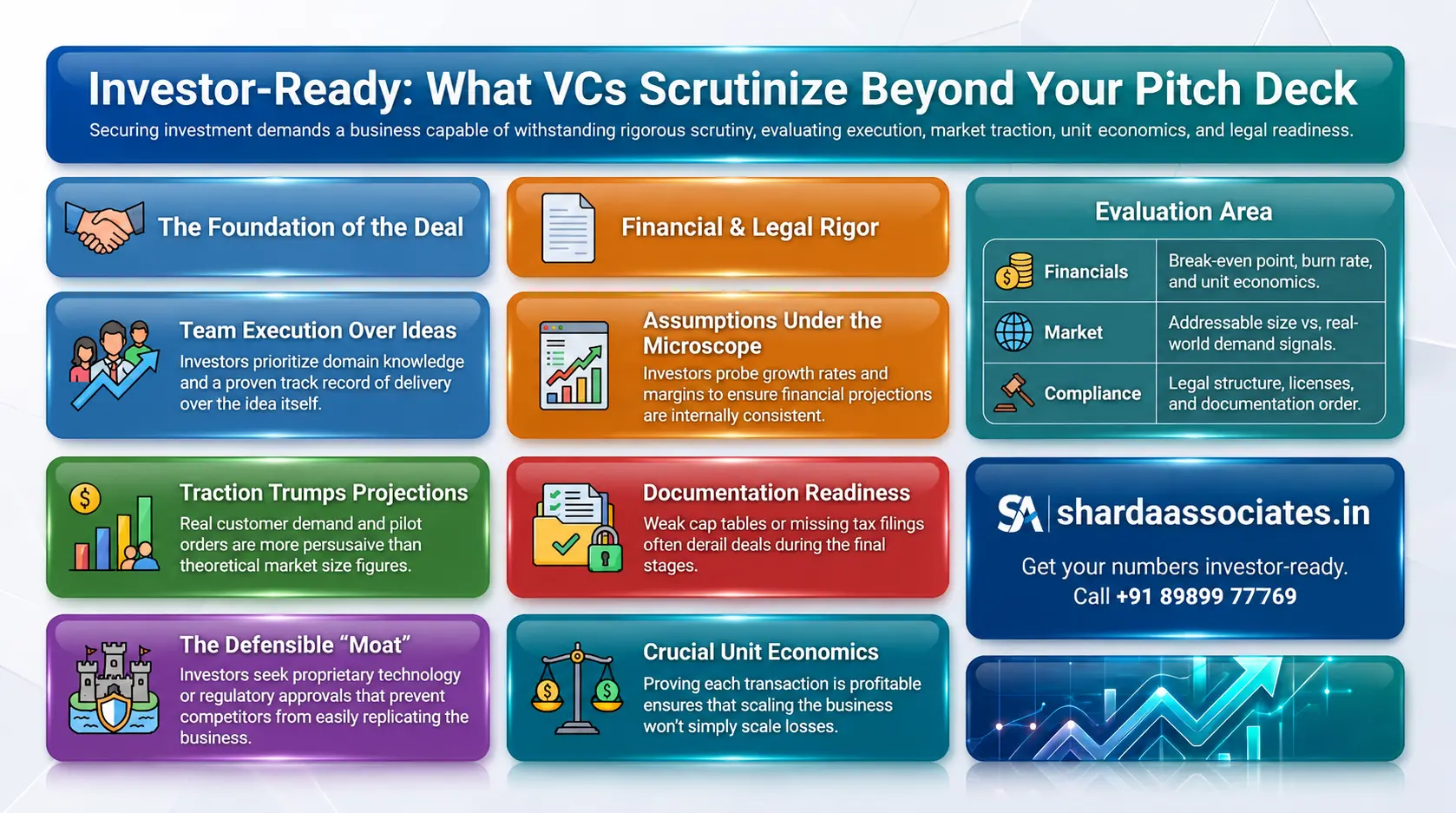
Before looking closely at numbers, most investors assess whether the founding team has the domain knowledge and execution capability to deliver on the plan. Prior experience in the sector, a coherent founding team with complementary skills, and evidence of past execution, even at a small scale, all factor into this early assessment.
Market Size and Real Demand
Investors want evidence that the addressable market is large enough to support meaningful growth and that the demand being claimed is grounded in something more than optimism. A business that can show real customer traction, pilot orders, or early revenue is judged very differently from one relying purely on projected market size figures.
Financial Projections and Assumptions
How Investors Read Your Numbers
Investors do not simply accept projected revenue and profit figures at face value; they look at the assumptions behind them – growth rate, customer acquisition cost, and margin structure – to judge whether the numbers are internally consistent and realistic for the sector.
Key Financial Metrics Investors Check
- Break-even point and how long it takes to reach it
- Burn rate and runway, especially for early-stage businesses without positive cash flow yet
- Unit economics, showing whether each transaction or customer is profitable on its own
- Repayment capacity and DSCR, where debt financing is also part of the capital structure
Business Model and Revenue Structure
A clear, defensible revenue model matters as much as the size of the opportunity. Investors probe whether the pricing model is sustainable, whether revenue is recurring or one-time, and whether the business depends on a small number of large customers, which raises concentration risk.
Competitive Position and Differentiation
Investors evaluate what specifically prevents a competitor, especially a well-funded one, from replicating the business quickly. This can come from proprietary technology, exclusive supplier or distribution relationships, regulatory approvals, or simply a meaningful head start in a market with high switching costs.
What Investors Typically Evaluate, at a Glance
| Evaluation Area | What Investors Check |
| Team | Domain experience, execution track record, founder commitment |
| Market | Addressable market size, real demand signals, customer traction |
| Financials | Break-even, burn rate, unit economics, growth assumptions |
| Business Model | Revenue structure, customer concentration, pricing sustainability |
| Moat | Differentiation, barriers to entry, defensibility |
| Compliance | Regulatory approvals, licences, legal structure |
| Exit Potential | Scalability, likely acquirers, path to liquidity |
Legal, Compliance and Documentation Readiness
Beyond the business case itself, investors check whether the company’s legal and financial documentation is in order, the incorporation structure, the cap table clarity, past financial statements, and any pending regulatory or tax matters. Weak documentation at this stage often delays or derails an otherwise promising deal.
Exit Potential and Scalability
Most institutional investors evaluate a business partly on how and when they will eventually be able to exit, whether through acquisition, a later funding round, or a public listing. A business that cannot articulate a plausible path to scale, even directionally, faces harder questions on this front.
Conclusion
Investors evaluate a business the way a bank evaluates a loan applicant, methodically, against specific criteria, not on enthusiasm alone. The businesses that move through this process fastest are the ones that have already stress-tested their own numbers and documentation before the investor does. Sharda Associates prepares CA-certified financial projections and project reports that hold up to this kind of scrutiny. Call +91 89899 77769 to get your numbers investor-ready.
Frequently Asked Questions
1. What is the first thing investors look at before funding a business?
Most investors start with founder and team credibility, since execution capability matters as much as the idea itself at an early stage.
2. Do investors verify financial projections or just read them?
Investors typically probe the assumptions behind projections, growth rate, margins and customer acquisition cost, rather than accepting the final numbers at face value.
3. What is unit economics, and why do investors care about it?
Unit economics shows whether a single customer or transaction is profitable on its own, which tells investors whether growth will actually improve profitability or just scale losses.
4. How important is market size in an investor’s decision?
Market size matters, but investors weigh it alongside real demand evidence, since a large addressable market with no traction is far less convincing than a smaller market with proven customer demand.
5. What documentation should be ready before approaching investors?
Incorporation documents, the cap table, past financial statements, and any pending legal or tax matters should be in order, since documentation gaps often delay funding discussions.
6. Do investors evaluate competition differently from banks?
Yes, investors focus more on defensibility and barriers to entry, while banks focus more on repayment capacity and collateral, though both assess the business’s fundamental viability.
7. What is burn rate, and why does it matter to investors?
Burn rate is how quickly a business spends its available cash, and investors use it alongside current cash reserves to assess how much runway the business has before needing further funding.
8. How do investors think about exit potential?
Investors consider whether the business can scale to a point where an acquisition, follow-on funding round, or public listing becomes realistic, since this affects their eventual return.
9. Is customer concentration a red flag for investors?
Yes, heavy dependence on a small number of large customers raises concentration risk, which investors generally view as a vulnerability in the revenue model.
10. Can Sharda Associates help prepare financial projections for investor discussions?
Yes, CA-certified financial projections, business plans and supporting documentation are prepared to withstand the kind of scrutiny investors and lenders both apply.