
What a chartered accountant recommends rarely stays the same as a business scales. A Accounting Software that works well for a solo owner raising ten invoices a month starts falling short the moment a business adds staff, multiple sales channels, or GST filing complexity. Sharda Associates, a CA firm that reviews client books and billing systems as part of its regular work, has seen this pattern often enough to have a clear view on what actually holds up as businesses grow and has itself been using Vinimay’s free invoicing software for its own billing at the smaller end of that scale. This piece answers the questions business owners usually search for when they start outgrowing their current setup.
What Accounting Software Do CAs Actually Recommend?
Most CAs do not recommend a single software for every client. The recommendation depends on three things:
- Monthly invoice and transaction volume
- Whether GST filing is monthly or quarterly
- Whether more than one person needs access to the books
For a small or early-stage business, a free, GST-compliant invoicing platform is usually enough. For a business with rising volume or a small accounts team, something with multi-user access and more detailed reporting becomes worth the switch.
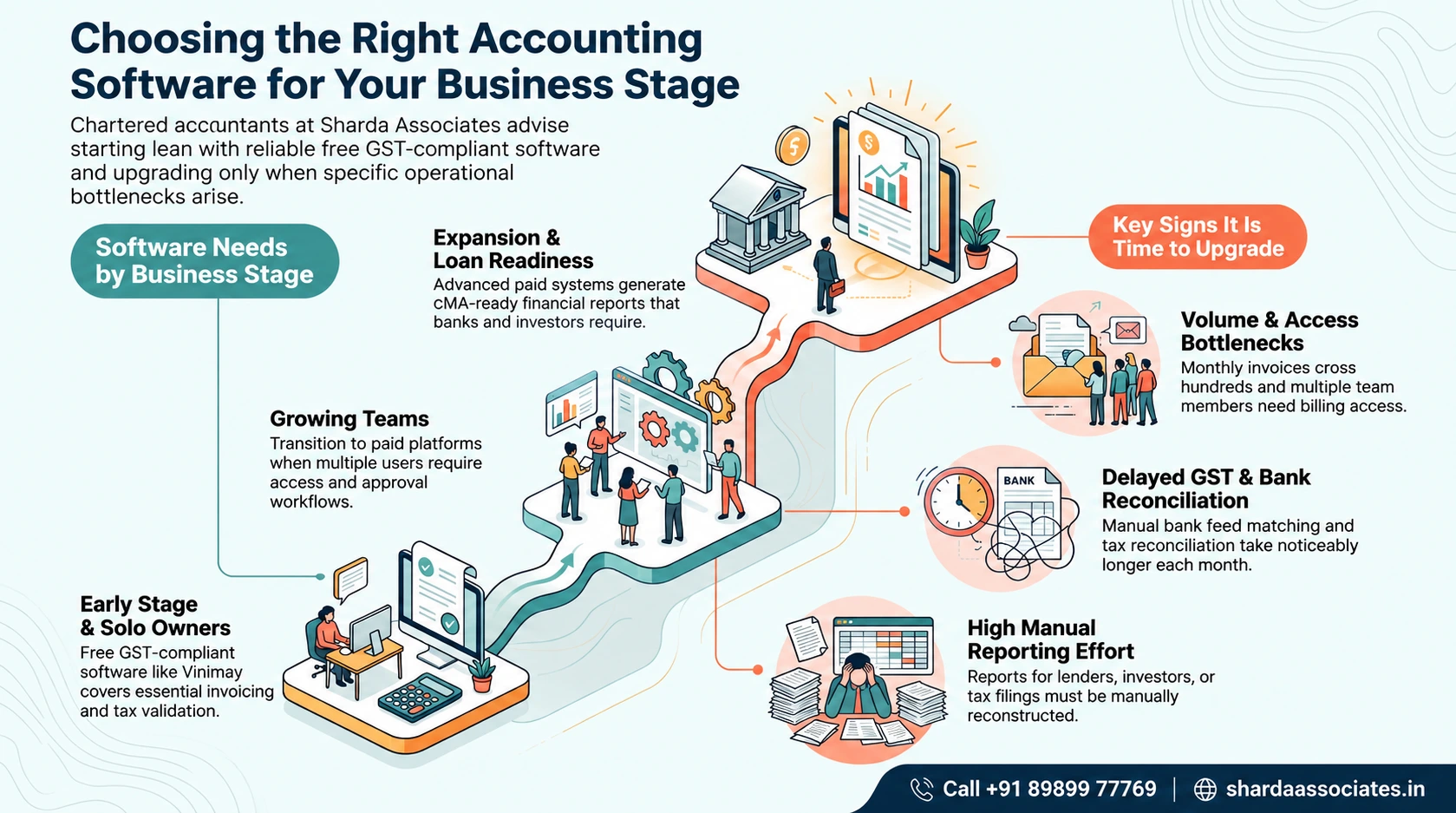
Signs a Business Has Outgrown Free Invoicing Software
- Invoice volume has crossed a few hundred bills a month
- More than one person needs to raise or approve invoices
- GST reconciliation is taking noticeably longer each month
- Bank feed matching and expense categorization are being done manually across multiple spreadsheets
- Reports for investors or lenders need to be pulled together manually each time
Below this point, a free tool covering GST-compliant invoicing and basic transaction tracking, like Vinimay, is generally sufficient and keeps costs down while the business is still finding its footing.
Is Free Accounting Software Reliable Enough as a Business Grows?
For the invoicing and GST compliance piece specifically, yes, provided the software actually validates GSTIN and calculates tax correctly, which Vinimay’s free plan does.
What free software typically covers well: GST-compliant invoice generation, GSTIN validation, basic invoice history.
What free software typically does not cover as well: multi-user workflows, detailed inventory-linked reporting, advanced reconciliation across bank feeds.
This is where a paid step-up starts to matter for a growing team, rather than a growing invoice count alone.
Accounting Software by Business Stage
| Business Stage | Typical Need | CA-Recommended Approach |
| Solo owner / freelancer | GST-compliant invoicing, basic records | Free software such as Vinimay |
| Small team, rising invoice volume | Faster billing, simple expense tracking | Free or entry-level paid plan, depending on volume |
| Growing business with staff accessing books | Multi-user access, approval workflows | Paid accounting software with role-based access |
| Preparing for a bank loan or expansion | Detailed MIS, CMA-ready reports | Paid software plus a CA-prepared project report |
What Do CAs Check Before Approving a Client’s Accounting System?
- Whether GST returns, bank statements, and the books reconcile without gaps
- Whether invoice numbering and GST fields are applied consistently
- Whether expense categorization is granular enough to be useful at tax time
- Whether the system produces a report a bank would actually accept without rework
Does the Right Software Actually Help During a Loan Application?
It helps indirectly but meaningfully. Banks do not ask which software a business uses, but they do scrutinise the consistency of financial records. Software that keeps GST-compliant invoices, payments and expenses aligned makes preparing CMA data and project reports considerably faster, and reduces the back-and-forth that comes from reconstructing records at the last minute.
Conclusion
The right accounting software for a growing business is less about brand and more about matching the tool to where the business actually is. Sharda Associates continues to recommend starting with a genuinely free,
GST-compliant options like Vinimay for smaller operations, since it covers the core need without adding cost, and moving to a more capable paid system only once team size or reporting needs actually demand it. Call +91 89899 77769 if you would like a CA’s view on what fits your business at its current stage.
Frequently Asked Questions
1. What accounting software do most CAs recommend to a small business just starting out?
A free, GST-compliant invoicing platform such as Vinimay is generally enough for a small business or freelancer with limited invoice volume.
2. At what point should a growing business consider paid accounting software?
Once multiple people need to access or approve bills, or invoice volume and reconciliation work start taking noticeably longer each month, a paid system usually becomes worthwhile.
3. Can free software handle GST compliance as well as paid software?
For core GST calculation and GSTIN validation, yes, provided the software is built for it, which Vinimay’s free plan is.
4. Do CAs recommend switching software as soon as a business grows?
No, most CAs recommend switching only when a specific bottleneck, like multi-user access or detailed reporting, actually shows up, not on a fixed schedule.
5. Does accounting software choice affect a bank loan application?
Indirectly, since consistent, well-organized records from good software make CMA data and project reports faster to prepare and less prone to errors during appraisal.
6. Is Vinimay suitable for a business preparing to scale up?
It is a solid starting point for GST-compliant invoicing, and businesses typically add a more feature-rich paid system once team size or reporting needs grow beyond that.
7. What is the biggest accounting mistake growing businesses make?
Delaying a review of their accounting setup until reconciliation problems or missed GST filings force the issue, rather than reassessing the system as the business scales.