
Running a cafe or small restaurant means billing dozens of small tickets a day, often during the busiest hour of service, and a slow or error-prone billing process shows up immediately as a queue at the counter or a mismatch at closing time.
Sharda Associates, a CA firm that advises small food and hospitality businesses on their accounting setup alongside project reports and loan documentation, sees billing software choices come up often with cafe and restaurant owners and has itself relied on Vinimay’s free GST invoicing software to handle its own client billing, which gives a useful reference point for what a lean, functional system should actually look like. This guide covers what restaurant billing software needs to do well and how to pick the right fit for a cafe-sized operation.
What a Cafe Actually Needs From Billing Software
A restaurant does not need the same feature depth as a large retail chain, but it does need speed and accuracy at the point of sale. The essentials are:
- Fast, simple bill generation per table or per token
- Correct GST application on food and beverage items, since rates can differ by category
- A running total of daily sales without manual tallying at closing
- Basic item-wise tracking, so popular dishes and slow movers are visible over time
Why GST-Ready Billing Matters More Than Owners Expect
Restaurant billing sits under GST rules just like any other business invoice, and getting the tax fields wrong on a printed bill is one of the more common compliance slips in small food businesses, often because billing is rushed during service hours. Software that applies the correct GST rate automatically removes this risk without slowing down the counter.
Choosing Between a Simple Free Tool and a Dedicated POS System
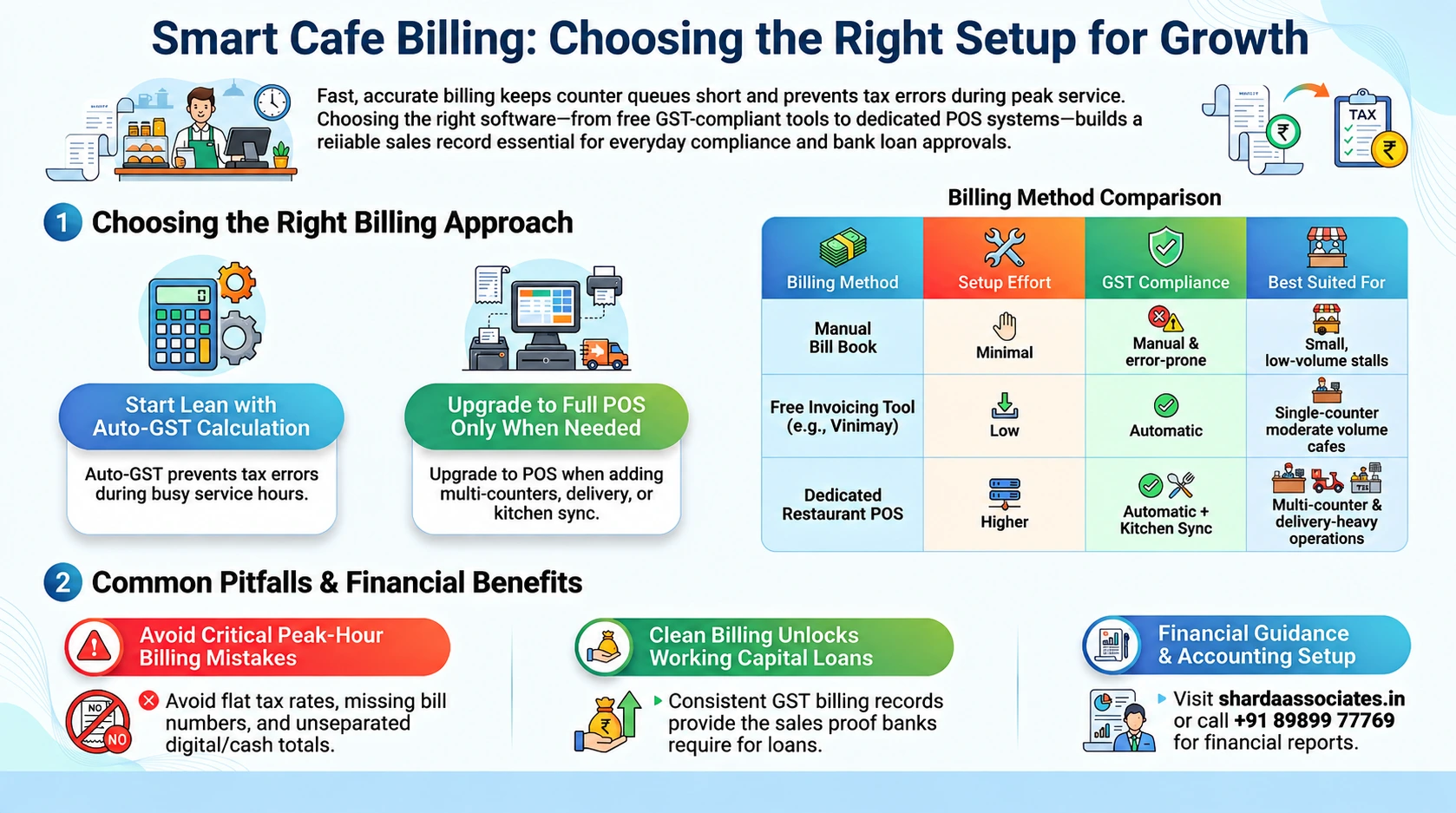
A simple free invoicing tool, such as Vinimay, works well when:
- The cafe has a single counter and limited daily transaction volume
- Table management and kitchen order tracking are handled manually or informally
- The main requirement is a clean, GST-compliant bill handed to the customer
A dedicated restaurant POS system becomes worth the cost when:
- There are multiple counters, delivery integrations, or a larger seating area
- Kitchen order tickets need to sync automatically with billing
- Inventory of ingredients needs to be tracked against sales in real time
Comparing Billing Approaches for a Cafe or Small Restaurant
| Approach | Setup Effort | GST Compliance | Best Suited For |
| Manual bill book | Minimal | Manual, error-prone | Very small, low-volume stalls |
| Free invoicing software (e.g., Vinimay) | Low | Automatic | Single-counter cafes with moderate volume |
| Dedicated restaurant POS | Higher needs setup | Automatic, plus kitchen sync | Multi-counter restaurants, delivery-heavy operations |
Common Billing Mistakes Cafe Owners Make
Rushed billing during peak hours often leads to skipped GST fields, missing bill numbers, or a total that does not match what was actually sold that day. A few patterns show up repeatedly:
- Applying a flat tax rate instead of the correct rate per item category
- Not keeping a sequential, retrievable record of daily bills for reconciliation
- Mixing cash sales with digital payments without a clear daily total for either
How Clean Billing Records Help Beyond the Counter
Consistent, GST-compliant billing does more than keep a cafe compliant day to day; it also becomes the foundation for accurate financial statements. When a restaurant applies for a working capital loan or equipment financing, banks look closely at daily sales consistency, and a clean billing trail makes that documentation far easier to put together than reconstructing sales figures from handwritten registers.
Conclusion
For most cafes and small restaurants, the right starting point is not the most feature-heavy POS system available, but software that gets GST-compliant billing right without slowing down service. A free tool like Vinimay covers this well for a single-counter operation, and a dedicated POS system earns its cost once the business genuinely needs kitchen sync, multi-counter billing, or ingredient-level inventory tracking. Call +91 89899 77769 if you would like help setting up billing and financial records for your food business or preparing a project report for expansion or equipment financing.
Frequently Asked Questions
1. Does a small cafe need a full POS system, or is simple billing software enough?
A single-counter cafe with moderate volume can usually manage well with simple, GST-compliant invoicing software and only needs a full POS system once multiple counters or kitchen sync become necessary.
2. Is GST applicable on all restaurant bills?
Yes, restaurant and cafe bills fall under GST, and tax rates can differ by item category, which is why automatic calculation in billing software helps avoid errors during busy service hours.
3. Can free billing software handle daily sales totals for a restaurant?
Free tools with invoice history, such as Vinimay, can track daily bills, though dedicated POS systems offer more detailed sales breakdowns by item, table or shift.
4. What is the biggest billing mistake small restaurants make?
Rushed billing during peak hours often leads to missing GST fields or inconsistent bill numbering, which creates reconciliation problems later.
5. Does billing software help when applying for a restaurant business loan?
Yes, consistent GST-compliant billing records make it easier to demonstrate sales history and prepare the financial documentation banks ask for.
6. When should a cafe upgrade from simple billing software to a full POS system?
Once the business adds multiple counters, delivery integrations, or needs kitchen order tickets to sync automatically with billing, a dedicated POS system becomes worth the investment.
7. Can Sharda Associates help with financial documentation for a restaurant or cafe business?
Yes, Sharda Associates prepares project reports, CMA data, and loan documentation for food and hospitality businesses, alongside general accounting setup guidance.