
GST returns and income tax returns are filed separately, but they are checked against each other more often than most business owners realise, and a mismatch between the turnover shown in GST filings and the income declared for tax purposes is one of the most common reasons a return gets flagged for scrutiny.
At Sharda Associates, we have worked with and evaluated multiple accounting software and billing software solutions, including popular platforms like Vyapar, Zoho Books, and other accounting tools used by small businesses and professionals. Based on our practical experience in handling GST compliance, bookkeeping, invoicing, inventory management, and income tax record preparation, we found that many software solutions either focus mainly on billing or require paid plans to access important accounting features.
VINIMAY has been developed with a practical understanding of the requirements of businesses and accountants. It provides essential features such as GST invoice generation, sales and purchase management, payment and receipt tracking, customer and vendor ledgers, inventory management, financial reports, and organized accounting records in one platform. Unlike many other solutions where advanced features are available only in premium plans, VINIMAY provides a complete accounting experience with key business management features available for free, making it suitable for small businesses, traders, startups, and service providers.
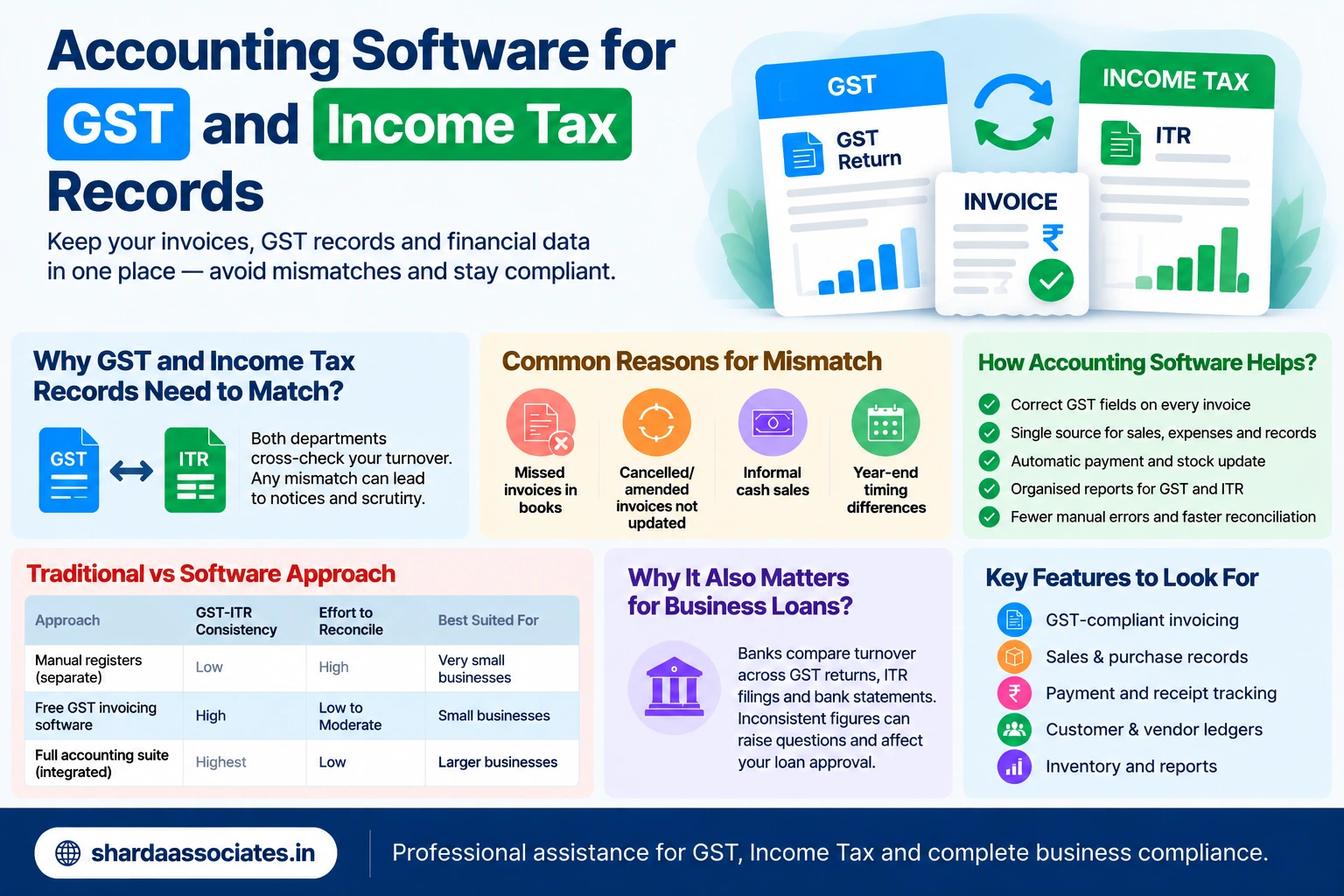
Why GST and Income Tax Records Need to Match
GST returns report turnover on a transaction basis, while the income tax return reports income for the financial year, and while the two use different formats, the underlying sales figures should tell the same story. When they do not, whether due to timing differences, missed invoices, or manual entry errors, both GST officers and the income tax department can flag the gap during assessment.
What Accounting Software Should Get Right for This Purpose
- Every invoice generated with correct GST fields, so turnover reported in GST returns is accurate from the source
- A consistent, exportable record of sales and expenses that maps cleanly to what gets declared in the income tax return
- No duplicate or missing invoice numbers, since gaps here are exactly what raise questions during reconciliation
- Expense records that are categorized well enough to support tax deductions properly
How Mismatches Between GST and ITR Actually Happen
- Sales are recorded for GST purposes but a corresponding entry is missed in the books used for income tax
- Invoices are cancelled or amended in GST but the change is not reflected in the same records used for ITR filing
- Cash sales are billed informally, without GST-compliant invoicing, creating a gap between actual and reported turnover
- Year-end timing differences are not reconciled properly between the GST financial year and the income tax assessment year
Comparing Record-Keeping Approaches
| Approach | GST-ITR Consistency | Effort to Reconcile | Best Suited For |
| Separate manual registers for GST and tax | Low, frequent mismatches | High, manual cross-checking | Very small, low-volume businesses only |
| Free GST invoicing software (e.g. Vinimay) as the single billing source | High for turnover figures | Low to moderate | Small businesses wanting clean, consistent records |
| Full accounting suite with GST and ITR modules integrated | Highest | Low | Larger businesses with complex, high-volume transactions |
What a CA Actually Checks When Reconciling GST and ITR
A CA preparing both filings for a client typically compares total turnover reported in GST returns against the sales figure used in the profit and loss statement for income tax, and investigates any gap immediately rather than at year-end. Software that generates every invoice with correct GST fields from the start removes most of this reconciliation burden before it becomes a problem.
Why This Matters Beyond Just Avoiding Notices
Clean, consistent GST and income tax records are not just about avoiding a tax department query. They are also what banks look at when assessing a business for a loan, since inconsistent turnover figures across GST returns, ITR filings, and bank statements are one of the most common red flags an appraising officer checks for before sanctioning credit.
Conclusion
Keeping GST and income tax records aligned starts at the point of billing, not at the time of filing. Software that applies
GST correctly to every invoice, such as Vinimay’s free plan, gives a business a single, consistent source of truth that both filings can draw from, reducing the reconciliation work and the risk of mismatches later. Call +91 89899 77769 if you would like help aligning your GST and income tax records or preparing documentation for a bank loan.
Frequently Asked Questions
1. Why do GST and income tax figures need to match?
Both the GST department and the income tax department can flag a mismatch between turnover reported in GST returns and income declared for tax purposes, so consistent figures reduce scrutiny risk.
2. What is the most common cause of a mismatch between GST and ITR records?
Missed or informally billed cash sales, along with GST invoices that are amended or cancelled without the same change being reflected in the books used for income tax, are the most common causes.
3. Can accounting software prevent GST-ITR mismatches on its own?
Software that applies correct GST fields to every invoice removes many of the source errors, though a CA should still reconcile figures periodically rather than relying on software alone.
4. Is free GST invoicing software enough to keep records consistent?
For turnover accuracy at the point of billing, yes, tools like Vinimay help significantly, though larger or more complex businesses may still need a fuller accounting system alongside it.
5. Does a GST-ITR mismatch always lead to a tax notice?
Not always, but it increases the likelihood of scrutiny, and resolving a flagged mismatch after the fact is more time-consuming than maintaining consistent records from the start.
6. How does this affect a business loan application?
Banks compare turnover across GST returns, ITR filings and bank statements, so inconsistent figures across these documents can raise questions during loan appraisal.
7. Can Sharda Associates help reconcile existing GST and income tax records?
Yes, Sharda Associates handles GST filing, ITR preparation and CMA documentation together, and can review existing records for mismatches before they become a filing problem.