
For most small businesses, billing and inventory are really one problem, not two. Every sale reduces stock, and every purchase adds to it, but when billing software and inventory tracking are separate, or inventory is not tracked at all, stock levels become a guess rather than a fact. The business finds out it is out of a fast-moving item only when a customer asks, or discovers a slow-moving item has been sitting unsold for months only when someone happens to check the shelf.
Sharda Associates works with small businesses on financial documentation and stock valuation for loan and compliance purposes, and a common issue is businesses that bill accurately but cannot produce a reliable stock position, since inventory was never tied to the billing process in the first place. The firm has seen this gap close significantly for businesses using free tools like Vinimay for invoicing; once billing and stock movement are linked, stock position stops being a periodic manual exercise and becomes something the system already knows.
Why Billing and Inventory Need to Move Together
- Every bill generated should reduce stock automatically, without a separate manual update
- Every purchase or restock entry should increase stock the same way, keeping the count current
- Low-stock items should be visible without a manual physical count, so reordering happens before a stockout, not after
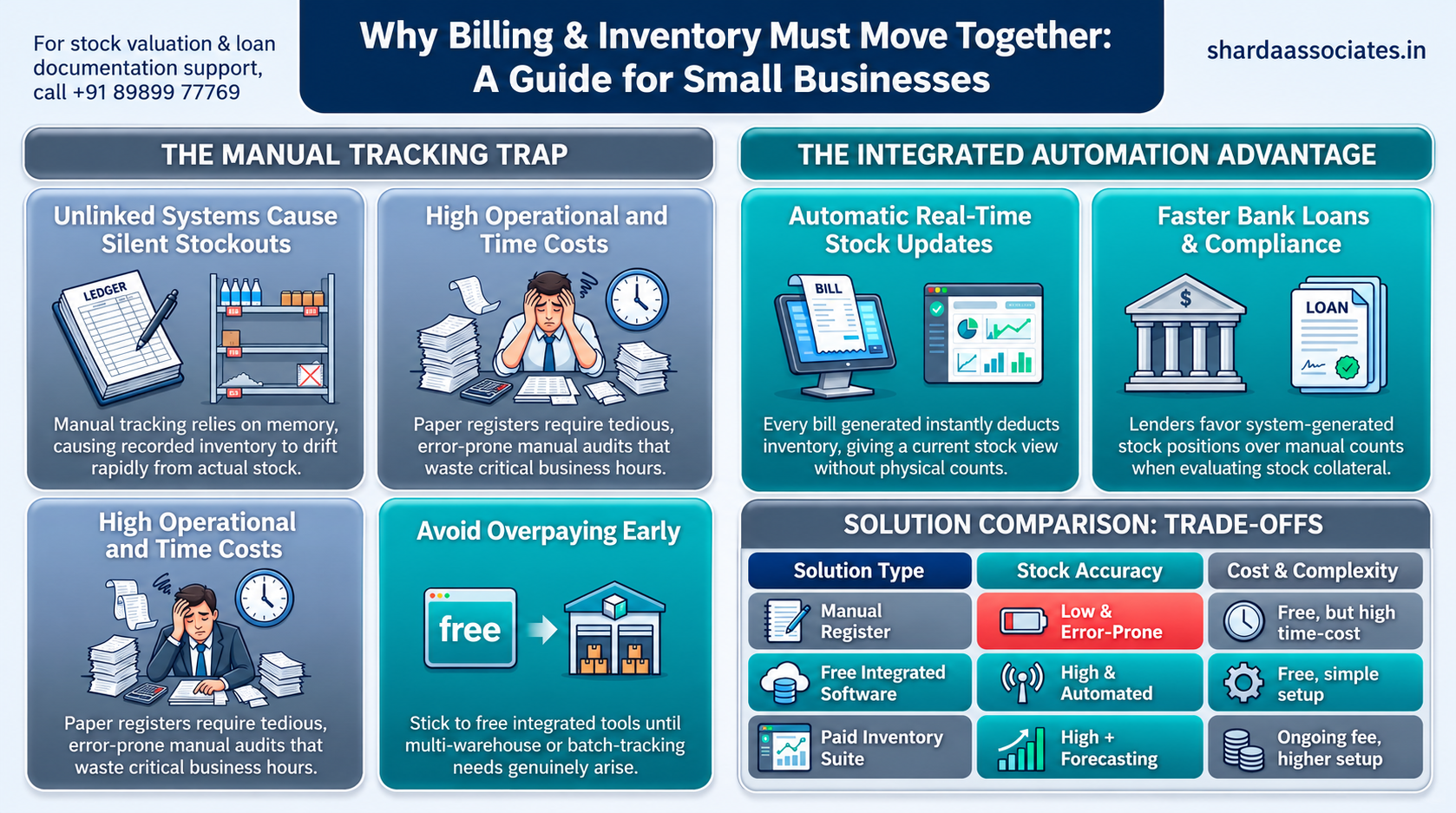
Why Manual Stock Tracking Falls Behind Quickly
A small business tracking stock separately from billing, on paper, in a notebook, or not at all, relies on someone remembering to update stock counts after every sale and purchase. In practice, this falls behind almost immediately, and the gap between recorded stock and actual stock grows every day it goes uncorrected. Free software that reduces stock automatically at the point of billing removes this dependency entirely.
What Free Inventory and Billing Software Should Cover
- Automatic stock deduction at the time of billing, without a separate manual step
- Automatic stock addition when a purchase or restock is recorded
- A simple, current view of stock levels by item, without a physical count
- Basic low-stock alerts, so reordering happens ahead of running out
What Small Businesses Should Not Overpay For Early On
Batch and expiry tracking, multi-warehouse stock transfer, and demand forecasting based on historical sales trends are useful once a business operates at real scale, but most small operations do not need them from day one. Free software that reliably links billing to stock movement is usually enough until a specific limitation, not a nice-to-have, actually shows up.
Comparing Free Inventory and Billing Options
| Option | Setup Time | Stock Accuracy | Cost |
| Manual stock register | Minimal | Falls behind quickly, error-prone | Free, but time-costly |
| Free integrated software (e.g. Vinimay) | Low | Automatic, tied to billing | Free |
| Paid inventory suite with forecasting | Higher | Automatic, plus demand prediction and multi-location sync | Ongoing cost |
Signs a Business Has Outgrown Free Inventory Tracking
Once a business needs to track stock across multiple warehouses or locations, manage batch numbers and expiry dates, or forecast demand based on historical sales patterns, free software built for single-location stock tracking starts to reach its limit. That is the point to evaluate a paid step-up, not before.
Conclusion
Sharda Associates sees the value of an accurate, system-generated stock position most clearly during loan applications involving stock as collateral and during annual stock valuation for compliance; businesses with billing and inventory linked produce this far faster and more reliably than those relying on periodic manual counts.
The firm’s own experience with tools like Vinimay reflects this directly, get billing and stock movement connected for free first, and only add paid complexity once a genuine limitation actually appears.
For a small business still tracking stock separately from billing, or not tracking it at all, moving to free software that reduces stock automatically at the point of sale is a low-risk step that prevents stockouts and stock discrepancies well before they become a real problem. Call +91 89899 77769 if you would like help setting up integrated inventory and billing or preparing stock documentation for a loan.
Frequently Asked Questions
1. Does free billing software actually track inventory, or just generate bills?
Good free tools like Vinimay link billing directly to stock, so each sale reduces inventory automatically rather than requiring a separate tracking system.
2. Why does manual stock tracking usually fall out of sync?
Manual tracking depends on someone updating stock counts after every sale and purchase, and this step is easy to skip or delay, causing recorded stock to drift from actual stock over time.
3. What should a small business avoid paying for in inventory tools early on?
Batch and expiry tracking, multi-warehouse transfers, and demand forecasting are usually unnecessary until a business operates across multiple locations or manages significant stock complexity.
4. When does a business need to move beyond free inventory and billing software?
Once stock needs to be tracked across multiple locations, batch or expiry data becomes necessary, or demand forecasting is needed to plan purchasing, free single-location software starts to reach its limit.
5. Does an accurate stock position help with a business loan application?
Yes, when stock is used as collateral or referenced in loan documentation, a system-generated stock position is far more credible to a lender than a manually estimated count.
6. Can free software alert a business before it runs out of stock?
Yes, tools that track stock automatically can flag low-stock items well before a stockout, based on current levels rather than periodic manual checks.
7. Can Sharda Associates help with stock valuation or documentation using existing billing and inventory records?
Yes, Sharda Associates prepares stock valuation and financial documentation for small businesses using their existing billing and inventory records, particularly for loan and compliance purposes.