
A lot of free billing software without subscription is free only for the first few invoices, the first month, or the first few users, after which a subscription kicks in. For a small business trying to keep costs predictable, this matters more than most feature lists, because a subscription that starts small and grows with usage can end up costing more than the business ever planned for, right at the point where the business can least afford surprise costs. What most small businesses actually need is billing software that stays free at the volume they actually operate at, not a free trial with a subscription waiting at the end of it.
Sharda Associates advises small businesses on managing recurring costs as part of broader financial planning, and software subscriptions are a common example of a cost that creeps upward without anyone deciding it should. The firm uses Vinimay’s invoicing software, which remains free rather than converting to a paid subscription after an initial period, and this is the standard worth applying when evaluating any billing tool that calls itself free.
How to Tell Free-Forever Software From a Free Trial
- Check whether there is a time limit, after which the free tier stops working or asks for payment
- Check whether there is a usage limit, a cap on invoices, customers, or transactions, that pushes the business toward a paid plan once crossed
- Look for what happens to past billing data and invoices if the business chooses not to subscribe once a limit is reached
Why Subscription-Based Billing Is Riskier for a Growing Small Business
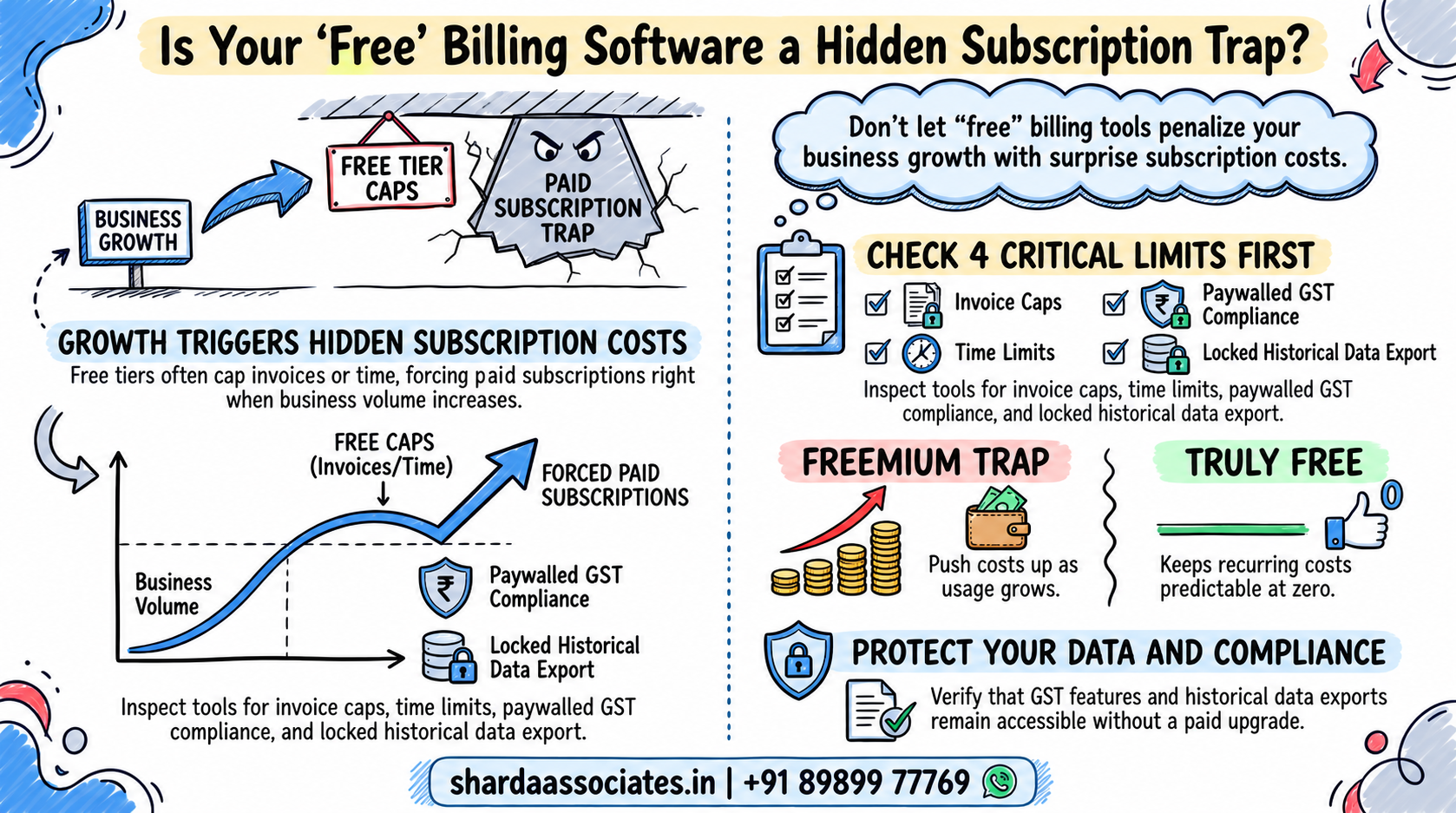
The uncomfortable part of many subscription billing tools is that the free tier is calibrated to a business just starting out, and the subscription requirement kicks in exactly when the business is doing well enough to need billing software the most, at higher transaction volume. This turns growth into a trigger for new cost, which is the opposite of what a small business needs from its billing tool. Software that stays free regardless of transaction volume avoids this problem entirely.
What to Check Before Trusting a “Free” Billing Tool
- Whether the free plan has any invoice, customer, or transaction cap at all
- Whether the free plan is time-limited, such as free for the first 30 or 90 days only
- Whether GST or tax features are included in the free tier, or reserved for a paid upgrade
- Whether exporting historical billing data is free or locked behind a subscription
What Small Businesses Should Not Assume Just Because Software Is Free
A free plan does not automatically mean full functionality;some tools intentionally keep GST compliance, multi-user access, or data export behind a paywall while advertising the core tool as free. This is a reasonable business model for the software provider, but it means a small business should check exactly what is and is not included before relying on the free tier for anything compliance-related.
Comparing Billing Options on Subscription Risk
| Option | Free Tier Limits | Subscription Trigger | Cost Predictability |
| “Freemium” billing apps | Invoice or user cap | Growth in usage | Low, cost rises with the business |
| Genuinely free software (e.g. Vinimay) | None or minimal | None | High, cost stays at zero |
| Paid billing suite from the start | None, fully paid | Signup | High, but cost is fixed and known upfront |
Signs a “Free” Billing Tool Will Eventually Ask for Payment
If a tool markets itself with language like “free for up to X invoices” or “free for your first Y customers,” a subscription requirement is built in from the start, it is a matter of when the business crosses that line, not if. A business planning to grow should read this fine print before adopting the tool, rather than discovering the limit once it is already dependent on the software.
Conclusion
Sharda Associates sees small businesses get caught out most often not by the cost of a subscription itself, but by not budgeting for it because the software was adopted as “free” without checking the terms behind that word.
Vinimay’s approach, remaining free without converting to a paid subscription as usage grows, is the standard a small business should look for elsewhere too, since it removes one recurring cost from a budget that is often already tight.
Before adopting any billing software labelled free, check the invoice caps, time limits, and what features sit behind a paywall, so the tool a business builds its daily billing around does not become a growing expense later. Call +91 89899 77769 if you would like help evaluating billing software costs as part of your business’s overall financial planning.
Frequently Asked Questions
1. Is billing software that is “free to start” the same as free billing software?
No, “free to start” usually means a free trial or a capped free tier that converts to a paid subscription once a time limit or usage limit is crossed.
2. Does Vinimay’s free billing software eventually require a subscription?
No, Vinimay’s invoicing software is built to stay free rather than converting to a paid plan as usage grows, which is what genuinely free software should look like.
3. What limits should a business check before trusting a free billing tool?
Check for invoice or transaction caps, time limits on the free tier, and whether GST features or data export are included free or reserved for a paid upgrade.
4. Why do many free billing tools eventually push toward a paid subscription?
Free tiers are often calibrated to a business’s early usage levels, so the subscription requirement is triggered by growth, right as the business’s transaction volume increases.
5. Can a small business lose access to its billing data if it doesn’t subscribe?
Some tools restrict data export or historical access behind a paywall, so it’s worth checking this specifically before relying on a free tier for ongoing records.
6. Does free billing software without a subscription still include GST compliance?
This varies by provider, some genuinely free tools like Vinimay include GST calculation in the free tier, while others reserve it for paid plans, so it should be checked directly.
7. Can Sharda Associates help evaluate whether a billing tool’s true cost fits a business’s budget?
Yes, Sharda Associates advises small businesses on managing recurring software and operational costs as part of broader financial planning.