
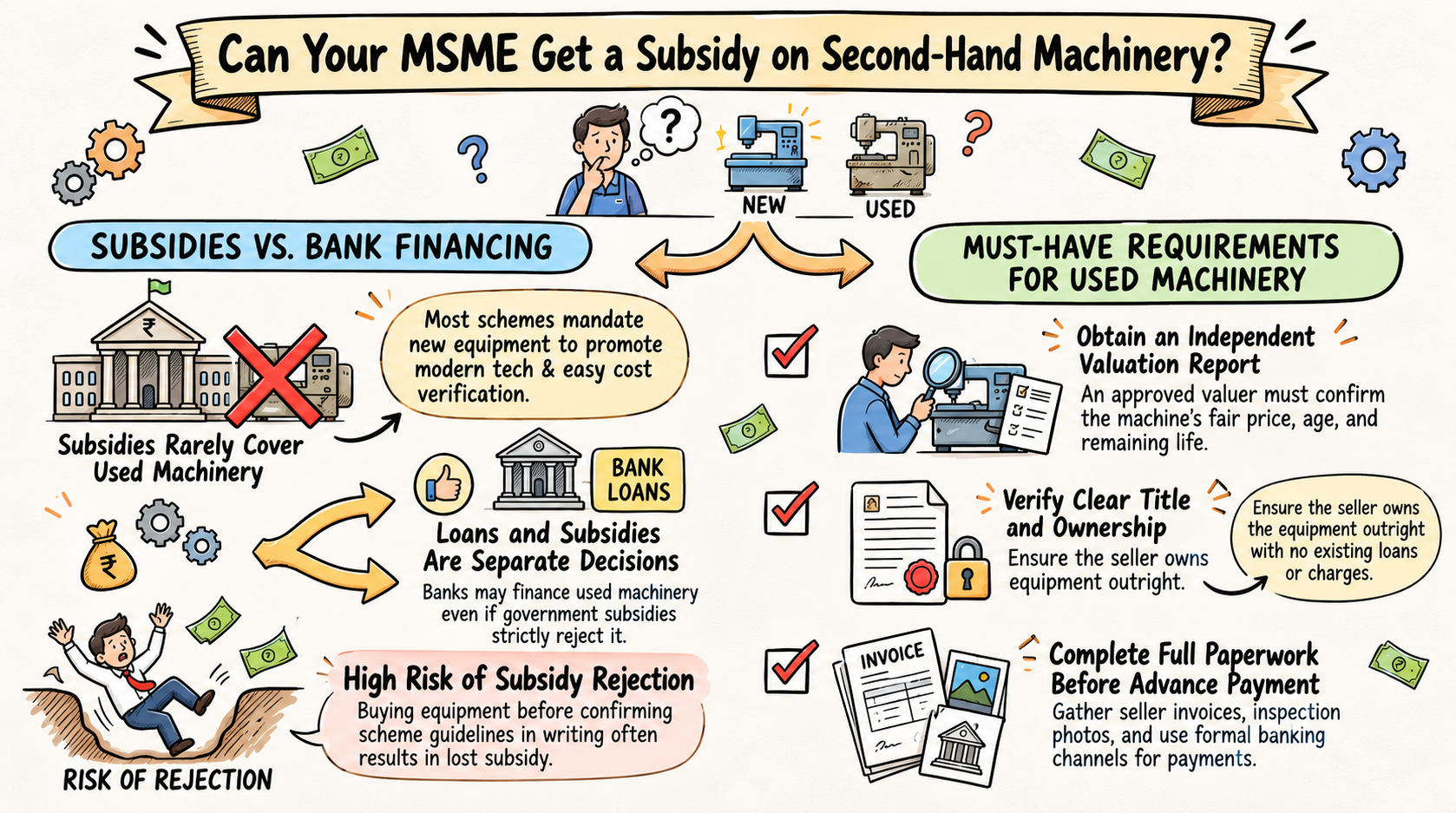
Short answer: Usually it is difficult. Most subsidy schemes prefer or require new machinery, and many do not accept second-hand machinery. A few may allow it under strict conditions, such as valuation and proof of ownership. Always check the current guidelines of your scheme before buying a used machine.
Introduction
New machinery is expensive, and many small businesses look at second-hand machines to save money. A used machine can work well, so it is natural to ask whether a subsidy can be claimed on it.
The problem is that schemes are written with certain goals, such as bringing in modern technology, and they need proper proof of cost and quality. A used machine makes both harder to verify. So many schemes simply exclude it.
At Sharda Associates, we prepare CA-certified project reports and CMA data, and we help MSMEs with bank loan documentation. In this guide, we explain why second-hand machinery is a problem for subsidy, when it may still be considered, and what you should do before buying.
Does a Subsidy Scheme Accept Second-Hand Machinery?
In most cases, no. Many schemes state that the machinery must be new. Some may allow used machinery in limited situations, but this is the exception, not the rule. The guidelines of the specific scheme decide.
- Many schemes: new machinery only
- Some schemes: used machinery with conditions
- Check the current guidelines, because rules can change
Why Do Schemes Usually Prefer New Machinery?
New machinery has a clear invoice, a fixed price, a warranty and up-to-date technology. It is easy to verify. Used machinery has uncertain age, condition and value, which makes it easier to inflate the price or claim a benefit that is not justified.
- Clear price and invoice
- Warranty and after-sales support
- Better technology and efficiency
- Lower risk of inflated values
When Might Second-Hand Machinery Be Considered?
Where a scheme or a bank allows it, it usually comes with extra conditions. These help the lender or agency confirm that the price is fair and the machine is in good condition.
- Independent valuation by an approved valuer
- Proof of ownership by the seller
- Clear title, with no loan or charge on the machine
- Age and remaining life of the machine
- Inspection before sanction or payment
How Do Banks Treat Second-Hand Machinery in a Loan?
Banks may finance second-hand machinery, but they are more careful. They may ask for a valuation, finance a lower share and insist on a clear title. The bank’s treatment can be different from the scheme’s treatment, so the loan may be possible even if the subsidy is not.
- Bank loans and subsidies are separate decisions
- A loan may be sanctioned where the subsidy is not allowed
- Margin may be higher for used machinery
What Documents Are Needed for Used Machinery?
Because verification is harder, the paperwork is heavier. Gather everything before you commit to a purchase.
- Seller’s invoice or sale agreement, with ownership proof
- Valuation report from a qualified valuer
- Details of age, make and model
- Proof that the machine is free from any charge
- Photographs and inspection report
- Payment proof through banking channels
What Are the Risks of Buying Second-Hand Machinery With Subsidy in Mind?
The biggest risk is buying first and finding later that the scheme does not accept it. You may lose the subsidy and have to fund the machine without it. There is also the risk of hidden defects or unclear ownership.
- Subsidy may be rejected after purchase
- Machine condition may be poor
- Seller may not have clear title
- Valuation may be lower than the price paid
Example: A Small Fabrication Unit Considering a Used Lathe
(Illustrative example. Figures and rules are not from any real case.)
A fabrication unit finds a used lathe at a price much lower than a new one. The owner wants to apply for a subsidy and a bank loan. Before paying, he reads the scheme guidelines and finds that it covers only new machinery.
He then asks his branch about financing. The bank says it can consider the used lathe for a loan, but it needs a valuation report, proof of ownership and a higher margin from him. The owner decides to go ahead with the loan only, without counting on the subsidy, and plans his cash flow accordingly.
By checking first, he avoided a surprise after paying the seller.
Conclusion
Subsidy on second-hand machinery is possible only in limited cases, and most schemes prefer new equipment. Even where a bank can finance a used machine, the subsidy may not follow.
Before you buy, check the exact guidelines, speak to the bank and the implementing agency, and get their answers in writing. Do not pay a large advance on the hope that the subsidy will be approved later.
A realistic, CA-certified project report with accurate CMA data helps you compare the cost of new and used machinery honestly. If you need help with scheme eligibility or loan documentation, call or message our team directly. Contact us: +91 89899 77769
FAQs
1. Can an MSME get a subsidy on second-hand machinery?
Usually it is difficult. Many schemes accept only new machinery. A few may allow used machinery with conditions. Check your scheme’s current guidelines and get the agency’s reply in writing before you buy.
2. Why do schemes avoid second-hand machinery?
Used machinery is harder to verify in terms of age, condition and value. New machinery has a clear invoice and warranty. Schemes also aim to promote better technology, which new machinery usually provides.
3. Can I get a bank loan for second-hand machinery?
Possibly. Some banks finance used machinery, but they may ask for a valuation, proof of ownership and a higher margin. The loan decision is separate from the subsidy decision, so ask your branch.
4. Is a valuation report required for used machinery?
Often yes. Banks and agencies commonly want an independent valuation to confirm that the price is fair and the machine is in good working condition. Use a qualified valuer acceptable to the bank.
5. What if the used machine already has a loan on it?
The bank is unlikely to proceed unless the earlier charge is cleared. A clear title is important. Ask the seller for proof that the machine is free from any loan or charge before you pay.
6. Can I import second-hand machinery with a subsidy?
It is generally more complicated, and import rules and scheme conditions apply. Check the scheme guidelines and the applicable import regulations before committing to any purchase of used imported equipment.
7. Should I buy the machine first and apply for subsidy later?
It is risky. Many schemes expect approval before purchase, and used machinery may not be accepted at all. Confirm eligibility in writing first, because you may lose the subsidy if you buy early.
8. How can I reduce the risk when buying used machinery?
Get a valuation, verify ownership, inspect the machine, pay through banking channels and confirm the scheme and bank position in writing. Share all documents with the bank before you pay a large advance.