
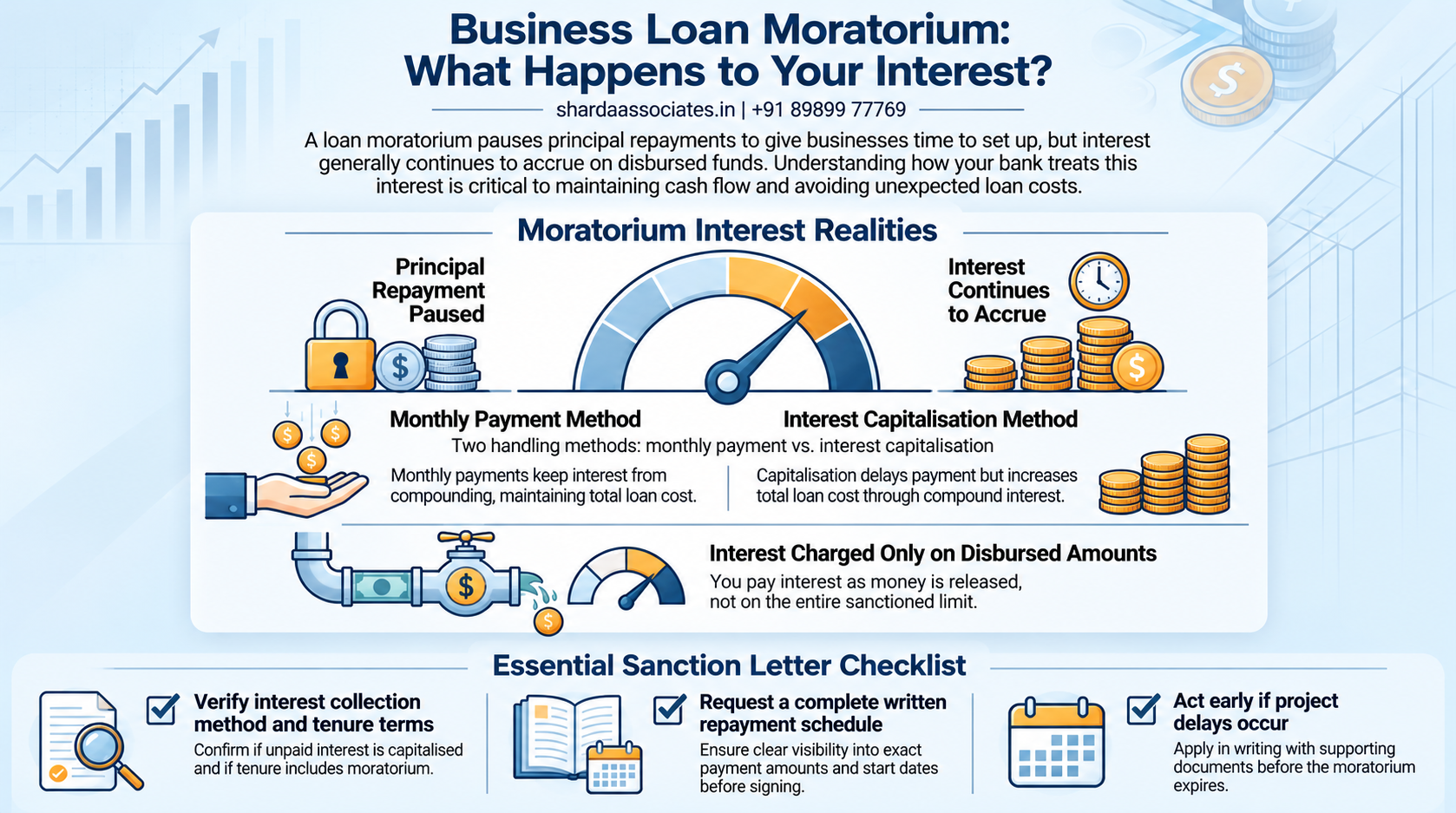
Short answer: In most cases, yes. A moratorium usually pauses the repayment of the principal, not the interest. Whether you pay the interest every month or it gets added to your loan depends on your sanction letter.
Introduction
You get your business loan sanctioned, and the letter says there is a moratorium of a few months. Naturally, the first thought is, “So I don’t have to pay anything until then?” This is one of the most common doubts business owners have, and the answer is not as simple as a yes or no. In most business loans, the moratorium is a break on the principal, not on the interest. The bank has already released money to you or your supplier, and it continues to charge interest on that amount. Many borrowers realise this only when the first interest debit appears in their account, and by then their cash flow plan has already gone wrong.
At Sharda Associates, we prepare CA-certified project reports and CMA data, and we help MSMEs with bank loan documentation. In this guide, we explain in simple words what you pay during a moratorium, how banks usually handle the interest, and what you should check in your sanction letter before you sign.
Do I Have to Pay Interest During the Moratorium?
Usually, yes. The moratorium pauses only the repayment of the amount you borrowed. Interest keeps building on the amount the bank has released, so it is not a payment-free period. What changes is how and when the interest is collected, and that depends on your bank.
- Principal repayment: paused
- Interest: generally continues
- Exact treatment: written in your sanction letter
Will I Pay the Interest Monthly, or Will It Be Added to My Loan?
Banks usually follow one of two methods. In the first, you pay only the interest regularly, so your loan balance does not grow. In the second, the unpaid interest is added to the loan, which makes your cash flow easier now but the loan costlier later.
- Pay regularly: often monthly, the loan balance stays the same
- Added to the loan (capitalisation): no payment now, but you pay interest on interest later
Your loan agreement will say which method applies to you.
Is Interest Charged on the Full Loan or Only on What Is Released?
Generally, interest is charged on the amount actually disbursed, not on the full sanctioned amount. If the bank releases money in parts, your interest will be small at first and will increase as more money is released.
- Advance to the supplier: interest starts on that amount
- Balance on delivery: interest increases after release
- Undisbursed amount: generally no interest
Does a Moratorium Make My Loan Cheaper?
No. A moratorium only delays the principal. If the interest is added to your loan, you end up paying interest on interest, and the total cost goes up. The real benefit is time, because you can install machinery, start production and begin earning before the full instalments start.
- Benefit: time to set up and earn
- Cost: interest continues and may be added to the loan
What Happens If My Project Is Delayed and the Moratorium Ends?
The full repayment schedule begins as per the sanction, even if your unit is not ready. If you can see a delay coming, talk to the bank before the moratorium ends and ask in writing. An extension, if allowed, is at the bank’s discretion.
- Inform the bank early, not after the date
- Give the reason for delay with supporting documents
- Ask for the bank’s decision in writing
What Should I Check in My Sanction Letter?
Before you sign, read the moratorium clause carefully, and ask the branch for a repayment schedule in writing so you can see exactly how much you will pay and when.
- How long the moratorium lasts
- Whether interest must be paid during this period
- Whether unpaid interest is added to the loan
- When the first full instalment starts
- Whether the moratorium is counted inside the total loan tenure
Conclusion
A moratorium gives your business time to set up and start earning, but it does not stop the interest. In most cases the principal is paused while the interest continues, so it should never be treated as a payment-free period.
Before you accept the sanction, find out whether you must pay interest during this time or whether it will be added to your loan. Ask for the repayment schedule in writing, and plan your cash flow for the date your full instalments begin.
A realistic, CA-certified project report with proper cash flow projections helps the bank fix a moratorium that actually suits your business. If you need help understanding your sanction terms or preparing your project report, call or message our team directly. Contact us: +91 89899 77769
FAQs
1. Is interest charged during a moratorium?
Usually yes. A moratorium generally pauses only the repayment of the principal amount. The bank continues to charge interest on the amount it has released, so the period is not completely payment-free. Your sanction letter confirms the exact treatment for your loan.
2. Do I have to pay the interest every month during the moratorium?
It depends on your sanction terms. Some banks collect interest regularly, often monthly, while others add the unpaid interest to the loan balance. Check your loan agreement, and ask the branch to explain the method in writing.
3. What does capitalisation of interest mean?
It means the unpaid interest is added to your loan balance instead of being collected now. This eases your cash flow during the moratorium, but later you pay interest on a larger amount, so the total cost of the loan increases.
4. Is interest charged on the full sanctioned amount?
Generally, no. Interest is usually charged on the amount actually disbursed. If the bank releases money in stages, interest rises as more is released. Confirm this with your bank, because terms can differ between lenders and schemes.
5. Does a moratorium reduce my total interest?
No. It delays the principal repayment but does not remove interest. If unpaid interest is added to the loan, the total interest you pay can increase. The main benefit is time to start your business operations.
6. Can the moratorium period be extended?
Possibly, in genuine cases such as a delay in installation or supplier delivery. It is entirely at the bank’s discretion. Apply in writing before the moratorium ends, with the reason and supporting documents, instead of waiting until the date passes.
7. Is the moratorium included in the total loan tenure?
It depends on how your sanction letter defines the tenure. In some loans the moratorium is part of the total period, and in others it is counted separately. Ask your branch to confirm this clearly before signing.
8. What happens when the moratorium ends?
Regular repayment begins as per the schedule in your sanction, usually with both principal and interest in each instalment. Your monthly outgo rises from this date, so plan your cash flow in advance and ask the bank for the full repayment schedule.