
Quick Answer
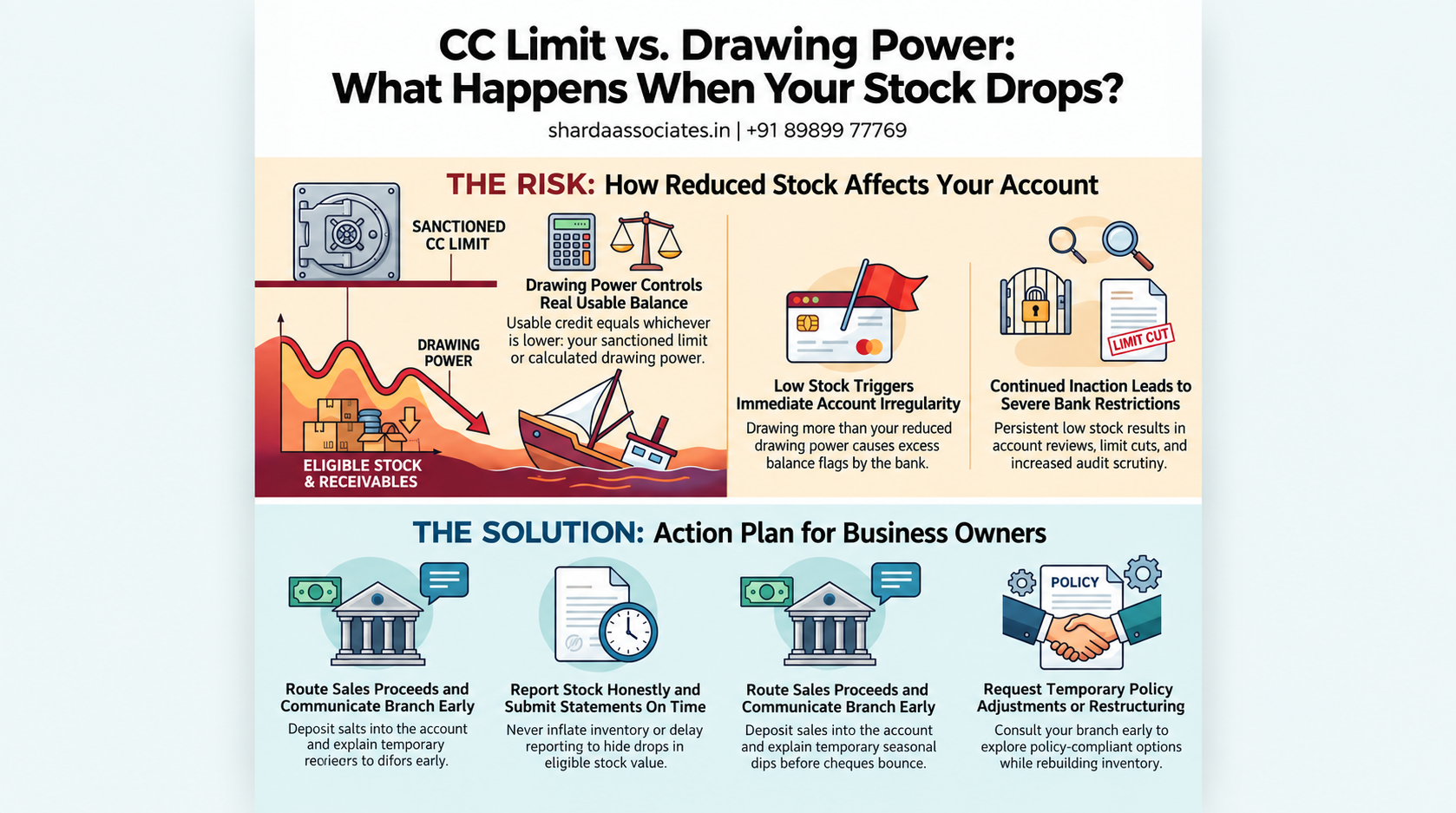
If your stock statement shows less stock and receivables than your cash credit (CC) limit needs, your drawing power falls below the sanctioned limit. You can then withdraw only up to the drawing power, not the full limit. If you have already drawn more than that, the excess can be treated as an irregularity, and the bank may ask you to deposit funds, restrict the account, or review the limit. Exact consequences depend on your sanction terms.
Introduction
A sanctioned CC limit is a ceiling, not a guaranteed balance. What you can actually use depends on the value of your current assets at that point in time. When business slows down or stock is sold off without being replaced, the stock statement shows a lower value, and the usable amount shrinks. Many owners notice this only when a check bounces or a withdrawal is refused. Knowing how the calculation works lets you plan ahead.
At Sharda Associates, we prepare CA-certified project reports, CMA data, and DPRs and handle bank documentation for MSME and government scheme loans. This guide explains what happens when the stock statement is lower than the limit and how to handle it.
Limit vs Drawing Power
| Term | Meaning |
| Sanctioned limit | The maximum the bank has approved |
| Drawing power | The amount you can withdraw based on eligible stock and receivables, after margin |
| Usable amount | Generally the lower of the two |
If the statement lowers your drawing power, the usable amount falls with it, even though the sanctioned limit stays the same.
What Can Happen
- Reduced drawing. The bank allows withdrawals only up to the new drawing power.
- Excess overdrawing power. If your outstanding balance is already higher, the excess may be flagged. The bank may ask you to bring in funds or reduce the balance.
- Account classification issues. Continued irregularity can affect how the account is classified, as per the bank’s and regulatory norms.
- Review of the limit. If low stock continues, the bank may question whether the limit is still justified.
- Closer monitoring. The bank may ask for more frequent statements, inspections, or a stock audit.
How strictly each step is applied depends on the bank’s policy and your agreement.
Common Reasons the Statement Shows Lower Stock
- Seasonal or slow sales
- Stock sold but not replaced due to cash shortage
- Old or damaged stock excluded from eligible value
- Receivables overdue and not counted
- Creditors rising, reducing eligible stock
- Diversion of funds away from the business
- Wrong or incomplete reporting
Example: A Hardware Trader
A hardware trader has a CC limit, but after a slow season his stock is much lower. His statement reduces his drawing power below his outstanding balance. The bank asks him to regularize the excess.
He explains the seasonal dip, deposits part of the sale proceeds into the account, and rebuilds stock gradually. The bank sees the account returning to normal and does not escalate.
Had he ignored the notice, the account might have attracted stricter action.
What You Should Not Do
- Inflate stock to protect the drawing power
- Submit the statement late to avoid showing the drop
- Ignore the bank’s calls or notices
- Divert CC funds to non-business use
- Wait until the account becomes irregular before speaking to the branch
What to Do If Your Stock Is Low
- Check your drawing power against your outstanding balance.
- Submit the statement honestly and on time.
- Route sale proceeds through the CC account.
- Speak to the branch early and explain the reason.
- Ask whether temporary adjustment or restructuring is possible under bank policy.
- Rebuild stock as cash flow improves.
- Reconsider the limit if your actual business needs are lower.
Conclusion
A lower stock statement does not cancel your CC limit, but it reduces the amount you can use. The sanctioned limit is a cap, while drawing power decides what you can actually withdraw.
Report your stock honestly, keep sales flowing through the account, and speak to the branch before the account turns irregular. Early communication usually works better than silence.
If you need help with stock statements, drawing power, or CC documentation, call or message our team directly.
FAQs
Q1. What happens if my stock statement is lower than the CC limit?
Your drawing power drops, and you can withdraw only up to it, not the full sanctioned limit.
Q2. Can the bank reduce my CC limit if stock is low?
It may review the limit if low stock continues. This depends on the bank’s policy and sanction terms.
Q3. What if I have already drawn more than the drawing power?
The excess may be treated as an irregularity, and the bank can ask you to regularize it.
Q4. Is it wrong to show lower stock honestly?
No. Accurate reporting is expected. Overstating stock is the real risk.
Q5. Does low stock affect my credit record?
Continued irregularity in the account can affect how it is classified and reported. Speak to your bank early.
Q6. Can I request a temporary solution?
You can ask the branch. Whether anything is offered depends on the bank’s policy and your account history.
Q7. Can I increase my drawing power if my stock increases later?
Yes. If your eligible stock increases and the bank accepts the updated stock statement, your drawing power may be revised accordingly.
Q8. Does receivables value also affect drawing power?
Yes. Depending on the bank’s terms, eligible book debts or receivables may also be considered while calculating the drawing power.
Q9. How often should I submit a stock statement to the bank?
The frequency depends on the sanction terms and bank policy. Many CC accounts require regular stock statements, often monthly.
Q10. What documents are needed to support the stock statement?
The bank may ask for stock records, purchase and sales details, invoices, inventory statements, and other supporting documents to verify the reported figures.