
Quick Answer
A moratorium is a period after the MSME term loan is sanctioned during which you do not have to repay the principal. It is meant to give a new or expanding unit time to set up machinery and start earning. Interest usually still accrues during this period, and many banks collect it periodically or add it to the loan, depending on the sanction terms. After the moratorium ends, regular repayment of principal begins. Length and conditions vary by bank and scheme.
Introduction
Setting up a unit takes time. Machinery has to be bought, installed and tested, and sales take time to build. Repaying full instalments from the first month would strain a new business. A moratorium gives breathing space, but it is often misunderstood. Many borrowers think it means “no payment at all.” In most cases, it only pauses the principal. At Sharda Associates, we prepare CA-certified project reports, CMA data, and DPRs and handle bank documentation for MSME and government scheme loans. This guide explains how a moratorium works, how it affects your repayment, and what to check in your sanction letter.
What a Moratorium Means
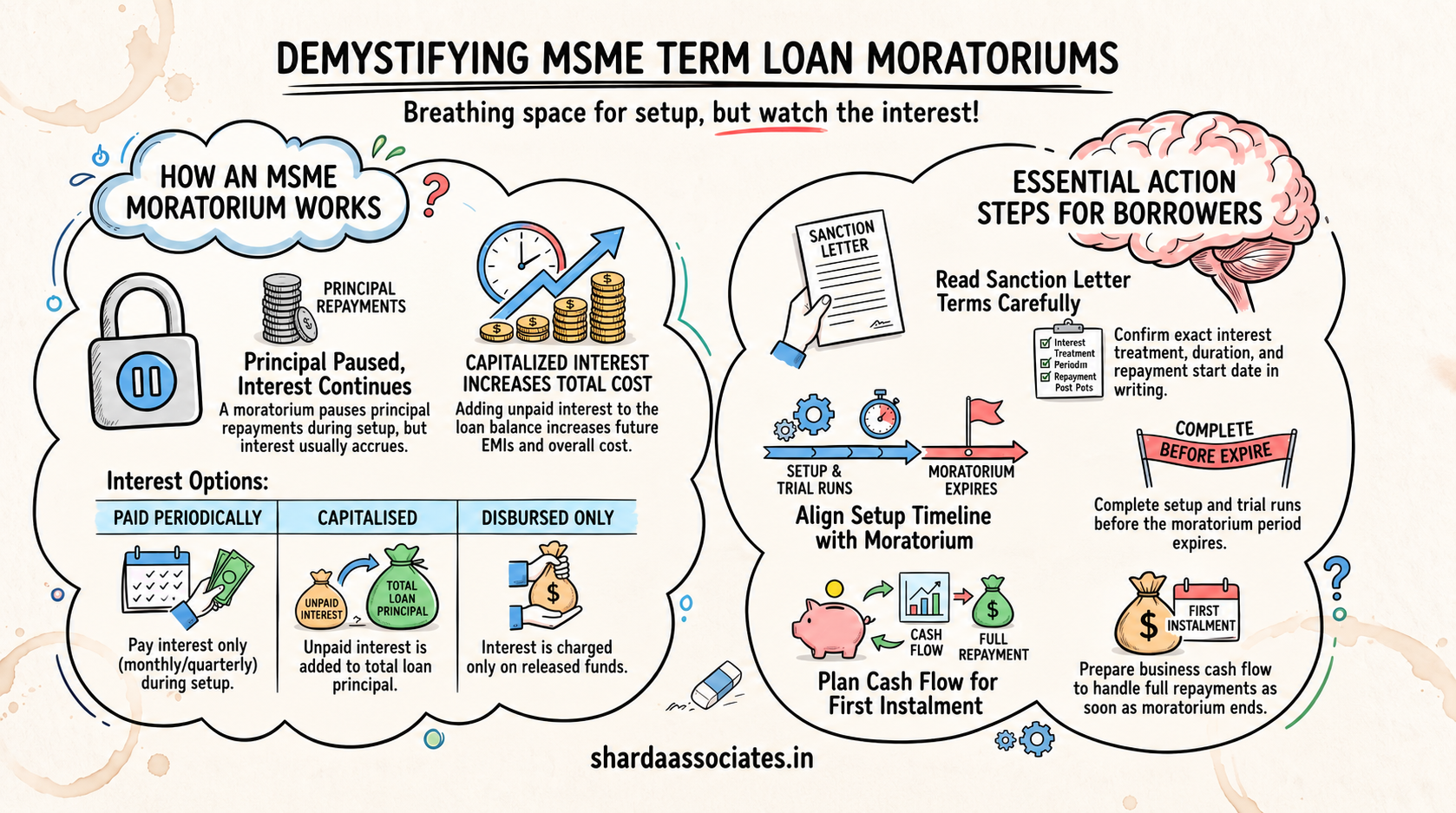
- Principal: not repayable during the moratorium.
- Interest: generally continues to accrue.
- Repayment schedule: starts after the moratorium ends.
Whether interest is paid monthly during this period or added to the loan depends on the sanction terms.
How the Period Is Usually Decided
The moratorium is normally linked to the project: the time needed for installation, trial runs and commercial production. Your project report should show a realistic implementation schedule and cash flow, so the bank can fix a period that fits. The exact duration is set by the bank or scheme and mentioned in your sanction letter.
Interest During the Moratorium
| Possibility | What it means |
| Interest paid periodically | You pay interest only, often monthly or quarterly |
| Interest capitalised | Unpaid interest is added to the loan balance |
| Interest on disbursed amount only | Interest is charged on what has actually been released |
Which option applies depends on the sanction terms. Ask your branch to explain it in writing.
Effect on Total Cost and Instalments
A moratorium delays principal repayment, but it does not make the loan free. If interest is added to the loan, the outstanding amount can rise, which may increase later instalments or the total interest paid. Ask the bank to share the repayment schedule so you can see the effect clearly.
Moratorium Is Not the Same as Repayment Holiday for Everyone
Some loans under government schemes may have specific moratorium rules set by the scheme. A moratorium given at sanction for a new project is different from a relief given later to an existing borrower under a special policy. Do not assume one applies to the other.
Example: A New Bakery Unit
(Illustrative example, figures are not from any real case)
A bakery sets up a new unit with a term loan for ovens and mixers. The sanction letter provides a moratorium on principal while the unit is installed and begins production. During this time, the owner pays interest on the amount disbursed.
Once the moratorium ends, the bank starts regular instalments of principal and interest as per the repayment schedule. Because the owner planned cash flow for this date, the first instalment does not come as a surprise.
Mistakes to Avoid
- Assuming no payment is due during the moratorium
- Not checking whether interest is payable or capitalised
- Delays in installation that run past the moratorium
- Not planning cash flow for the first instalment
- Ignoring the repayment schedule shared by the bank
- Assuming the period can be extended automatically
Practical Steps
- Read the moratorium clause in your sanction letter.
- Confirm how interest will be treated during the period.
- Ask for the repayment schedule in writing.
- Plan your project timeline to finish within the moratorium.
- Build cash flow for the first instalment.
- If delays occur, inform the bank early and ask in writing.
Conclusion
A moratorium gives a new MSME unit time to start earning before principal repayment begins, but it does not remove the cost of borrowing. Interest usually continues, and the repayment schedule begins once the period ends.
Read your sanction letter, understand how interest is treated, and plan your cash flow for the first instalment. If your project is delayed, speak to the bank before the moratorium ends.
A realistic, CA-certified project report with proper cash flow projections helps in fixing a suitable moratorium. If you need help with your project report, CMA data, or repayment planning, call or message our team directly.
FAQs
Q1. What is a moratorium in an MSME term loan?
It is a period during which you do not repay the principal, so your unit can start operations first.
Q2. Do I pay interest during the moratorium?
Usually, interest still accrues. Whether you pay it or it is added to the loan depends on your sanction terms.
Q3. How long is the moratorium?
It varies by bank, scheme, and project. Check your sanction letter for the exact moratorium period.
Q4. Can the moratorium be extended?
It may be considered in genuine cases, at the bank’s discretion. Ask in writing before the existing moratorium ends.
Q5. Does the moratorium reduce the total interest?
No. It delays principal repayment, and the total cost may even rise if interest is capitalised.
Q6. Is the moratorium counted in the loan tenure?
It depends on how the sanction defines the tenure. Confirm this with your branch.
Q7. Can I repay the loan during the moratorium period?
You may be able to make repayments during the moratorium, subject to your loan terms and the bank’s applicable conditions.
Q8. What happens if I cannot pay the interest during the moratorium?
If interest is not paid, the bank may capitalize it or add it to the outstanding loan amount, depending on the sanction terms.
Q9. Does a moratorium affect my EMI after it ends?
It can. If accrued interest is added to the outstanding principal, the EMI or repayment schedule may be higher after the moratorium.
Q10. When should an MSME request a moratorium?
A moratorium is generally useful when a new project needs time to become operational and start generating sufficient cash flow for regular repayments.