
Quick Answer
For a new business, banks usually decide the first cash credit limit from the projected working capital requirement in your project report and CMA data, not from past sales. The bank checks how much money is blocked in stock, raw material, and customer credit, deducts your margin money and supplier credit, and sanctions a limit within that gap. Many banks use a turnover-based method for small limits, but each bank follows its own policy, so your sanction letter is the final reference.
Introduction
When a business has no history, the first CC limit can feel like a guess. In reality, banks follow a fairly structured logic. They estimate how much cash your business needs to run from buying material to collecting payment and then decide how much of that gap they will fund.
Knowing this logic helps you prepare better numbers. A limit requested without any working capital calculation is often cut down or questioned.
At Sharda Associates, we prepare CA-certified project reports, CMA data, and DPRs and handle bank documentation for MSME and government scheme loans. This guide explains how banks usually arrive at the first limit and what you can do to support it.
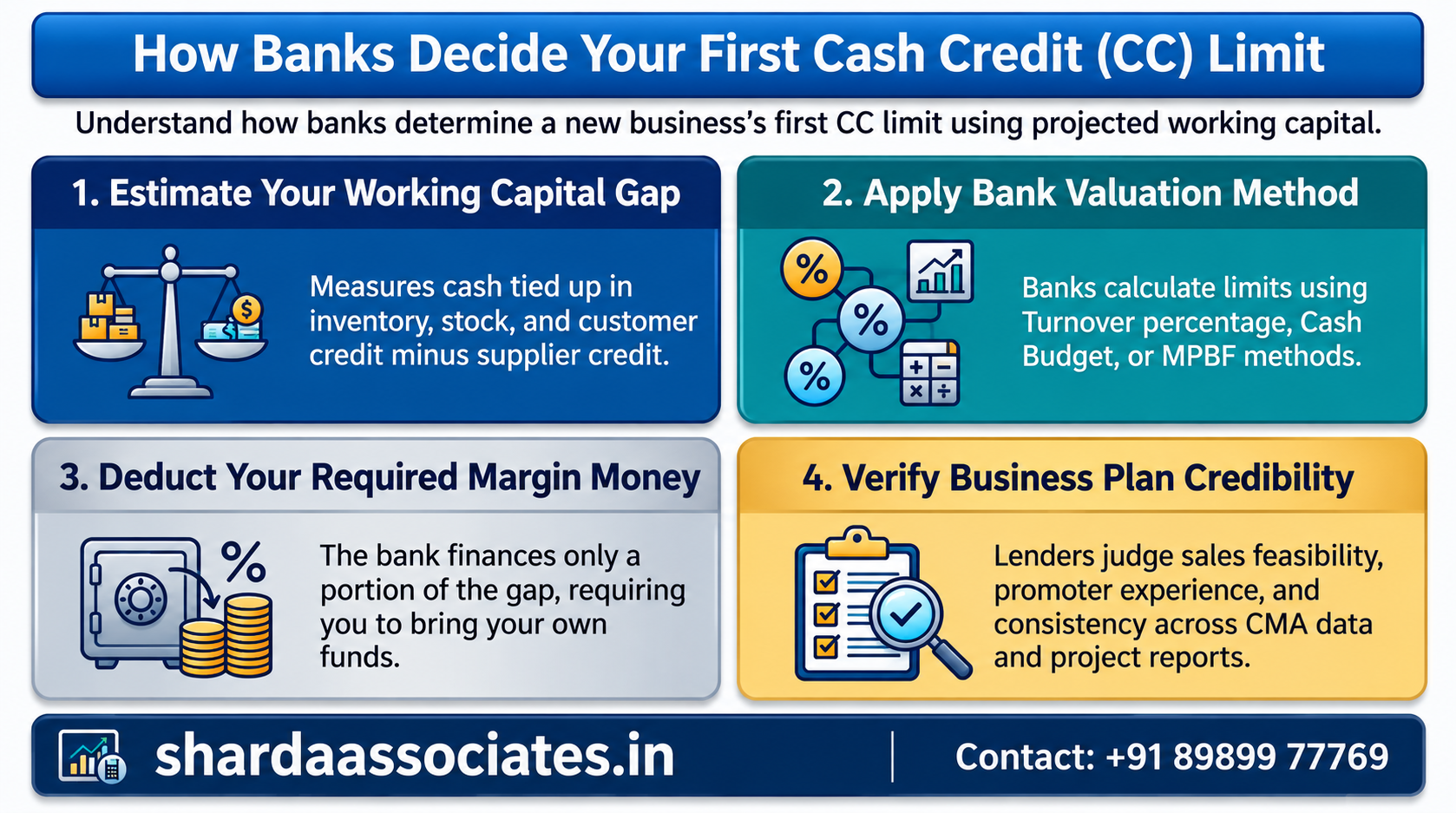
Step 1: The Bank Estimates Your Working Capital Gap
The starting point is the operating cycle: how long raw material is held, how long production takes, how long finished goods stay in stock, and how long customers take to pay. A longer cycle means more money is blocked, so a larger working capital need.
Step 2: The Bank Applies an Assessment Method
Banks may use different methods depending on the size of the limit and their policy:
| Method | Basic idea |
| Turnover method | Working capital need is taken as a share of projected annual turnover; commonly used for smaller limits |
| Cash budget or operating cycle method | Need is worked out from the cash cycle and projected cash flows |
| Maximum Permissible Bank Finance (MPBF) | Bank finance is limited after the borrower’s own contribution toward current assets |
Under the turnover method, many banks take a fixed share of projected turnover as the requirement, with the borrower bringing a smaller part as margin and the bank financing the rest. The exact percentages depend on the bank’s policy, so ask your branch which method applies to you.
Step 3: Your Margin Money Is Deducted
The bank does not fund the full gap. You are expected to contribute part of it from your own funds, and the limit covers the rest. A higher margin often gives the bank more comfort.
Step 4: The Bank Checks the Quality of the Proposal
Beyond the formula, the bank studies:
- Whether projected sales are realistic for the capacity and market
- Your experience in the same or related business
- Confirmed orders, buyer tie-ups or supplier credit terms
- Consistency between the project report, CMA data and other documents
- Security offered and any guarantee cover available
- Your personal credit record
Why the First Cash Credit Limit Is Often Modest
Banks usually prefer to start cautiously and review once actual figures appear. A limit that begins smaller can be enhanced later if the account is run well and sales are routed through it. This is the bank’s discretion.
Example: A New Plastic Moulding Unit
A promoter with prior factory experience sets up a small moulding unit. His project report shows expected production in the first year, one month of raw material stock, a short credit period to buyers, and his own margin contribution.
The bank compares these with its assessment method, adjusts for margin and supplier credit, and sanctions a limit that is lower than what he first asked for. It also notes that the limit will be reviewed after the account shows real turnover.
Mistakes That Lead to a Lower Limit
- Asking for a limit without a working capital calculation
- Overstating sales with no orders or market support
- Assuming very long supplier credit that suppliers have not confirmed
- Inconsistent figures across documents
- Keeping too little margin money
- Not mentioning the real credit period given to customers
How to Prepare
- Work out your operating cycle honestly.
- Prepare CMA data that matches the project report.
- Keep margin money ready.
- Gather orders, quotations or letters of intent.
- Ask the branch which assessment method it uses.
- Plan to route sales and purchases through the account after sanction.
Conclusion
The first CC limit for a new business is built on projections, not history. Banks estimate your working capital gap, apply their assessment method, deduct your margin and then judge how believable your plan is.
Ask for a limit that matches your real operating cycle. Keep your numbers consistent and your documents ready, and be prepared for a modest start that grows with good account performance.
A well-prepared, CA-certified project report with accurate CMA data makes this assessment easier. If you need help with your working capital calculation, CMA data or bank documentation, call or message our team directly.
Frequently Asked Questions
1. How do banks decide the first CC limit for a new business?
Banks mainly assess the projected working capital requirement shown in the project report and CMA data, after considering margin money, supplier credit, and other available sources of funds.
2. Is the CC limit based on turnover?
For smaller working capital limits, many banks may use a turnover-based method. However, the exact calculation depends on the bank’s policy, business type, projected turnover, and financial requirements.
3. Why is my first CC limit lower than I asked?
Banks often take a cautious approach when a business has no previous banking or financial track record. The sanctioned limit may be lower initially and can be reviewed later based on performance.
4. Does margin money affect the CC limit?
Yes. Margin money affects the amount the bank finances. The borrower is generally expected to contribute a certain portion of the working capital requirement, while the bank finances the eligible balance.
5. Can the first CC limit be increased?
Yes, a CC limit may be enhanced after the business demonstrates satisfactory turnover, regular account conduct, repayment capacity, and proper utilization of the existing limit. Enhancement remains subject to the bank’s assessment.
6. Do I need a CA-certified project report?
Requirements vary depending on the bank, loan amount, and business profile. A professionally prepared and appropriately certified project report can strengthen the loan proposal and present financial projections clearly.
7. What documents are required to apply for a first CC limit?
Banks may ask for KYC documents, business registration documents, GST and ITR records where applicable, bank statements, project reports, CMA data, financial projections, quotations, and details of the promoter’s contribution.
8. Does projected turnover affect the first CC limit?
Yes. Projected turnover can influence the assessment of working capital requirements, particularly when the bank follows a turnover-based approach. The bank also considers margins, operating cycle, stock, receivables, and business risk.
9. How does CMA data help in getting a CC limit?
CMA data presents the business’s projected financial position, working capital requirements, operating performance, and repayment capacity. Banks use this information to evaluate whether the requested CC limit is reasonable.
10. Can a new business get a CC limit without previous turnover?
A new business can potentially obtain a CC facility based on its business plan, project cost, projected sales, promoter contribution, working capital requirement, and other financial information. Approval depends on the bank’s credit assessment.