
Quick Answer
Yes, it is possible, but not easy. A cash credit (CC) limit is normally sanctioned on the basis of stock, receivables and turnover. A new business has no past turnover, so the bank relies on projected figures in your project report, your promoter background, margin money and security. Many banks sanction a smaller limit at first and review it after the business shows actual performance. Your bank’s policy and scheme rules are the final reference.
Introduction
For most running businesses, the cash credit limit is calculated on past sales and the stock and debtors on the books. A new business has none of this. Owners often hear “no turnover, no limit” at the first branch they visit and give up.
In practice, banks can and do sanction working capital to new units, especially along with a term loan for a new project. The difference is that the bank assesses the limit on projections rather than history. Those projections must be realistic, supported by evidence and presented in a proper format.
At Sharda Associates, we prepare CA-certified project reports, CMA data and DPRs, and handle bank documentation for MSME and government scheme loans. This guide explains how banks assess a CC limit for a new business, what they look at, and how to improve your chances.
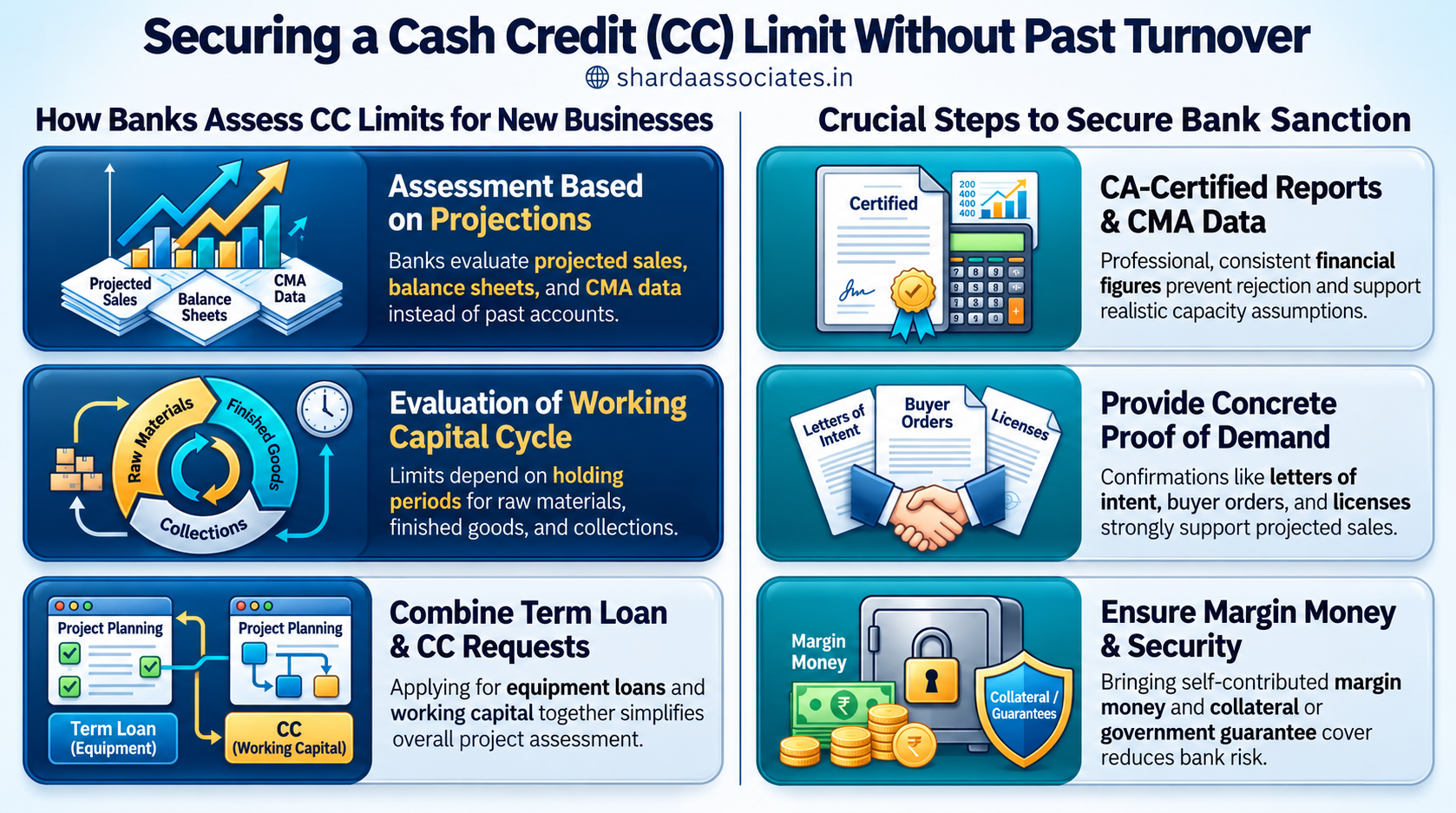
How Banks Assess a cash credit Limit Without Past Turnover
Since there are no past accounts, the bank studies:
- Projected sales and production for the first year, with the assumptions behind them
- Working capital cycle: how long raw material, finished goods and debtors stay before cash comes back
- Projected balance sheet and CMA data, showing the funding of working capital
- Your margin contribution toward the working capital requirement
- Promoter experience in the same or a related line
- Market demand, orders, tie-ups or letters of intent, if any
- Security and guarantees offered
The limit is generally linked to the projected working capital gap, with the borrower bringing part of it as margin. The exact method depends on the bank’s policy and the type of facility.
Role of the Project Report and CMA Data
For a new business, the project report is the main evidence. A weak or unrealistic report is one of the most common reasons for rejection or a reduced limit.
A good report usually shows:
- Clear description of the product, process and target customers
- Capacity and realistic capacity utilisation in the early years
- Cost of project and means of finance
- Working capital assessment with stock and credit period assumptions
- Projected profitability and repayment capacity
CMA data presents these figures in the format banks commonly use for working capital assessment. Numbers must be consistent across the report, CMA data and your supporting documents.
What Else Can Support Your Application
| Support | Why it helps |
| Prior experience in the same industry | Shows you understand the business |
| Confirmed orders or purchase intent | Supports projected sales |
| Supplier credit terms in writing | Supports the working capital cycle |
| Higher margin money | Reduces the bank’s risk |
| Collateral or third-party guarantee | Strengthens security |
| Government guarantee cover, where eligible | May reduce the need for collateral |
| Udyam registration and required licences | Shows compliance |
Eligibility for any guarantee scheme depends on the scheme’s current rules, so check them before relying on it.
Term Loan with Cash Credit Limit Together
A new unit often applies for a term loan and a working capital limit in the same proposal. Banks can then assess the whole project, from machinery to raw material to sales, in one go. The working capital requirement is built into the project report rather than treated as a separate request. This is often easier than approaching a bank later with no track record.
Example: A New Food Processing Unit
A promoter with experience in a food processing company starts her own small unit. There is no turnover yet. She applies for a term loan for machinery and a cash credit limit for raw material and packaging.
Her project report shows expected capacity use in the first year, supplier credit terms, the time taken to sell and collect payment, and a letter of intent from a regular buyer. The CMA data sets out the working capital gap and her margin contribution.
The bank sanctions a cash credit limit based on these projections, with a review planned once actual figures are available. The limit is based on the evidence she provided, not on past sales.
Common Mistakes to Avoid
- Overstating sales projections without supporting orders or market data
- Applying for a cash credit limit far above what the working capital cycle justifies
- Submitting a project report and CMA data with inconsistent figures
- Ignoring the margin money required for working capital
- Using the limit for long-term needs such as buying machinery
- Mixing personal and business transactions
- Not routing sales and purchases through the bank account once the limit is sanctioned
Steps to Improve Your Chances
- Prepare a realistic, detailed project report with clear assumptions.
- Calculate working capital based on your actual cycle of stock, production and collection.
- Arrange margin money before applying.
- Collect proof of demand, such as orders, quotations or letters of intent.
- Complete Udyam registration, GST and any required licences.
- Apply for the term loan and working capital together if both are needed.
- Maintain a clean personal credit record.
- Once sanctioned, run your business transactions through the account so the bank can review the limit later.
Conclusion
A new business can get a cash credit limit even without previous turnover, but the bank needs strong evidence in its place. Realistic projections, a well-reasoned working capital cycle, promoter experience and proper margin money all help the bank trust the numbers. Do not ask for a limit larger than your business cycle justifies. Keep your project report, CMA data and supporting documents consistent, and be ready for a smaller starting limit that grows after the bank sees how your account performs.
A well-prepared, CA-certified project report with accurate CMA data makes the bank’s assessment easier and improves your chances of approval. If you need help with your project report, CMA data or bank documentation, call or message our team directly. Contact us: +91 89899 77769
FAQs
Q1. Can a new business get a cash credit limit?
Yes, it is possible. Banks assess it on projected figures, promoter background, margin money and security instead of past turnover.
Q2. How is the cash credit limit decided for a new business?
It is generally linked to the projected working capital requirement, with part funded by your margin. The exact method depends on the bank.
Q3. Is collateral required for a cash credit limit for a new business?
Banks usually ask for security. For eligible small units, some guarantee schemes may reduce the need for collateral. Check the current scheme rules.
Q4. What documents are needed for a cash credit limit without turnover?
Typically a project report, CMA data, KYC, Udyam registration, GST registration where applicable, and proof of demand or orders. Your bank will confirm the list.
Q5. Is a CA-certified project report mandatory?
Requirements vary by bank and loan size. A professionally prepared and CA-certified report strengthens the application.
Q6. Can I get a cash credit limit and a term loan together?
Yes. Many new units apply for both in a single proposal.
Q7. Will the bank increase the limit later?
It can review the limit once the business shows actual turnover and good account conduct. This is at the bank’s discretion.
Q8. Why do banks reject cash credit limits for new businesses?
Common reasons are unrealistic projections, inconsistent figures, low margin contribution, weak security or limited experience.