
GST Notice for Excess ITC Claim: How to Reply and Correct It
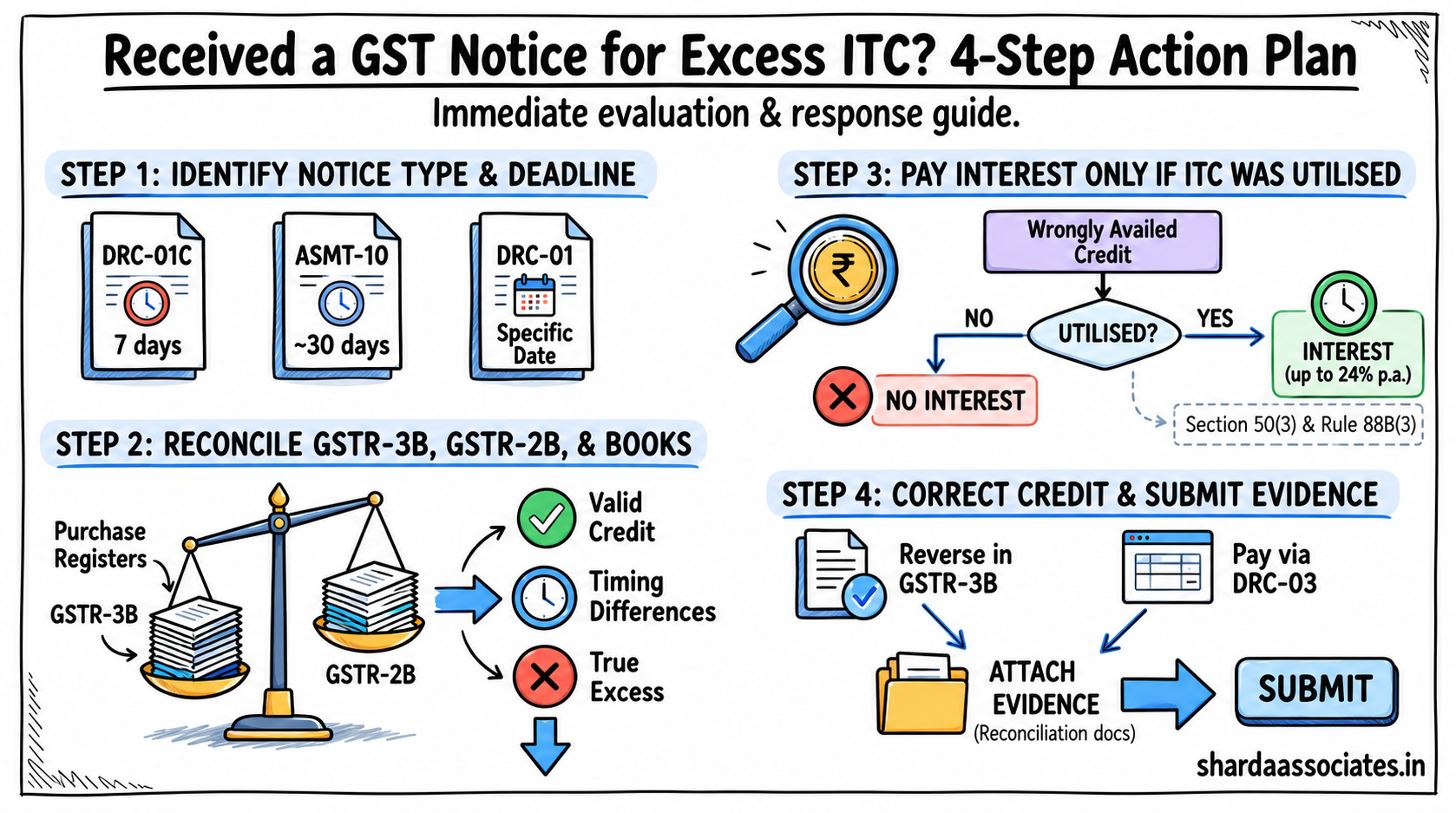
Short answer: First identify the form: DRC-01C (intimation, 7 days), ASMT-10 (scrutiny, reply in ASMT-11), or a show cause notice. Then reconcile the ITC with GSTR-2B and your books, separate valid items from excess, and either explain with documents or correct the excess through payment or reversal. Interest under Section 50(3) applies to ITC wrongly availed and utilized, so check whether the excess credit was actually used.
An excess ITC notice can look alarming because it talks about tax, interest, and sometimes penalties. In practice, the first job is calm and procedural: read the form, note the reply date, and find out exactly which invoices or period are being questioned.
Sharda Associates is a CA-led firm that has prepared over 45,500 CA-certified reports. GST and ITC figures are cross-checked by banks during loan appraisal, so a clean, documented reply helps beyond the notice itself.
This guide explains the forms, how to correct an excess claim, how interest works, and how to build the reply. It is general information. Always follow the dates and instructions in your own notice and consult a CA for your facts.
Which Notice Have You Received?
| Form | What it is | Where to reply | Time |
| DRC-01C | System intimation when ITC in GSTR-3B exceeds GSTR-2B | Part B of DRC-01C | 7 days |
| ASMT-10 | Scrutiny notice listing discrepancies | ASMT-11 | Generally 30 days, extendable |
| Show cause notice (DRC-01). | Proposal to demand tax, interest and penalty | DRC-06 | As stated in the notice |
What Counts as Excess ITC?
Excess ITC is credit claimed that is not supported by the conditions of the Act. Typical cases are invoices not reflected in GSTR-2B, blocked credits under Section 17(5), duplicate claims, claims on a wrong invoice or period, and credit not reversed when it should have been.
How Can You Correct an Excess ITC Claim?
Depending on the facts, there are two practical routes. You can reverse the excess in a later GSTR-3B, or pay it voluntarily through Form DRC-03 and report the payment in your reply. Voluntary payment can be made before a show cause notice or within 30 days of it. Choose the route that matches your notice and your records, and confirm it with a CA before you act.
How Does Interest Work on Excess ITC?
Section 50(3) charges interest, at a rate not exceeding 24% per annum, on ITC that was wrongly availed and utilized. Rule 88B(3) looks at the balance in your electronic credit ledger to decide utilization. The Finance Act 2022 made this change with effect from 1 July 2017. If the ledger had enough balance and the excess was never used, interest may not arise, but the position depends on facts, so compute it carefully.
How Do You Build the Reply?
- Note the form, the period, and the reply date.
- List each invoice or amount in the notice.
- Reconcile with GSTR-2B and your purchase register.
- Classify each line as valid, timing, or excess.
- Compute interest only on the excess that was utilized.
- Attach evidence: invoices, payment proof, supplier correspondence, and a reconciliation statement.
- File the reply in the correct form within time and keep the acknowledgement.
What If the GST Notice Alleges Fraud or Suppression?
Sections 73 and 74 of the CGST Act distinguish cases without and with fraud, wilful misstatement, or suppression, and the consequences differ. If your notice says so, get professional help before replying, since the wording of your reply matters.
How Do You Know If Excess ITC Was Utilised?
Rule 88B(3) treats wrongly availed credit as utilised when the balance in your electronic credit ledger falls below the amount of that credit, and only to the extent of the fall. Here is an illustration with made-up figures. You wrongly availed ₹100,000. If your ledger balance never fell below ₹1,00,000, the excess is generally treated as not utilised.
If on 20 July the balance fell to ₹60,000 because you paid tax from the ledger, ₹40,000 is treated as utilised from that date, and interest under Section 50(3), at a rate not exceeding 24% per annum, applies on that amount until the reversal. Courts have also held that where the ledger balance was sufficient, interest is not payable, so keep a ledger extract with your reply.
What Documents Should Go with Your Reply?
- The reconciliation of GSTR-3B ITC with GSTR-2B and your purchase register
- Copies of the invoices in question and proof of payment
- Ledger extracts showing the credit ledger balance by date
- Proof of any voluntary payment or reversal, such as the DRC-03 acknowledgement
- Correspondence with suppliers, where the issue is a supplier default
How Should the Reply Be Structured?
Open with the notice number, date and period. State the facts briefly. Present the reconciliation and say which items you accept as excess and which you explain. Show the correction and the interest, if any. Close with a request that the proceedings be dropped on the basis of your reply, and list the attachments. A reply that is brief, numbered and supported with documents is easier for an officer to accept than a long narrative.
Conclusion
An excess ITC notice is a request to explain or correct, and most of the work is a clean reconciliation done early. Separating valid credit from excess, computing interest properly and attaching documents usually decides how smoothly the matter closes.
Acting before a show cause notice gives you more options, including voluntary payment. Leaving it to the last day leaves fewer.
If you have a notice open, call Sharda Associates on +91 89899 77769 to discuss the reconciliation. Outcomes depend on the facts, so no result can be promised.
Frequently Asked Questions
1. What is excess ITC?
Credit claimed that is not supported by the conditions of the Act, such as an invoice not reflected in GSTR-2B or a blocked credit.
2. How long do I have to reply?
It depends on the form: 7 days for DRC-01C, generally 30 days for ASMT-10, and the date stated in a show cause notice.
3. Can I pay voluntarily to avoid a notice?
Voluntary payment through DRC-03 can be made before a show cause notice or within 30 days of it.
4. Is interest payable even if I reverse the ITC?
Section 50(3) applies to ITC wrongly availed and utilised. If it was not utilised, interest may not arise, but check the ledger position.
5. What rate of interest applies?
Section 50(3) provides a rate not exceeding 24% per annum for wrongly availed and utilised ITC.
6. What if my supplier did not file?
Explain it with documents, and consider reversing until the invoice appears within the Section 16 time limit.
7. Do I need a CA to reply?
Not for a simple case, but for show cause notices or larger amounts, professional help is advisable.