
Short answer: Banks most often query or return CMA data because the figures do not match the ITR, GST returns, or audited accounts; the statements do not tie to each other, the working capital limit (MPBF) is calculated by the wrong method; or the projections and format do not suit the bank. All 10 mistakes are explained below, each with a fix.
When a bank sends your CMA data back, it rarely says “the numbers are wrong.” The file comes back with a short query, a request to revise a form, or a silent delay that stretches a working capital limit from days into weeks. The loan itself may be perfectly sound. What failed was the document that is supposed to prove it.
Sharda Associates is a CA-led firm that has prepared over 45,500 CA-certified reports, including CMA data and project reports accepted by SBI, PNB, Bank of Baroda and other scheduled banks. In that work we also see the other side: files prepared elsewhere, or by the business itself, that come to us after a bank has already flagged them. The same mistakes repeat, and almost all of them can be caught before submission.
What Is CMA Data, and What Do Banks Check in It?
CMA stands for Credit Monitoring Arrangement. It is a standard set of statements, covering past performance, projections, current assets and liabilities, the working capital assessment, and a funds flow statement, that a lender uses to judge how much working capital finance a business needs and can service. The framework traces back to the Tandon Committee in the 1970s. Banks use it to check three things: do the numbers tie together, are the projections believable, and is the requested limit calculated the way the bank’s own policy requires.
Every mistake below fails one of those three tests.
Which CMA Mistakes Come from the Numbers Themselves?
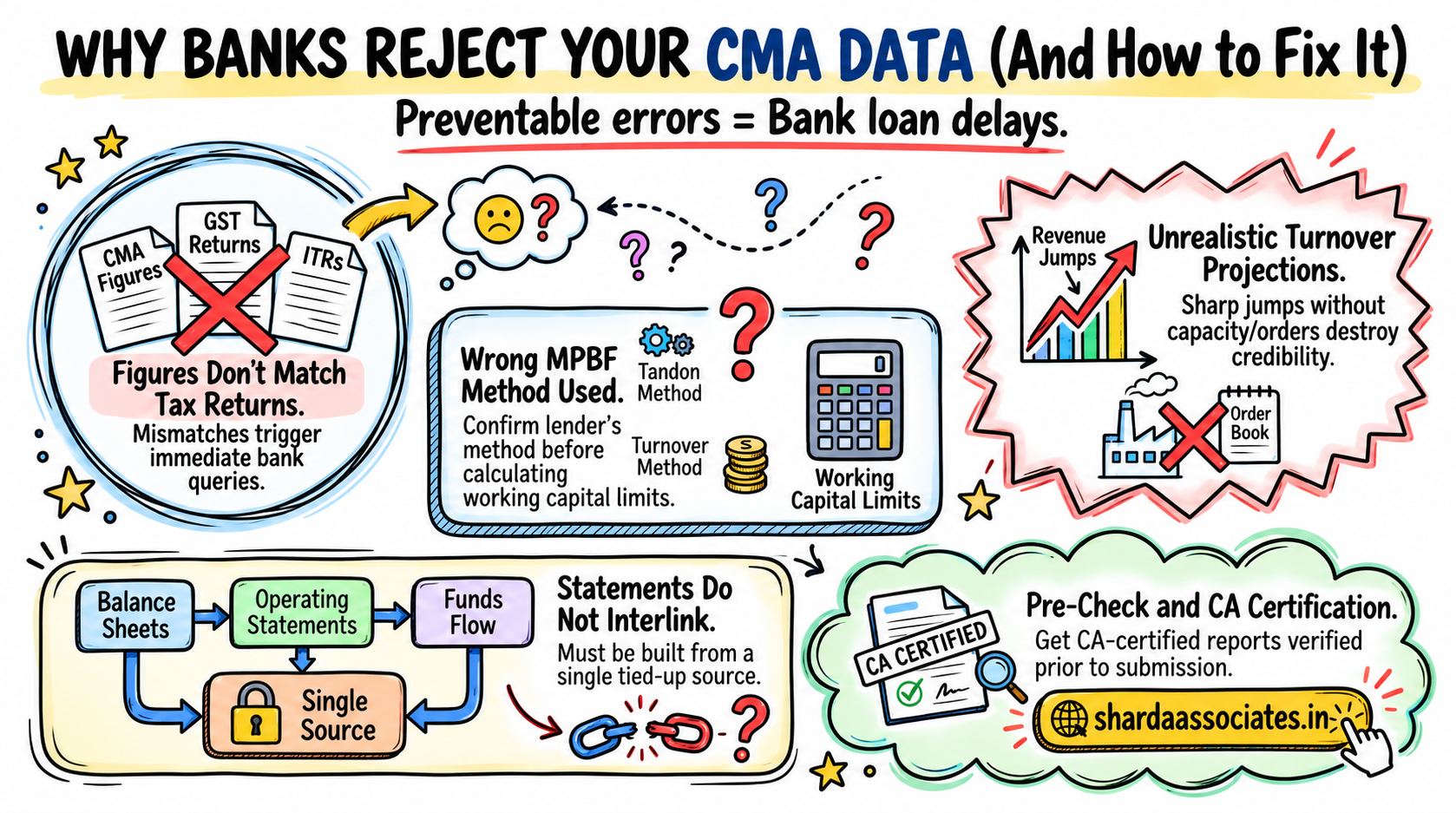
- Figures that do not match your audited financials, ITR or GST returns. The bank compares the CMA against the documents you submitted alongside it. If turnover in the CMA differs from GST turnover or the ITR, and no reconciliation is given, the file gets queried.
- Statements that do not tie to each other. The closing balance sheet in one form must match the operating statement and the funds flow. A balance sheet that does not balance, or a profit figure that does not flow into net worth, signals a file built from disconnected spreadsheets.
- Wrong classification of current and non-current items. The most common version is leaving the current-year instalment of a term loan out of current liabilities, or including long-term liabilities among current ones. Either error distorts the working capital gap and therefore the limit.
- Depreciation and tax effects not carried through. Depreciation, deferred tax and tax provisions must flow properly into net worth. When they are ignored, projected net worth and ratios look better than they really are, which a credit officer spots quickly.
Which Mistakes Affect the MPBF and Working Capital Limit?
- Using the wrong MPBF method. Banks compute Maximum Permissible Bank Finance by a method set in their own credit policy. Under the Tandon methods, the borrower must fund a minimum share from long-term sources. Under the turnover method used for smaller limits, working capital requirement is generally taken as 25% of projected turnover, with the bank financing 20% and the borrower contributing 5%. Applying a different method from the one your bank follows produces a limit the bank will simply recompute. Confirm the method with your branch before calculating.
- Inflated inventory and debtor figures. Stock and receivables holding periods that are far longer than your history, or that cannot be supported by your records, push the requirement up on paper. Banks adjust them down, and the credibility of the rest of the file goes with them.
- Ignoring the margin the borrower must bring. Some files show a limit equal to the full requirement, with no net working capital contribution. That is not how the assessment works, and it tells the bank the file was not prepared against its norms.
Which Projection and Format Mistakes Get CMA Data Returned?
- Unrealistic growth in projected turnover or margin. A sudden jump over the last actual year, with no order book, capacity addition or market reason behind it, is one of the quickest ways to lose a credit officer’s trust. Projections should follow your history and be explainable.
- No stated assumptions. Projections without the reasoning behind them, such as growth rate, holding periods and cost behaviour, force the bank to guess, and a bank that has to guess usually asks questions instead.
- Wrong or generic format. Some banks prescribe their own CMA format. A generic file with correct numbers can still be returned because it does not match what the bank’s system expects. Ask for the bank’s format before you start.
Quick Reference: What the Bank Notices and How to Avoid It
| Mistake | What the bank notices | How to avoid it |
| Numbers differ from ITR/GST | Turnover or profit mismatch | Reconcile before submission and keep a note |
| Statements do not tie | Balance sheet or funds flow does not agree | Build all forms from one source |
| Wrong classification | Working capital gap looks distorted | Show current maturities of term loans as current |
| Wrong MPBF method | Limit recomputed by the bank | Confirm the bank’s method first |
| Inflated stock/debtors | Holding periods out of line with history | Base projections on actual records |
| Unrealistic growth | Sharp jump with no support | Tie growth to orders, capacity or history |
| No assumptions | Bank cannot see the logic | State every key assumption |
| Wrong format | File returned for presentation | Use the bank’s prescribed format |
How Can You Check CMA Data Before Submitting It?
- Reconcile CMA turnover and profit with the audited accounts, ITR and GST returns
- Check that every statement agrees with the others before sending
- Confirm the MPBF method and format with your bank in advance
- Test each projection against your last two or three actual years
- Have a CA review and certify the file, since banks give weight to certified figures
What Should You Do If the Bank Returns Your CMA Data?
- Read the query exactly as written. Banks usually name the form or the figure they are questioning, so fix that specific point first instead of redoing everything.
- Identify which of the three tests failed. Ask whether the problem is a mismatch with ITR/GST, a calculation or method issue, or a projection or format issue. The fix differs for each.
- Reconcile before you resubmit. Where figures differ from your ITR or GST returns, add a short reconciliation note, because a bank is far more comfortable with an explained difference than an unexplained one.
- Confirm the method and format with the branch. If MPBF was recomputed, ask which method and format the bank follows, and rebuild on that basis.
- Resubmit one corrected, certified file. Sending several partial corrections tends to create new mismatches, so send a single complete file.
A returned CMA is a delay, not a final decision. Most queries relate to reconciliation, classification, method or format, all of which can be corrected.
Conclusion
Most CMA rejections are not about a weak business. They are about a file that does not tie together, uses the wrong method, or promises more than the history supports. Each of the ten mistakes above is visible to a credit officer within minutes, which is why fixing them before submission saves far more time than answering queries afterwards.
In our experience reviewing files that banks have already queried, the fix is rarely a rewrite from scratch. It is usually reconciling the figures with the ITR and GST records, correcting the classification, and putting the working capital assessment on the method the bank actually follows. That work goes faster when your billing and accounting records are clean to begin with.
Sharda Associates prepares CA-certified CMA data and project reports, typically delivered in 24-48 hours once the inputs are ready, and also reviews files a bank has already returned. No one can guarantee a sanction, but a correct, well-supported file gives your proposal the fairest hearing. Call +91 89899 77769 to get your CMA data prepared or reviewed.
Frequently Asked Questions
1. What is CMA data and why do banks ask for it?
CMA data is a standard set of financial statements, covering past results, projections, current assets and liabilities, the working capital assessment and funds flow, that a bank uses to decide how much working capital finance to sanction.
2. What is the most common reason CMA data gets returned?
Figures that do not match the audited accounts, ITR or GST returns, and statements that do not tie to one another, are among the most frequent reasons.
3. What is MPBF?
MPBF stands for Maximum Permissible Bank Finance. It is the ceiling a bank can lend for working capital, computed by the method the bank follows, such as the Tandon methods or the turnover method.
4. How does the turnover method work?
For smaller limits, banks commonly take working capital requirement as 25% of projected turnover, with the bank financing 20% and the borrower contributing 5%. Confirm the exact norm with your bank, as policy can vary.
5. Can I use any CMA format?
Not always. Some banks prescribe their own format, and a file in a different layout can be returned even when the numbers are correct. Ask your bank first.
6. Do banks check CMA projections against past performance?
Yes. Projections that jump sharply above the last actual year without a clear reason are queried, so growth should be explainable.
7. Does a CA certificate on CMA data matter?
Banks generally give more weight to certified figures, though requirements depend on the lender and the limit, so check with your branch.
8. How long does it take to prepare CMA data?
It depends on how ready your financials are. Sharda Associates typically delivers within 24-48 hours once the required inputs are shared.
9. Can a rejected CMA be corrected and resubmitted?
Usually yes. Most queries relate to reconciliation, classification, method or format, which can be corrected and resubmitted.
10. Does a correct CMA guarantee loan approval?
No. Sanction depends on the lender’s policy, your proposal and your credit profile. A correct CMA only removes avoidable reasons for delay or rejection.