
Quick answer: Clause 44 of Form 3CD in a tax audit asks for a breakup of your total expenditure for the year based on whether the supplier was registered under GST or not. You must report the total expenditure and split it into spending on exempt supplies, composition dealers, other registered entities and unregistered entities.
At Sharda Associates, our Chartered Accountants (CA) prepare Form 3CB-3CD and 3CA-3CD, including Clause 44 reporting, file income tax returns and handle notices for proprietors, firms, LLPs and companies, and also prepare CA-certified project reports for bank loans and business funding. A clean Clause 44 breakup also keeps your GST and income tax records consistent.
What Is Clause 44 of Form 3CD?
Form 3CD is the statement of particulars that accompanies the tax audit report under Section 44AB of the Income Tax Act. Clause 44 was added to give the tax department a way to compare expenditure shown in the income tax return with purchase and expense data available under GST. It does not ask for supplier-wise or GSTIN-wise details, only the amounts in each category.
The reporting has been introduced and extended in phases, so check the applicability for your financial year and the latest version of Form 3CD with your CA before filing.
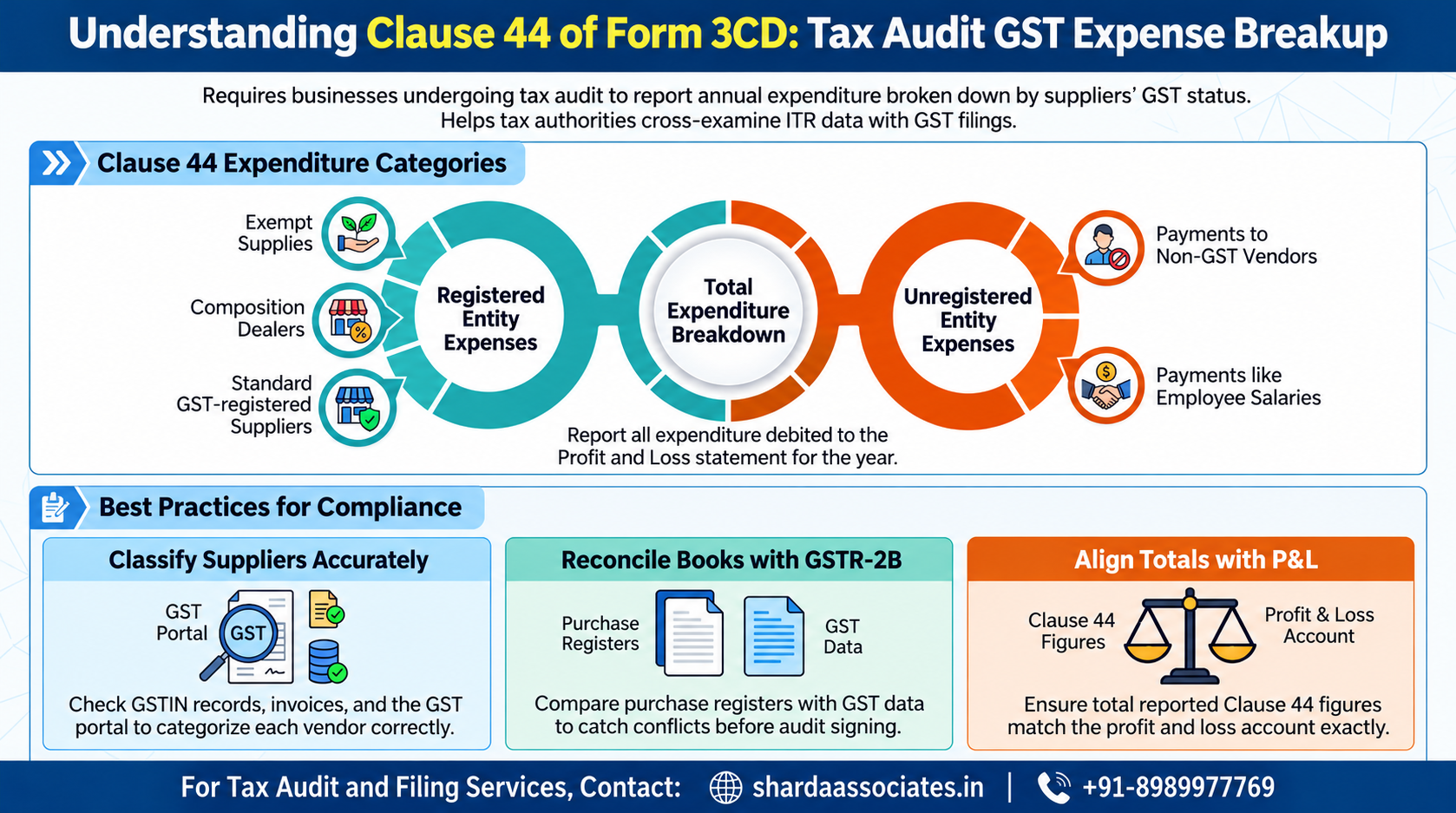
Details Required Under Clause 44
The clause asks you to give the total expenditure incurred during the year and then break it into the following parts:
- Expenditure relating to goods or services exempt from GST.
- Expenditure relating to entities under the composition scheme.
- Expenditure relating to other registered entities.
- Total payment to registered entities, which is the sum of the three items above.
- Expenditure relating to entities not registered under GST.
Clause 44 Breakup at a Glance
| Item | What to report | Example |
| Total expenditure | All expenditure debited to profit and loss for the year, as per the guidance followed | Rent, salary, purchases, repairs |
| Exempt goods or services | Spending on supplies that are exempt from GST | Certain agricultural produce, some education services |
| Composition dealers | Payments to suppliers who opted for composition | Small trader supplying goods under composition |
| Other registered entities | Payments to regular GST-registered suppliers | Wholesalers, service providers charging GST |
| Total to registered entities | Sum of the three registered categories | Total of exempt, composition and other registered |
| Unregistered entities | Payments to suppliers without GST registration | Small vendors below the turnover limit, salary to employees |
How to Prepare Clause 44 Data
- Start with the ledger. Extract all expense and purchase ledgers for the year.
- Classify each supplier. Use GSTIN records, invoices and the GST portal to check whether the supplier is regular, composed, or unregistered.
- Identify exempt items. Mark purchases and expenses that are exempt from GST, such as certain services or goods.
- Reconcile with GST data. Compare your purchase register with GSTR-2B and your books, so that the numbers do not conflict.
- Decide how to treat salary and similar items. Payments that are not supplies, such as salary, are normally shown under entities not registered under GST, as per the reporting guidance, so confirm the treatment with your auditor.
Where supplier details are missing, your CA may rely on management information and mention the limitation in the report.
Common Mistakes to Avoid
Businesses often report only GST-registered purchases and forget small unregistered expenses. Others mix capital and revenue expenditure inconsistently, or ignore composition vendors because their invoices carry no GST. Another frequent error is a mismatch between Clause 44 totals and the profit and loss account. Review the total before the audit report is signed.
Why Clause 44 Matters
The department can use Clause 44 figures along with GST returns to identify mismatches, unusual unregistered spending and possible ITC issues. An incorrect or careless report may invite questions during assessment. The CA signing the report can also face a penalty under Section 271J for furnishing incorrect information, so maintaining proper records is important for both the business and the auditor.
Conclusion
Clause 44 of Form 3CD requires a simple but careful breakup of your expenditure by the GST status of suppliers. The total must tie with your books, and each category must be supported by proper classification of vendors.
To make audit time easier, keep supplier GSTINs, invoices and ledgers organised through the year, and reconcile with GST data regularly. This reduces last-minute errors and avoids questions later.
For tax audit, Clause 44 reporting, ITR filing, GST compliance and CA-certified project reports, contact Sharda Associates at +91-8989977769.
Frequently Asked Questions (FAQs)
1. What is Clause 44 in Form 3CD?
It is the clause that requires a breakup of total expenditure based on the GST registration status of suppliers.
2. Is GSTIN-wise detail needed under Clause 44?
No. Only amounts under each category are reported, not supplier-wise details.
3. Who must report Clause 44?
Businesses and professionals subject to tax audit under Section 44AB, as per current applicability.
4. Which expenses go under unregistered entities?
Expenditure on suppliers without GST registration, and items like salary where the guidance requires it.
5. How do I know if a supplier is under composition?
Check the invoice, which will not show GST, and verify on the GST portal using the supplier’s GSTIN.
6. Does Clause 44 include capital expenditure?
Treatment depends on the guidance followed. Your CA should decide and apply it consistently.
7. Can the figures differ from GST returns?
Yes, because books and GST returns follow different bases, but you should be able to explain the differences.
8. What happens if Clause 44 is reported wrongly?
It can lead to queries from the department and, in some cases, penalty under the relevant sections.