
Quick answer: Tax audit applicability for business depends on annual turnover, gross receipts, cash transaction limits, and the conditions of presumptive taxation. Under Section 44AB, businesses generally require a tax audit when turnover exceeds ₹1 crore, with the limit increasing to ₹10 crore if cash receipts and cash payments are each within 5% of the total. For professionals, the audit threshold is generally ₹50 lakh in gross receipts. Presumptive taxpayers declaring profits below the prescribed limits may also require a tax audit, depending on the applicable conditions.
At Sharda Associates, our Chartered Accountants (CA) conduct tax audits, prepare Form 3CB-3CD or 3CA-3CD, file income tax returns and handle notices for firms, companies, LLPs and proprietors, and also prepare CA-certified project reports for bank loans and business funding. Checking your audit status early helps you avoid penalties and keep your books ready for lenders.
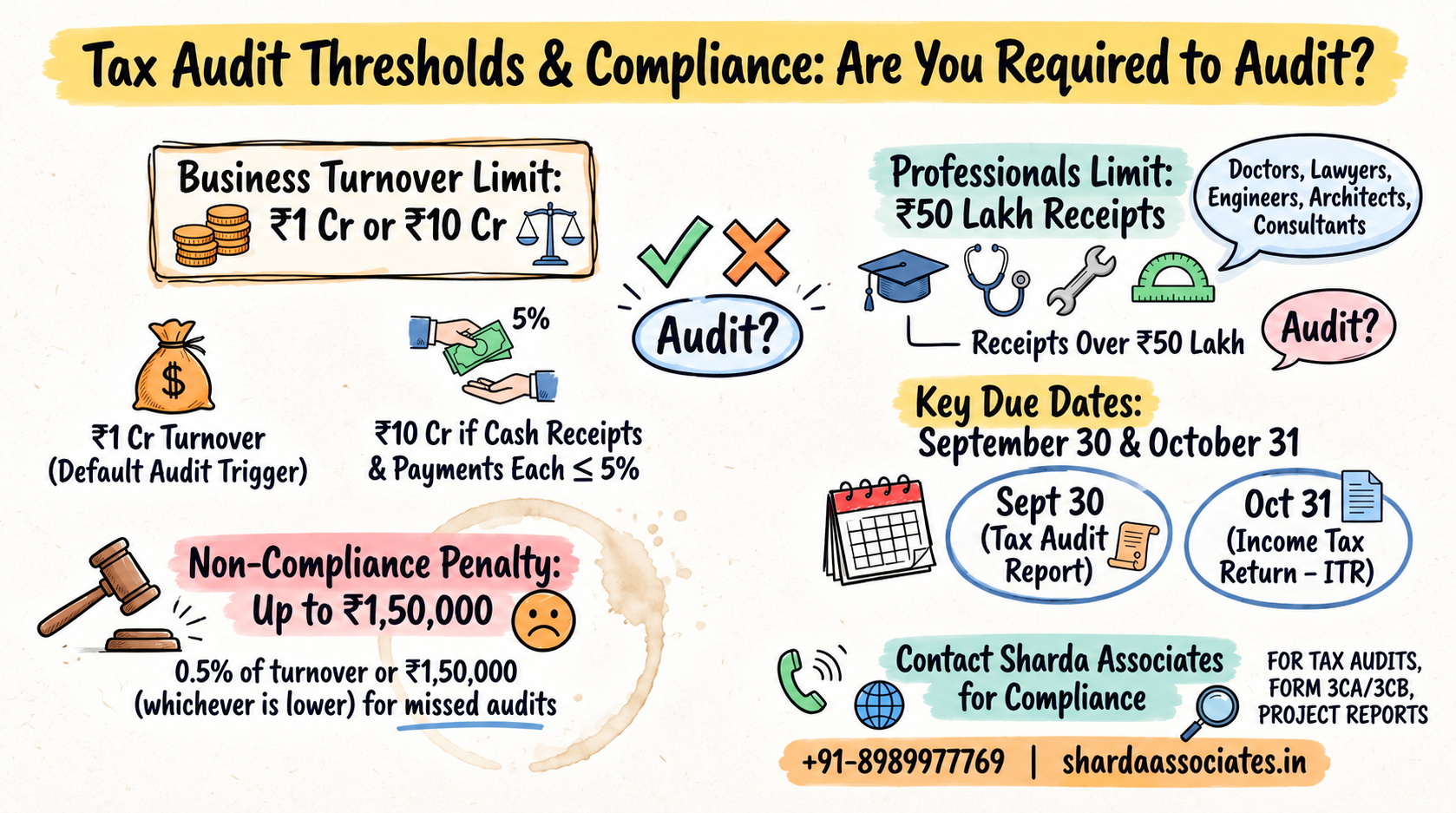
What Is a Tax Audit and Who Must Get It Done?
A tax audit is an examination of your books by a practicing CA under Section 44AB of the Income Tax Act. The CA reports on accounting methods, deductions, disallowances, cash transactions and other compliance points. It is different from a statutory audit under the Companies Act, although one auditor may do both.
Tax audit applies to every person carrying on business or profession, including proprietors, partnership firms, LLPs and companies, when the limits below are crossed.
Turnover Limits for Tax Audit
- Business, general limit: turnover, sales or gross receipts above ₹1 crore.
- Business, enhanced limit: above ₹10 crore, provided cash receipts and cash payments are each 5% or less of the total receipts and payments.
- Profession: gross receipts above ₹50 lakh, such as for doctors, lawyers, architects, engineers and consultants.
Turnover is checked for the financial year and includes all business sales and receipts, not profit. Where GST is collected separately, it is generally excluded from turnover as per professional guidance, but the treatment should be confirmed with your CA.
Tax Audit Applicability Summary
| Case | Limit or condition | Audit required? |
| Business with normal cash dealings | Turnover above ₹1 crore | Yes |
| Business with cash receipts and payments each up to 5% | Turnover above ₹10 crore | Yes, only above ₹10 crore |
| Profession | Gross receipts above ₹50 lakh | Yes |
| Presumptive business (Section 44AD) | Profit below 8% (6% digital) and income above exemption limit | Yes |
| Presumptive profession (Section 44ADA) | Profit below 50% and income above exemption limit | Yes |
| Goods carriage business (Section 44AE) | Profit below prescribed amount and income above exemption limit | Yes |
| Company, LLP or firm | Same turnover limits apply | Yes, once limits are crossed |
Other Conditions That Trigger a Tax Audit
- Lower profit under presumptive schemes when total income exceeds the basic exemption limit.
- Opting out of Section 44AD and then claiming profit lower than the deemed rate within the five-year lock-in.
- Combined businesses. If you run several businesses, turnover of all of them is added.
- Transfer pricing cases where an international transaction needs a separate accountant’s report.
Forms, Due Dates and Penalty
- Form 3CB-3CD is used when the person is not otherwise required to have accounts audited, and Form 3CA-3CD when accounts are audited under another law, such as a company.
- Report due date: generally 30 September after the financial year, subject to extensions.
- ITR due date: generally 31 October for audit cases, and 30 November where transfer pricing applies.
- Penalty under Section 271B: 0.5% of turnover or ₹1,50,000, whichever is lower, unless reasonable cause is shown.
Practical Tips to Stay Compliant
Track turnover every quarter, since crossing the limit even by a small amount triggers audit. Keep cash transactions low if you want to use the ₹10 crore limit. Reconcile your books with GST returns and bank statements, and appoint the CA well before the due date.
Conclusion
Tax audit depends mainly on your turnover, the cash ratio of your transactions and your choice of presumptive scheme. Cross the limit, and the audit report becomes mandatory even if your profit is small.
Monitor turnover during the year, limit cash dealings where possible and keep records ready. Early planning avoids penalty and gives you time to correct errors before filing.
For tax audit, ITR filing, GST compliance and CA-certified project reports, contact Sharda Associates at +91-8989977769.
Frequently Asked Questions (FAQs)
1. What is the turnover limit for tax audit?
It is ₹1 crore for business, or ₹10 crore if cash receipts and payments are each within 5%.
2. What is the limit for professionals?
Professionals need an audit when gross receipts exceed ₹50 lakh.
3. Does a company need a tax audit?
Yes, if it crosses the turnover limit, and it may also need a separate statutory audit.
4. Is a tax audit required if the business has a loss?
Only if turnover crosses the limit or presumptive scheme conditions are triggered.
5. What is the difference between Form 3CA and 3CB?
Form 3CA is for persons whose accounts are audited under another law, and Form 3CB is for others.
6. What is the last date for tax audit?
Generally 30 September after the financial year, unless the government extends it.
7. What is the penalty for missing a tax audit?
The penalty is 0.5% of turnover or ₹1,50,000, whichever is lower.
8. Does the 5% cash condition include all payments?
It covers total cash receipts and cash payments of the year, so keep a track of both.