
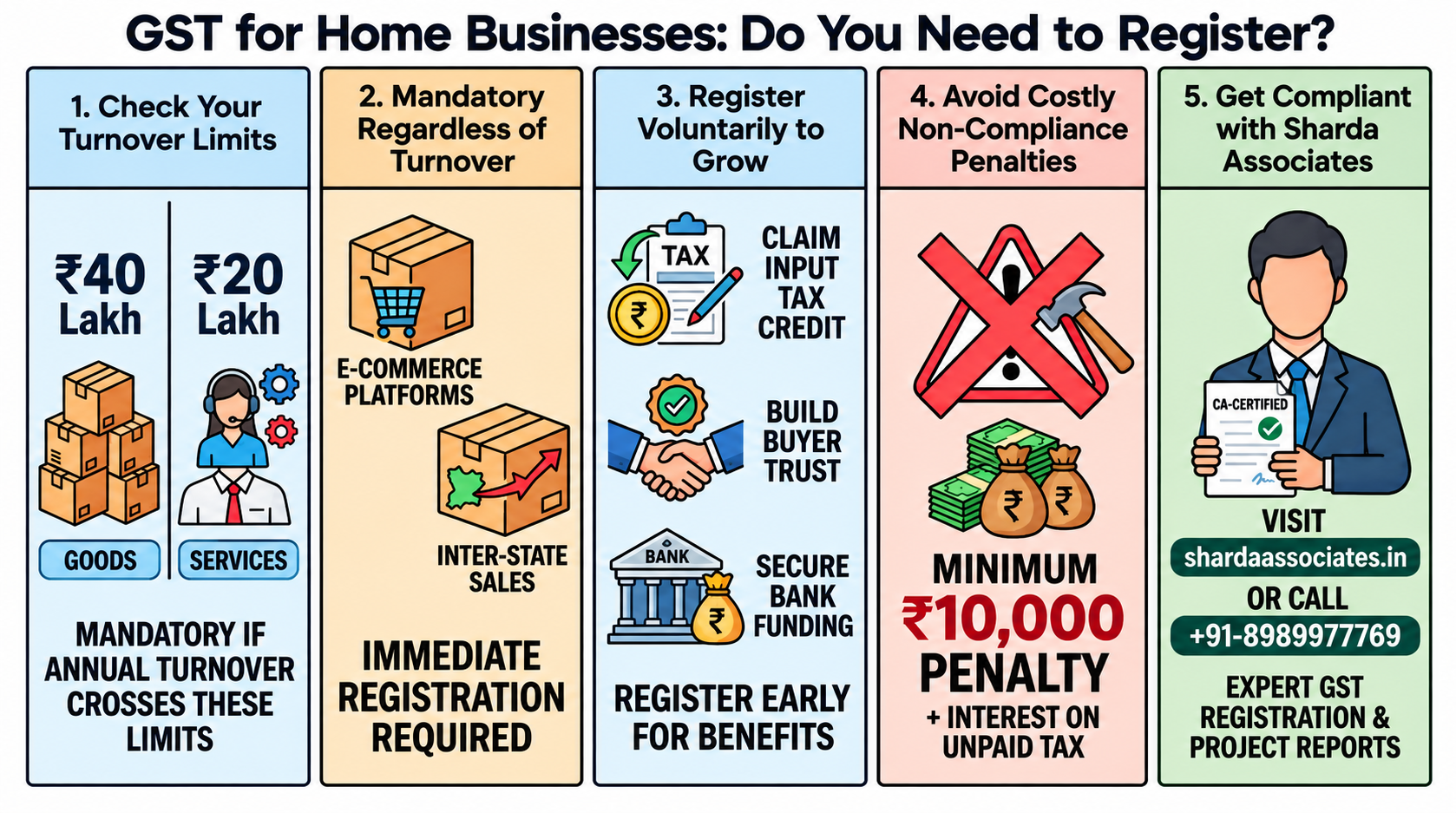
Quick answer: It depends on your turnover and the nature of your supplies, not on working from home. A home-based business must register for GST once its aggregate turnover crosses ₹40 lakh for goods or ₹20 lakh for services (lower in special category states). Registration is also compulsory in some cases, such as inter-state supply of goods, regardless of turnover.
At Sharda Associates, our Chartered Accountants (CA) help home-based businesses, freelancers and online sellers with GST registration, compliance, and notices, and also prepare CA-certified project reports for bank loans and business funding. Knowing when registration is required helps you avoid penalties and plan growth with confidence.
Does Working from Home Change GST Rules?
No. GST applies to the supply of goods and services, and it does not matter whether you operate from a shop, an office or your living room. A home baker, tutor, boutique owner, designer or online reseller is treated like any other supplier. The test is whether your turnover or type of supply makes registration mandatory.
Turnover Limits for GST Registration
The limit is calculated on aggregate turnover, which includes taxable supplies, exempt supplies, and exports on a PAN basis across all states.
- Suppliers of goods: ₹40 lakh in most states, and ₹20 lakh in some special category states.
- Suppliers of services: ₹20 lakh in most states and ₹10 lakh in special category states.
- Mixed suppliers of goods and services: generally the service limit applies, unless only goods are supplied.
Once you cross the limit, you must apply within 30 days of becoming liable.
When Is Registration Required? A Quick Guide
|
Business situation |
Registration needed? |
|
Home-based service provider, turnover below ₹20 lakh, within the state |
Not mandatory |
|
Home-based seller of goods, turnover below ₹40 lakh, within the state |
Not mandatory |
|
Mandatory within 30 days |
|
|
Inter-state supply of goods |
Mandatory, even for small sellers |
|
Selling through e-commerce platforms |
Generally mandatory, with some relaxations for small intra-state goods sellers |
|
Liable to pay tax under reverse charge |
Mandatory |
|
Wanting to claim ITC or work with large buyers |
Voluntary registration possible |
Cases Where Registration Is Compulsory at Any Turnover
- Inter-state supply of goods, except where specific exemptions notified by the government apply.
- E-commerce selling. Most sellers who supply through platforms such as marketplaces must register, though some intra-state relaxations exist for goods sellers under the threshold.
- Casual taxable persons who supply occasionally from stalls or exhibitions.
- Persons paying tax under reverse charge and those required to deduct or collect tax at source.
- Non-resident taxable persons and certain agents of suppliers.
Should You Register Voluntarily?
Even when it is not mandatory, voluntary registration can help a home-based business:
- claim input tax credit on purchases and reduce tax cost;
- issue GST invoices and supply to registered businesses and large companies;
- build credibility with banks, customers and marketplaces;
- qualify for tenders and loan assessments with proper turnover records.
The trade-off is that once registered, you must file returns on time and maintain records, even for nil months.
What If You Do Not Register When Required?
Supplying without registration when it is mandatory is an offence. Under Section 122, the penalty can be 10% of the tax due, subject to a minimum of ₹10,000, and higher where there is fraud or deliberate evasion. You may also have to pay the tax with interest from your own pocket, since you could not collect it from customers. Registering on time is far cheaper than defending a notice later.
Conclusion
GST registration for a home-based business depends on turnover and the type of supply, not on where you work. Track your aggregate turnover every month, because crossing the limit gives you only 30 days to apply.
If you sell interstate, use e-commerce platforms or deal with registered businesses, registration is either mandatory or very useful. Voluntary registration can also help you claim ITC and build trust with banks and customers.
For GST registration, compliance, notice replies, and CA-certified project reports, contact Sharda Associates at +91-8989977769.
Frequently Asked Questions (FAQs)
1. Do I need GST registration for a small home business?
Not always. If your turnover is below the threshold and no compulsory category applies, registration is optional.
2. What is the GST limit for a home-based service business?
It is ₹20 lakh in most states and ₹10 lakh in special category states.
3. What is the limit for selling goods from home?
It is ₹40 lakh in most states, and ₹20 lakh in some special category states.
4. Do online sellers need GST registration?
Generally yes, though certain intra-state goods sellers below the limit have relaxations. Check the latest notifications.
5. Is GST needed for inter-state sales from home?
Yes, for goods. Inter-state supply of goods normally requires registration irrespective of turnover.
6. Can I register voluntarily below the limit?
Yes. You can apply voluntarily and use input tax credit, but you must then follow all compliances.
7. Can I use my home address for registration?
Yes. A residential address is accepted with valid proof, and an NOC if it is not in your name.
8. What happens if I cross the limit and do not register?
You may face tax demand with interest and a penalty, so apply within 30 days of crossing the limit.