
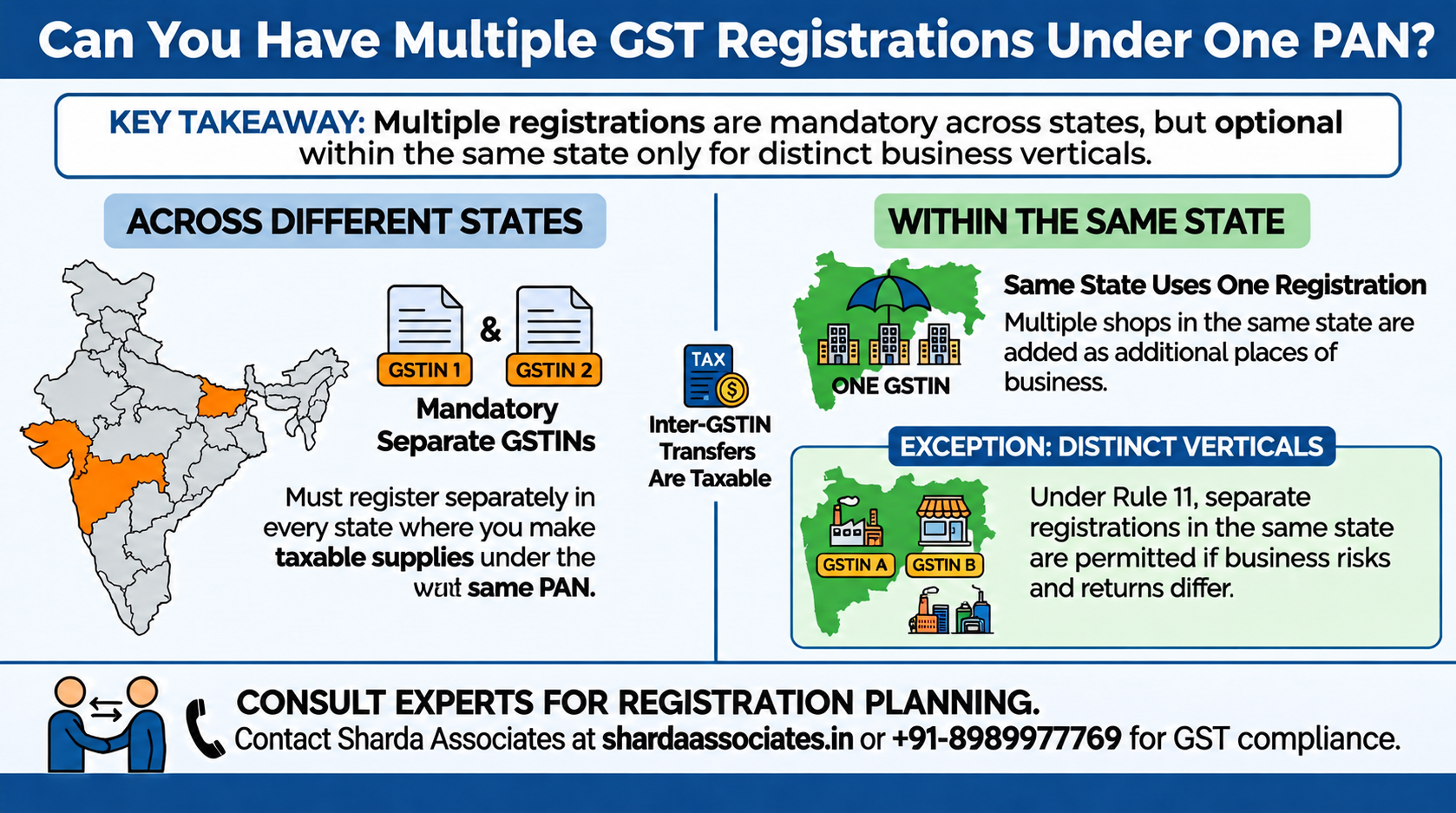
Quick answer: Yes, but only in specific cases. GST registration is PAN-based and state-wise, so one person with one PAN needs a separate registration in every state where business is carried out. Within the same state, a second registration is allowed only for a distinct business vertical under Section 25(2) of the CGST Act and Rule 11, subject to conditions.
At Sharda Associates, our Chartered Accountants (CA) help proprietors, partnerships and companies with GST registration, multiple registrations, compliance and notices, and also prepare CA-certified project reports for bank loans and business funding. Choosing the right registration structure early avoids duplicate returns and costly mistakes later.
How GST Registration Works for One Person
A person is identified by PAN under GST. Section 25(1) says that a person liable to register must do so in each State or union territory from where taxable supplies are made. Therefore, a trader with one PAN selling from Madhya Pradesh and Maharashtra needs two GSTINs, one for each state.
If you run two shops or two businesses in the same state under the same PAN, you normally need only one registration. The other shop or office is added as an additional place of business in the same GSTIN.
One or Two Registrations? Quick Guide
|
Situation |
Registrations needed |
|
Two businesses in the same state, same PAN, no distinct verticals |
One registration, with an additional place of business |
|
Same state, same PAN, clearly distinct business verticals |
Separate registration allowed under Section 25(2), if Rule 11 conditions are met |
|
Same PAN, businesses in different states |
One registration in each state |
|
Proprietor and a company owned by the same person |
Separate registrations, as PANs are different |
|
Person opting for the composition scheme |
All registrations under the PAN must opt for composition; separate vertical registration is not available |
What Is a Business Vertical?
Section 2(18) defines a business vertical as a distinguishable component of a business that is subject to risks and returns different from other verticals. Examples include a company running a manufacturing unit and a retail trading arm, or a person selling electronics in one vertical and providing consultancy in another. Merely opening a second shop for the same activity is not a separate vertical.
Conditions for Separate Registration in the Same State
Under Rule 11, the person must satisfy these conditions:
- Hold a PAN and be liable to be registered under GST.
- Not pay tax under the composition scheme for any of the verticals.
- Pay tax as a normal taxpayer on all taxable supplies.
- Apply for the separate vertical in Form GST REG-01 and ensure the vertical is genuinely distinct.
Once separate registrations are granted, each GSTIN files its own GSTR-1 and GSTR-3B. Supplies between two GSTINs of the same person are treated as supplies between distinct persons under Section 25(4), so GST must be charged on them.
Practical Pros and Cons
Benefits: Separate compliance for each vertical, clearer accounts, easier loan assessment and the ability to isolate tax issues of one business.
Drawbacks: Double filing work, GST on inter-unit transfers, separate ITC ledgers that cannot be freely combined, and more notices if returns are not matched.
Before applying, compare the cost of extra compliance with the benefits. For small businesses, one registration with additional places of business is usually simpler.
Conclusion
One person can hold more than one GST registration, but only where the law allows it. Different states always need separate registrations, and the same state allows them only for distinct business verticals after meeting Rule 11 conditions.
Before you apply, study your business model, compare compliance cost with the benefits and avoid the composition scheme if you plan to split verticals. A well-planned structure protects your input tax credit and keeps filing simple.
For GST registration, multiple GSTIN planning, notice replies and CA-certified project reports, contact Sharda Associates at +91-8989977769.
Frequently Asked Questions (FAQs)
1. Can I have two GST numbers with one PAN?
Yes, if you operate in different states, or in the same state for distinct business verticals.
2. Can I get two GST registrations in the same state?
Only for separate business verticals, and only if the Rule 11 conditions are met.
3. What is a business vertical under GST?
It is a distinguishable part of a business having different risks and returns from other parts.
4. Can I add a second shop to my existing GSTIN?
Yes. You can add it as an additional place of business through an amendment on the portal.
5. Do I need a new registration for a new state?
Yes. Each state needs its own registration under the same PAN.
6. Can I use the composition scheme with multiple registrations?
If you opt for composition, all registrations under the same PAN must opt for it, and separate vertical registration is not allowed.
7. Is GST charged between my two GSTINs?
Yes. They are treated as distinct persons, so supplies between them are taxable.
8. Can I merge two GST registrations later?
You can cancel one registration, but you must file final returns and reverse ITC where required.