
Quick answer: Yes. You can use your home as the principal place of business for GST registration, whether it is owned, rented or shared with family. You only need valid address proof, such as an electricity bill, and a No Objection Certificate (NOC) if the property is not in your name. There is no separate rule that bars residential premises.
At Sharda Associates, our Chartered Accountants (CA) help home-based businesses, freelancers and startups with GST registration, address documents and notices, and also prepare CA-certified project reports for bank loans and business funding. Getting the address right at the start saves you from rejection and later trouble.
Is a Residential Address Allowed Under GST?
The CGST Act asks for the principal place of business and the proof of possession of that place. It does not require commercial premises. Many small traders, consultants, tailors, online sellers and home bakers therefore register at their house address. The officer only checks that the place exists, that you have the right to use it and that business can actually be carried out there.
While filling Form GST REG-01, you select the nature of possession: own, rented, leased, consent or shared. The documents you upload depend on that choice.
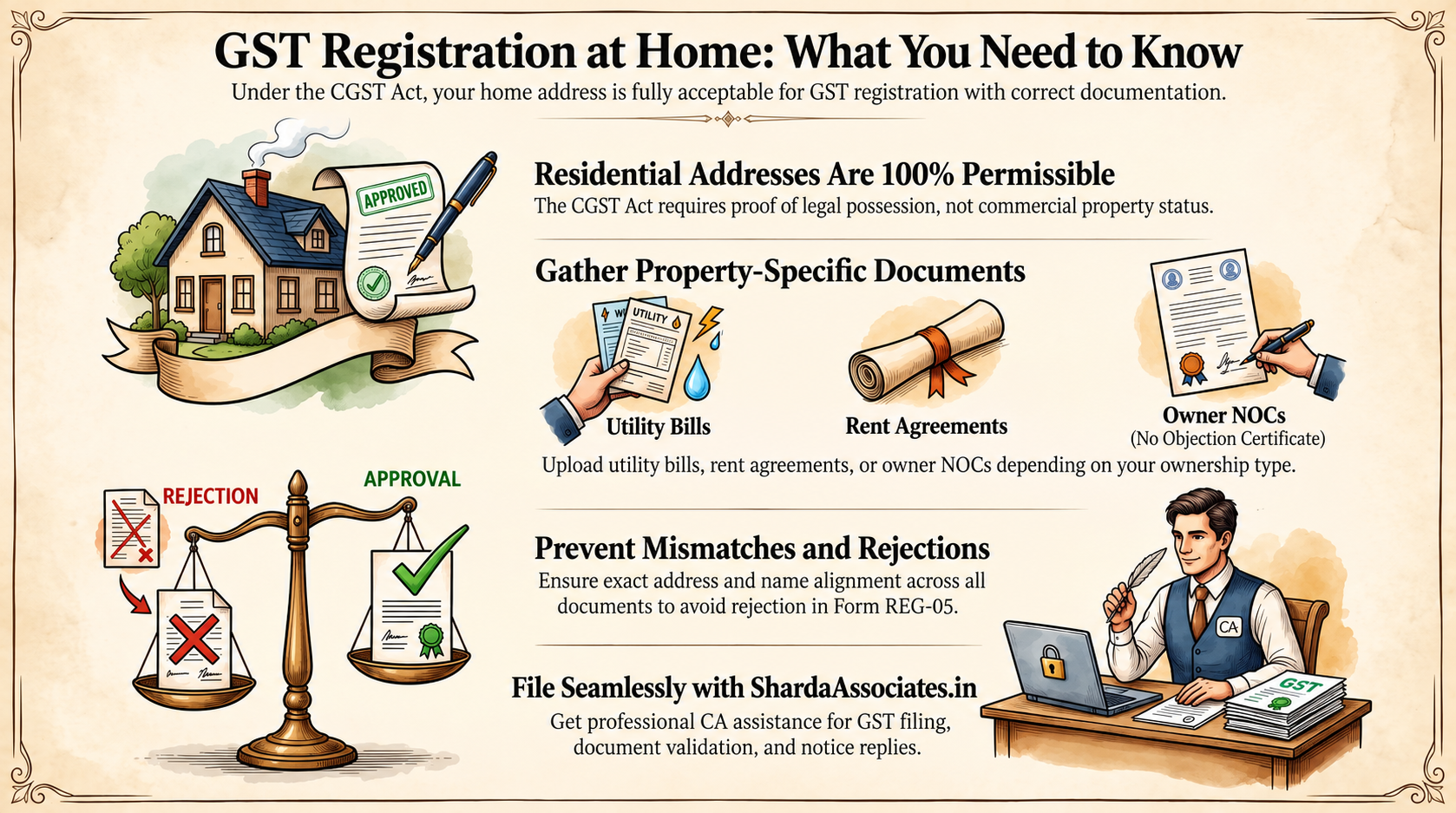
Documents Required by Type of Property
|
Type of premises |
Documents to upload |
|
Own house |
Latest electricity bill, property tax receipt or ownership deed |
|
Rented house |
Registered or notarised rent agreement, owner’s utility bill and owner’s NOC |
|
House of a parent or spouse |
NOC or consent letter with that person’s utility bill and ID proof |
|
Shared or co-owned house |
Consent letter from the owner or co-owner with address proof |
|
Virtual office or co-working space |
Valid agreement with the provider and its utility or ownership proof |
Step-by-Step: Registering with a Home Address
- Decide the principal place of business. It should be the place where you keep your books and carry out the main activity.
- Collect the right address proof from the table above, and make sure the name and address are clearly readable.
- Get an NOC from the owner if the house is rented or belongs to a family member. Attach the owner’s ID and utility bill.
- Fill Form GST REG-01 on the GST portal and choose the correct nature of possession and nature of business.
- Complete Aadhaar authentication and attend the biometric appointment if the system asks for it.
- Reply to any notice in Form REG-04 within seven working days if the officer asks for clarification.
- Add bank details within 30 days of registration or before filing your first return, whichever is earlier.
Risks and Points to Keep in Mind
Your address becomes public. The principal place of business appears on the GST search page, so customers and suppliers can see it. If privacy is a concern, think about this before choosing your home address.
Physical verification is possible. The officer may visit to confirm that the business operates from the address. Keep documents ready and display a small name board or board with your business name if possible.
Local rules may apply. GST does not forbid home-based business, but society bylaws, municipal rules or trade licence conditions may restrict certain activities, such as manufacturing or heavy storage in residential areas.
Mismatch causes rejection. A name or address that differs between the rent agreement, utility bill and application is a common reason for rejection in Form REG-05. If that happens, you can correct the documents and apply again.
Keep the address updated. If you shift your home or business, file an amendment of registration on the portal within 15 days of the change.
Conclusion
A residential address is fully acceptable for GST registration, as long as you can prove your right to use it. Choose the correct type of possession, upload clear documents and arrange an NOC where needed.
Before you apply, think about privacy, local rules and the chance of physical verification. Matching names and addresses across all documents is the simplest way to avoid rejection and delay.
For GST registration, address documentation, notice replies and CA-certified project reports, contact Sharda Associates at +91-8989977769.
Frequently Asked Questions (FAQs)
1. Can I register GST at my home address?
Yes. Your home can be your principal place of business if you have valid proof of possession.
2. Do I need a shop or office to get GST registration?
No. GST law does not require commercial premises, so a residential address is acceptable.
3. Is an NOC required for a rented home?
Yes. You should attach the owner’s NOC, the rent agreement and the owner’s address proof.
4. Can I use my parents’ or spouse’s address?
Yes, with a written consent letter and that person’s ID and utility bill.
5. Which electricity bill is accepted?
A recent bill that clearly shows the address is normally accepted. It should match the address entered in the application.
6. Will my home address be visible to the public?
Yes. The principal place of business is visible on the GST portal’s taxpayer search.
7. Can I use a virtual office address?
It is possible with a proper agreement and valid proof, but officers may verify such addresses more closely.
8. What if my application is rejected for address problems?
Correct the address proof or NOC as per the rejection order in Form REG-05 and file a fresh application.