
Quick Answer
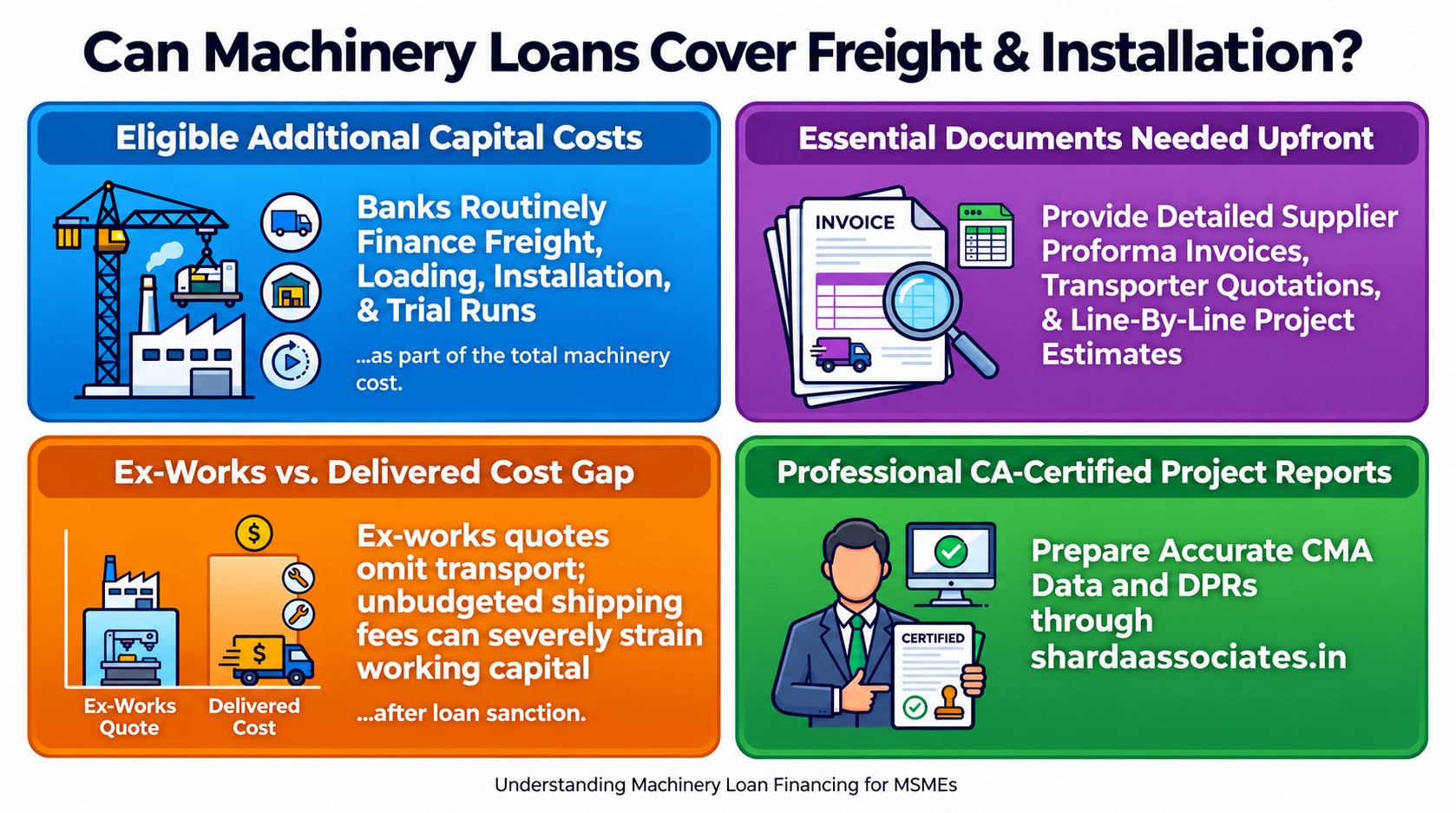
Often, yes. Banks generally treat freight, transportation and installation as part of the capital cost of machinery, because the machine cannot be used without them. So these costs can usually be included in the project cost and considered for term loan finance. But the bank decides how much it finances, usually as a percentage of the eligible project cost, with the rest coming from your margin money. Costs must be reasonable, documented and shown in your project report. Your sanction letter is the final reference.
Introduction
Most borrowers plan only for the machine’s price. Then the bills arrive: transport from the supplier’s factory, loading and unloading, foundation work, erection, wiring and trial runs. These can add up, and many owners discover too late that they were not part of the loan. Whether such costs are financed depends on how they are shown in the project report and how the bank appraises them. Costs that are clearly linked to getting the machine ready for use are generally easier to include than costs that look like routine running expenses.
At Sharda Associates, we prepare CA-certified project reports, CMA data and DPRs, and handle bank documentation for MSME and government scheme loans. This guide explains which of these costs banks commonly accept, how to present them, and how to avoid a funding gap.
Why Banks Usually Accept These Costs
In accounting, the cost of an asset normally includes everything needed to bring it to its working location and condition. That includes the purchase price, freight and installation. Banks follow a similar approach when they build the project cost.
This is why a properly prepared project report lists machinery cost along with transport and installation charges as separate line items. A bank can then see exactly what is being financed and why.
Costs That Are Commonly Considered
|
Cost item |
Usually included? |
Note |
|
Machinery price |
Yes |
Basis of the loan |
|
Freight and transportation to site |
Generally yes |
Keep the transporter’s bill |
|
Loading and unloading |
Generally yes |
Part of delivery |
|
Installation and erection |
Generally yes |
Supplier or contractor invoice needed |
|
Foundation and civil work for the machine |
Depends |
Often shown under civil or building cost |
|
Electrical connection and wiring for the machine |
Depends |
Bank may treat it as a separate item |
|
Transit insurance |
Depends |
Some banks accept it, some do not |
|
Trial run and commissioning |
Often yes |
Should be a documented charge |
|
Customs duty (imported machinery) |
Often yes |
Bank may finance via letter of credit |
|
GST |
Depends |
Usually not financed if input tax credit is available |
This table is a general guide only. Each bank and scheme sets its own rules, so confirm with your branch.
Will the Bank Finance 100% of These Costs?
Not usually. A machinery loan is normally linked to a margin requirement, so you contribute part of the eligible project cost from your own funds. Freight and installation costs generally follow the same margin as the machinery, but this depends on the bank’s policy.
Also note that “included in project cost” does not always mean “paid by the bank.” In some cases the bank pays only the supplier’s invoice, and you are expected to pay the transporter or installer yourself. Ask the branch how each cost will be paid before you commit.
Documents You Should Keep Ready
- Supplier’s quotation or proforma invoice showing whether freight and installation are included or extra
- Transporter’s bill, lorry receipt or freight quotation
- Installation or erection quotation from the supplier or contractor
- Estimate for foundation or electrical work, if applicable
- Insurance quotation, if you want transit cover considered
- Project report with these costs shown line by line
- Payment proofs for any amount you pay from your margin
Where the supplier’s quotation says “ex-works,” freight is not included and you must budget for it separately. If it says “freight extra” or “installation extra,” the same applies. Read the quotation closely.
Example: A Packaging Unit’s Hidden Costs
A packaging unit plans to buy a printing and sealing machine. The quotation covers only the machine price on an ex-works basis. The owner’s first project estimate shows just that price, and the loan is sanctioned on it.
After sanction, the owner realises that transport, unloading, installation and wiring are not covered. Paying these from personal funds strains working capital in the first months.
If those items had been included in the project report from the start, supported by quotations, the bank could have appraised them together with the machinery. The cost would have been part of the plan rather than a surprise.
Common Mistakes to Avoid
- Taking an ex-works quotation without budgeting for freight
- Leaving installation and foundation costs out of the project report
- Adding inflated or undocumented transport charges
- Assuming GST is always financed
- Not asking how each cost will be paid, to the supplier or by you
- Mixing routine running expenses with capital costs
- Adding new costs after sanction without telling the bank
What to Do Before You Apply
- Ask each supplier for a quotation that clearly states what is included.
- Get separate estimates for freight, installation, foundation and electrical work.
- List every cost in your project report as a distinct line item.
- Confirm the bank’s margin and how it treats each item.
- Check how GST will be handled in your case.
- If costs rise after sanction, inform the bank in writing before paying.
Conclusion
Freight, transportation and installation can usually be part of your machinery finance, because they are needed to bring the machine into working condition. The key is to plan for them early, support them with quotations, and show them clearly in the project report instead of leaving them out.
Do not assume that every cost will be financed or paid by the bank directly. Confirm the margin, the payment method and the treatment of items like GST and insurance before you place the order. If costs change after sanction, tell the bank in writing first.
A well-prepared, CA-certified project report with accurate CMA data helps the bank see the full picture and reduces the chance of a funding gap later. If you want help with your project cost, DPR or bank documentation, call or message our team directly.
FAQs
Q1. What happens if I change the supplier before the loan is disbursed?
The bank usually pauses disbursement, reviews the new quotation and specifications, and releases funds only after approving the change.
Q2. Will the bank cancel my loan if I switch suppliers?
Not automatically. Problems arise mainly when the change is large, undisclosed or made without the bank’s approval.
Q3. Do I need the bank’s permission to change the machinery supplier?
Yes, you should get the bank’s written approval before ordering from or paying the new supplier.
Q4. Can the loan amount change after a supplier change?
It can. If the bank finances a percentage of actual cost, a different invoice value can change both the loan and the margin money.
Q5. What if the new machinery costs more?
The sanctioned amount does not rise automatically. You may need to fund the difference or request an enhancement, which the bank will appraise again.
Q6. What if I already paid an advance to the old supplier?
Inform the bank right away and share the payment proof. The bank may ask for a refund or adjustment from the old supplier.
Q7. Will a supplier change delay disbursement?
It can, because the bank needs time to review the new documents. Complete, matching paperwork helps shorten this.
Q8. Does the same rule apply to PMEGP or other subsidy loans?
The principle is similar, but scheme guidelines may add extra conditions. Check the scheme rules and your sanction letter.