
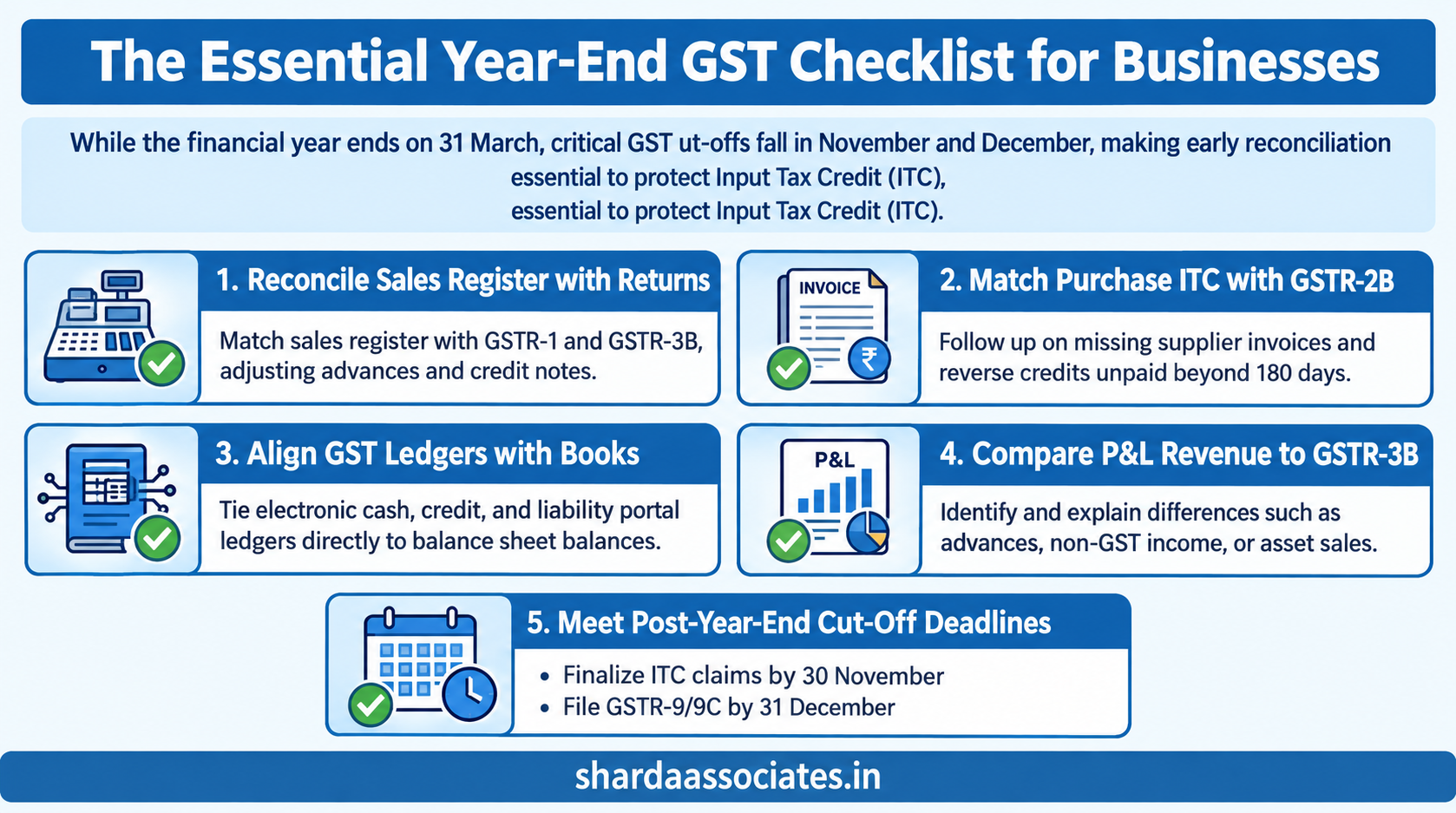
Short answer: Before you close the books, reconcile sales (books, GSTR-1 and GSTR-3B), reconcile ITC (books against GSTR-2B), settle credit notes, advances and reverse charge, match your GST ledgers with the balance sheet, and plan the deadlines that follow the year. For FY 2025-26 these are 30 November 2026 (ITC claims and generally credit notes and return corrections) and 31 December 2026 (GSTR-9, and GSTR-9C above ₹5 crore). Most businesses think of year-end gst as 31 March and the audit. GST works on a longer tail: some of the most important cut-offs for a financial year fall in the following November and December. A year-end routine that ignores them loses credit or leaves figures that do not match.
Sharda Associates is a CA-led firm that has prepared over 45,500 CA-certified reports. We see GST figures in loan files next to financial statements and the ITR, so a clean GST year-end helps with the audit, with banks and with the annual return.
This checklist is general information. Dates and thresholds can change by notification, so confirm them with your CA and the GST portal before you rely on them.
What Are the Key Dates After the Year Ends?
| Task | Date for FY 2025-26 | Note |
| Claim ITC on FY 2025-26 invoices | 30 November 2026 | Section 16(4), or the annual return date if earlier |
| Issue credit notes and rectify GSTR-1 details | Generally 30 November 2026 | Sections 34(2) and 37(3), or the annual return date if earlier |
| File GSTR-9 | 31 December 2026 | Mandatory above ₹2 crore turnover, optional up to ₹2 crore |
| File GSTR-9C | 31 December 2026 | Above ₹5 crore turnover, self-certified |
For the financial year ending 31 March 2027, the same cut-offs fall on 30 November 2027 and 31 December 2027, unless extended.
What Should You Check on the Sales Side?
- Reconcile the sales register with GSTR-1 and GSTR-3B for every month
- List credit notes and debit notes and make sure they are reported in the right period
- Check advances received, with GST paid where required and adjusted against later invoices
- Match invoices with e-invoice and e-way bill records where applicable
- Check exports, supplies to SEZ and exempt or nil-rated supplies are shown in the correct fields
- Fix any amendments before the cut-off, not after it
What Should You Check on the Purchase and ITC Side?
- Reconcile ITC in your books with GSTR-2B for the whole year
- Chase suppliers whose invoices are missing, well before 30 November
- Check reverse charge liability and the ITC you claimed on it
- Remove blocked or ineligible credits under Section 17(5)
- Reverse ITC on invoices unpaid beyond 180 days, with interest
- Review reversals for exempt supplies or common credit and mixed use of inputs
Which Ledgers Should You Reconcile?
| Ledger or account | What to tie it to |
| Electronic cash ledger | Bank payments to the government |
| Electronic credit ledger | ITC claimed in GSTR-3B, less utilisation |
| Electronic liability ledger | Tax payable per returns, and any pending demands |
| GST payable and GST input accounts in books | Closing balances per ledgers and returns |
How Do You Tie GST to Your Financial Statements?
- Compare GSTR-3B turnover with revenue in the profit and loss account, and explain differences such as advances, asset sales and non-GST income
- Check that the GST payable and input credit balances in the balance sheet agree with the ledgers
- Confirm the ITC carried forward is genuine and not blocked
- Make a provision for any liability you know of, such as interest or a reversal
What Should You Prepare for the Annual Return?
Start GSTR-9 in early autumn rather than in the last week of December. Collect your GSTR-1 and GSTR-3B for the whole year, the amendments made after year-end, and the books-to-return reconciliation. If aggregate turnover on the PAN exceeds ₹5 crore, GSTR-9C is also due and the reconciliation with audited accounts has to be ready.
Which Compliance Housekeeping Items Are Often Missed?
- Confirm all returns for the year have been filed and no notice is open
- Update registration details if the business address, partners or signatory changed
- Check HSN codes and rates on your most used items
- Keep invoices, reconciliations and ledgers for the period your records must be retained, and confirm that period with your CA
What Does a Simple Year-End Timeline Look Like?
A staggered plan is easier than a December rush:
- Before 31 March: review unpaid supplier invoices nearing 180 days, advances and open credit notes
- April to June: reconcile the full year of sales and purchases, and fix errors early
- September to October: chase suppliers whose invoices are missing from GSTR-2B and claim what has appeared
- By mid-November: issue remaining credit notes and rectify GSTR-1 details, so nothing is left for the last day
- Early December: prepare GSTR-9 and, if applicable, GSTR-9C, and keep a few days free for corrections
Keep the reconciliation sheets from each step in one folder. The annual return is much easier to prepare when the monthly work has already been documented.
Conclusion
A year-end GST checklist is mostly about three things: matching the returns with the books, matching ITC with GSTR-2B, and meeting the late-year deadlines. If those three are clean, the annual return and the audit are mostly assembly work.
The cost of skipping the exercise is usually small items that become large by December: a credit note issued too late, an invoice the supplier reported after the ITC cut-off, a balance sheet that does not agree with the ledgers. Doing the work in October is cheaper than doing it in December.
If you would like your year-end GST reconciliation reviewed before the books are closed, call Sharda Associates on +91 89899 77769. Outcomes depend on the facts, so no result can be promised.
Frequently Asked Questions
1. When does the GST year-end close? The financial year ends on 31 March, but key GST cut-offs fall on 30 November and 31 December of the following year.
2. What is the ITC cut-off for FY 2025-26? Generally 30 November 2026, or the annual return date if earlier, under Section 16(4).
3. When is GSTR-9 due for FY 2025-26? 31 December 2026, mandatory above ₹2 crore aggregate turnover and optional up to ₹2 crore.
4. Who must file GSTR-9C? Taxpayers with aggregate turnover above ₹5 crore, self-certified, along with GSTR-9.
5. Can I issue a credit note after the year-end? Generally only up to 30 November following the year, or the annual return date if earlier.
6. What if a supplier files after the cut-off? The credit may be lost, so follow up early and take advice on any options.
7. Should GST turnover equal book revenue? Not always. Reconcile and explain the differences, such as advances and non-GST income.
8. Do I need to reconcile ledgers before closing books? Yes, the cash, credit and liability ledgers should agree with the books and returns.
9. When should I start GSTR-9? Early autumn is sensible, since the reconciliation takes longer than people expect.
10. Are these dates fixed? They can be extended or changed by notification, so confirm on the GST portal.