
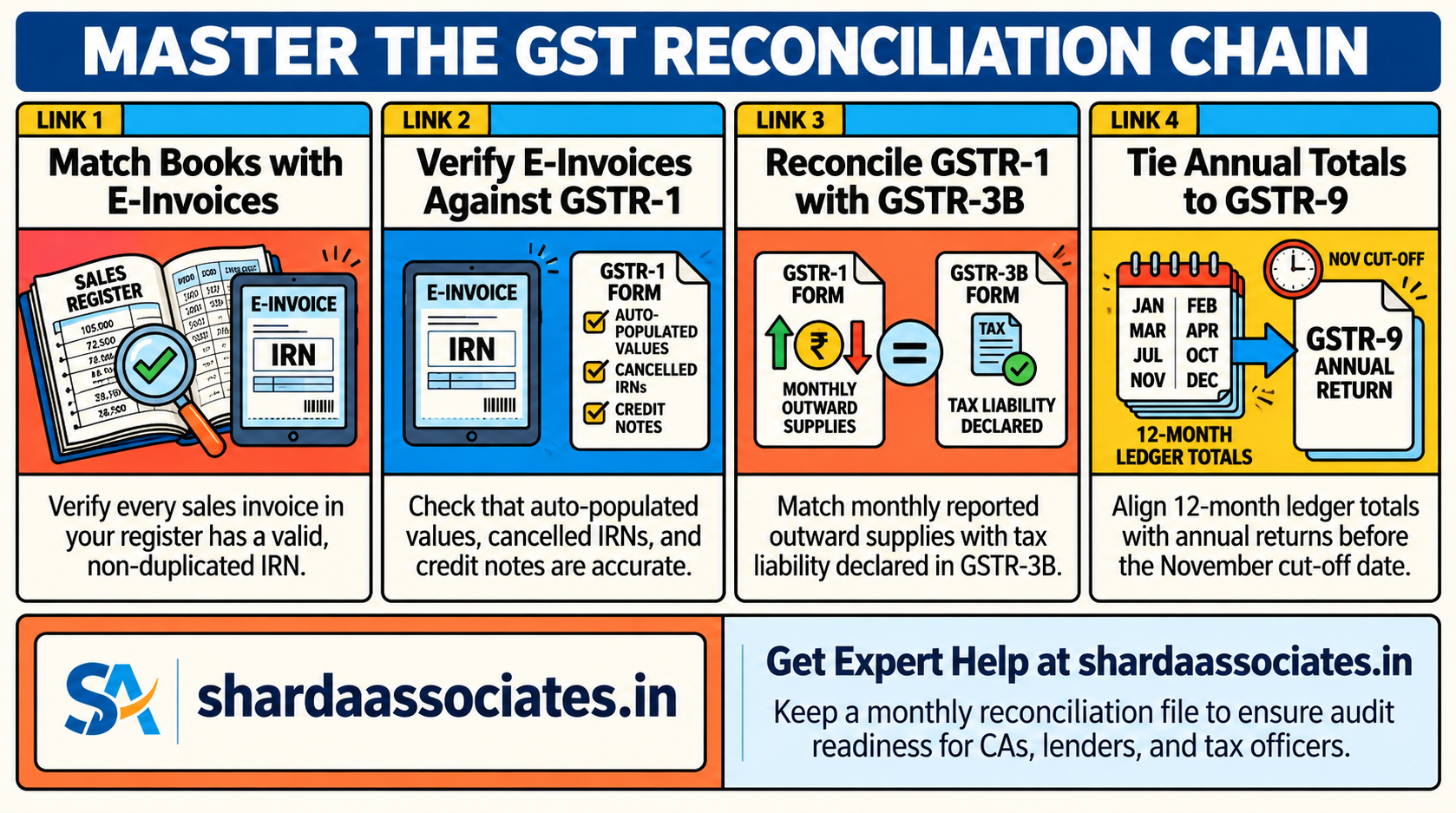
Short answer: GST Reconciliation in a chain. First match your sales register in the books with your e-invoice (IRN) register, then match both with GSTR-1, then match GSTR-1 with the liability declared in GSTR-3B, and finally tie the annual totals back to the books and the annual return. Each link tests a different risk, and a gap at any link should be explained, corrected before the year-end cut-offs, or paid.
Four data sources describe the same sales: the books, the e-invoice portal, GSTR-1 and GSTR-3B. They are meant to say the same thing, but they are filled at different times by different people and systems, so small differences collect through the year. At year end they become a long list of questions.
Sharda Associates is a CA-led firm that has prepared over 45,500 CA-certified reports. In loan files we see GST figures set against financial statements, which makes a clean reconciliation valuable beyond the GST portal.
This guide sets out what to match with what, the usual reasons for differences and how to fix each. It is general information. Thresholds and dates can change by notification, so confirm current rules with your CA.
What Is the GST Reconciliation Chain?
| Link | What to compare | What it tests |
| 1 | Books and e-invoice (IRN) register | Every invoice in the books has an IRN, and none is missing or duplicated |
| 2 | E-invoice register and GSTR-1 | Auto-populated invoices appear in GSTR-1 as issued |
| 3 | GSTR-1 and GSTR-3B | Liability in GSTR-3B covers outward supplies in GSTR-1 |
| 4 | Annual totals and the books, GSTR-9 | Year totals agree with the ledgers and annual return |
Link 1: Books and E-Invoices
E-invoicing applies to taxpayers whose aggregate turnover exceeded ₹5 crore in any year since FY 2017-18, and covered suppliers with turnover of ₹10 crore and above must report invoices within 30 days. Compare the sales register with the IRN register and list every invoice that is in one but not the other, such as an invoice raised without an IRN or an IRN for an invoice not booked. For a covered supplier, an invoice without a valid IRN is generally not a valid tax invoice.
Link 2: E-Invoices and GSTR-1
E-invoice details auto-populate GSTR-1. Do not assume the draft is correct. Check that every IRN-linked invoice appears, that cancelled IRNs are handled, and that you have not edited auto-populated values without a reason. Also check credit and debit notes, which also need an IRN for covered suppliers, and exports and SEZ supplies.
Link 3: GSTR-1 and GSTR-3B
GSTR-3B should declare liability for the same outward supplies that GSTR-1 reports. Compare the totals month by month for taxable value, each tax head and nil-rated or exempt supplies. Differences arise from credit notes in a different month, amendments and advances. A large gap can attract a system intimation, such as DRC-01B.
Link 4: Annual Totals, Books and GSTR-9
Add the twelve months and compare with the ledger, the profit and loss account and the annual return. Differences here usually come from timing, assets sold, non-GST income and corrections made after year end.
Why Do the Four Sources Differ?
- Cancellations. An e-invoice can be cancelled on the portal only in full and only within 24 hours. After that the fix is a credit note and, if needed, a new invoice
- Credit notes and debit notes recorded in a different month
- Advances on which tax was paid but revenue is recognised later
- Amendments to GSTR-1 after the original filing
- Cut-off invoices raised close to 31 March and recorded in different years
- Manual edits to auto-populated GSTR-1 data
- Offline invoices raised outside the system and missed in reporting
A Worked Example
Here is an illustration with made-up figures for one month. The sales register shows ₹40,00,000. The IRN register shows ₹3,950,000 because one invoice of ₹50,000 was raised without an IRN. GSTR-1 shows ₹39,50,000. GSTR-3B shows ₹3,950,000. The missing ₹50,000 is a real difference, not a timing item: the invoice needs to be regularised, the tax reported and, where the law requires it, an explanation prepared. Finding it in the month is easy; finding it in December is harder.
How Should You Fix a Difference?
- Missed or wrong outward supply: correct it in a GSTR-1 amendment or report it and pay the tax with interest as the facts require
- Cancelled invoice or return of goods: issue a credit note, and make sure it is reported
- Timing item: document it in the reconciliation and let it reverse next period
- Books error: correct the books so the year starts clean
Do this before the year-end cut-offs, generally 30 November after the year for credit notes and corrections, and keep proof for each correction.
What Should the Reconciliation File Contain?
Keep one file per financial year so that a CA, an officer or a lender can follow it without you:
- The sales register, the IRN register and the GSTR-1 and GSTR-3B summaries for each month
- A month-wise table of totals with the differences and the reason for each
- Copies of credit notes, amendments and proof of any tax paid on corrections
- A note listing offline invoices and how they were regularised
- The annual summary tied to the ledger and to GSTR-9
A file like this takes a few hours a month to maintain and saves days at year end.
Conclusion
Year-end reconciliation is easier if you treat it as a chain of small checks, not a single big one. Each link has a clear question, a clear document and a clear fix. Gaps found early are usually timing items; gaps found late tend to be tax.
A monthly version of the same chain, checking the sales register against the IRN register and GSTR-1 before you file each month, keeps year end quiet. It also gives you a ready reconciliation if a notice or a lender asks.
If you would like your sales reconciliation reviewed, call Sharda Associates on +91 89899 77769. Outcomes depend on the facts, so no result can be promised.
Frequently Asked Questions
1. What should I reconcile at GST year end?
Books, the e-invoice register, GSTR-1 and GSTR-3B, and then the annual totals with the books and GSTR-9.
2. Does e-invoice data flow into GSTR-1?
Yes, e-invoice details auto-populate GSTR-1, but check the draft against your books.
3. Who must issue e-invoices?
Taxpayers whose aggregate turnover exceeded ₹5 crore in any year since FY 2017-18, as per current rules.
4. Can I cancel an e-invoice later?
Only in full and within 24 hours. After that, issue a credit note.
5. What is the 30-day rule?
Taxpayers with aggregate turnover of ₹10 crore and above must report invoices to the IRP within 30 days of the invoice date.
6. Why does GSTR-3B differ from GSTR-1?
Credit notes, amendments and advances in different months are common reasons.
7. Can a gap lead to a notice?
A large gap between GSTR-1 liability and GSTR-3B can lead to a system intimation, so reconcile monthly.
8. Do I need this if I am below the e-invoice threshold?
You can skip the IRN link but should still reconcile books, GSTR-1 and GSTR-3B.
9. What deadline matters for corrections?
Generally 30 November following the year, or the annual return date if earlier.
10. How often should I reconcile?
Monthly, with a full check at year end.