
Short answer: If your startup is a company, the law requires a chartered accountant, as the statutory auditor, and a CA is also the practical choice for GST, TDS, income tax and ROC filings, DPIIT and tax-holiday applications, valuations, fundraising and bank-loan documents. Not every task is legally reserved for a CA, and a small proprietorship may not need an audit at all. But the cost of a wrong or missed filing is usually larger than the cost of good advice.
Founders rarely start a company to do compliance. They start to build a product, and accounts, filings and tax are things to deal with later. The trouble is that later arrives on a calendar: a GST return is due every month, ROC returns every year, and an investor or a bank will ask for clean numbers just when you are busiest.
Sharda Associates is a CA-led firm that has prepared over 45,500 CA-certified reports, including project reports and CMA data accepted by banks. We see what founders are asked for at the moment they raise money or apply for a loan, and the same gaps appear again and again.
Is a CA Legally Required for a Startup?
| Entity | Is a CA required? |
| Private limited company | Yes, a statutory auditor who is a chartered accountant must be appointed |
| LLP | Audit is required above prescribed turnover or contribution limits |
| Partnership or proprietorship | No audit by default, but tax audit applies if the prescribed limits are crossed |
Even where a CA is not mandatory, most founders need one for tasks that are technical and unforgiving: GST, TDS, ROC and income tax.
What Does a CA Do for a Startup?
- Structuring and incorporation advice: choosing between a company, an LLP and other forms, and setting up the books correctly from day one
- Bookkeeping review and financial statements that stand up to investors and lenders
- GST: registration, monthly returns, ITC reconciliation and notices
- TDS and income tax: deduction, deposit, returns and advance tax
- ROC compliance: annual financial statements and annual return, plus director and statutory filings
- Valuation and share issue support: certificates and workings needed when shares are issued
- Fundraising and due diligence: clean books, cap table support and responses to investor queries
- Bank finance: project report, CMA data and means of finance for loans and government schemes
When Do Founders Need a CA Most?
| Stage | What a CA helps with |
| Before incorporation | Choice of entity, founder agreements, tax planning |
| First sales | GST registration, invoicing, expense records |
| First hires | TDS, payroll compliance, ESOP planning |
| Fundraising | Valuation, due diligence, financial statements |
| Loan or scheme application | Project report, CMA, means of finance |
| Growth | Audit, internal controls, tax planning |
What Does Early CA Involvement Look Like in Practice?
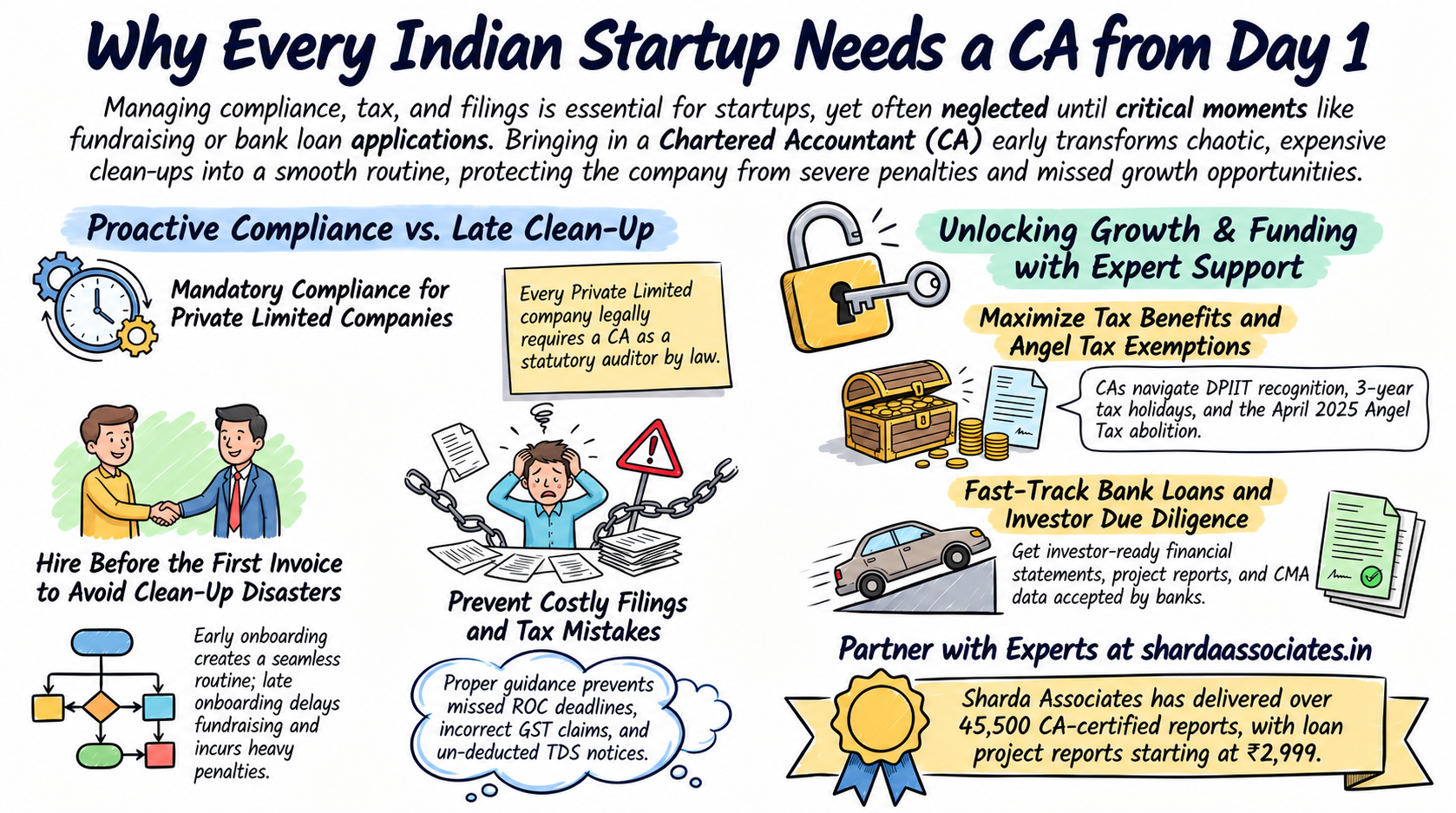
Here is an illustration, not a case study. Two founders set up similar companies. The first brings in a CA before the first invoice, so the books, GST registration and expense records are set up correctly, and ROC and tax dates go on a calendar. The second starts when an investor asks for financial statements, eighteen months later. The second founder’s CA has to rebuild eighteen months of records, correct GST and TDS issues and file overdue returns with late fees, all while the fundraise waits. The work is similar in both cases, but the first is a routine and the second is a clean-up.
Which Mistakes Does a CA Help Prevent?
- Missing annual ROC filings, which attract late fees and can lead to further action
- Mixing founder and company money, which blurs the accounts
- Wrong GST registration or ITC claims that surface as notices
- TDS not deducted or deposited on time
- Issuing shares without proper valuation support
- Claiming expenses without evidence
Which Tax Benefits Can a CA Help Evaluate?
DPIIT recognition is a gateway to Startup India benefits, and its criteria were revised in 2026, so check the current notification. The tax holiday for eligible startups, a 100 percent deduction of profits for three consecutive years out of the first ten, historically sat in Section 80-IAC and is understood to sit in Section 140 of the Income-tax Act, 2025. It needs an Inter-Ministerial Board certificate and has its own conditions, so DPIIT recognition alone does not give it. Angel tax under Section 56(2)(viib) has been abolished with effect from 1 April 2025. A CA can tell you whether a benefit applies to your structure and how to claim it.
How Do You Choose a CA for a Startup?
- Ask whether they have worked with startups at your stage
- Check that they cover GST, TDS, income tax and ROC, or can coordinate them
- Agree a calendar of filings and a way to share documents
- Ask how they handle notices and deadlines
- Confirm fees and scope in writing
Conclusion
A startup does not need a CA because the law says so in every case. It needs one because accounts, tax and filings run on a calendar and a missed date costs money. A CA turns that calendar into a routine and gives investors and lenders numbers they can trust.
The best time to bring a CA in is before the first invoice, when the structure and the books are easy to set up. The next best time is before the first fundraise or loan application, when the questions get harder.
Sharda Associates prepares CA-certified project reports starting from ₹2,999, typically delivered in 24-48 hours, and helps founders get their financial documents ready for banks and schemes. Outcomes depend on the facts, so no result can be promised. Call +91 89899 77769 to talk through what your startup needs.
Frequently Asked Questions
1. Is a CA mandatory for a startup in India? For a company, a CA statutory auditor is required. For other entities it depends on the audit limits, though a CA is still advisable.
2. Can a CA register my startup? Yes, a CA can advise on structure and help with incorporation formalities, along with tax registrations.
3. What is the difference between a CA and a CS? A CA focuses on accounts, audit and tax, while a company secretary focuses on corporate law compliance. Many startups use both.
4. When should I hire a CA? Ideally before the first invoice, and certainly before fundraising or applying for a loan.
5. Does DPIIT recognition give a tax holiday? No. The tax holiday needs a separate Inter-Ministerial Board certificate and meets other conditions.
6. Is angel tax still applicable? Section 56(2)(viib) has been abolished with effect from 1 April 2025.
7. What happens if I miss ROC filings? Late fees apply and further action can follow, so file on time.
8. Can a CA help me get a bank loan? Yes, by preparing the project report, CMA data and means of finance that lenders ask for.
9. Should I use an online accounting platform or a CA? Software helps with bookkeeping, but advice, filings and certifications still need a professional.
10. How do I choose a CA for a startup? Look for startup experience, coverage of GST, TDS, income tax and ROC, clear scope and responsiveness.