
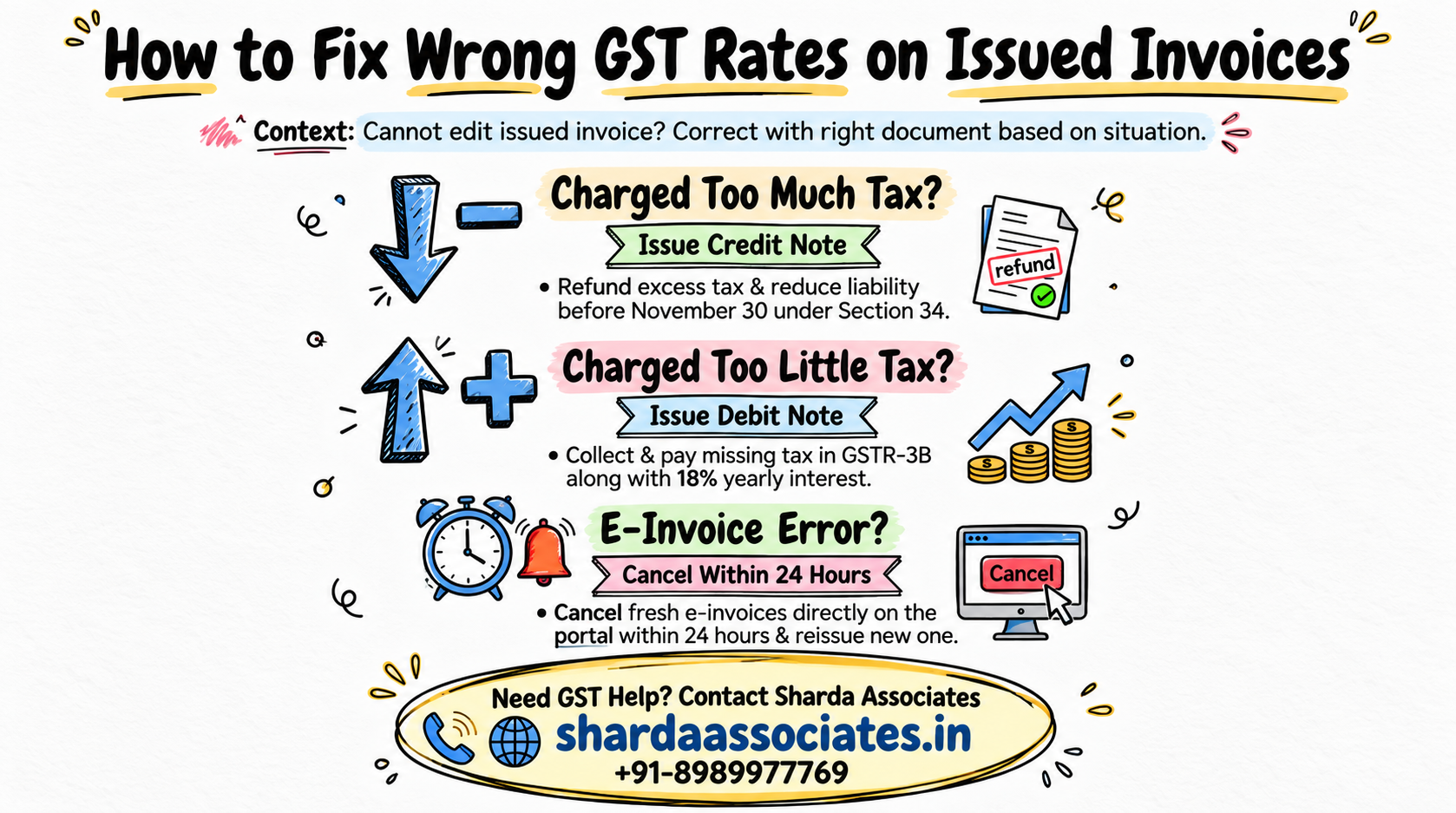
Short answer: You cannot edit a GST invoice once it is issued. If you charged too much tax, issue a credit note. If you charged too little, issue a debit note and pay the extra tax. If you made an e-invoice and notice the error within 24 hours, cancel it on the portal and issue a fresh one. The right fix depends on how late you find the error.
Key points
- Rate too high: credit note under Section 34.
- Rate too low: debit note, then pay the additional tax.
- E-invoice: cancel within 24 hours on the invoice portal, otherwise use a note.
- The 30 November limit applies to credit notes that reduce your liability.
Pick Your Situation
| What happened | What you do | Document |
| Charged 18% instead of 12% | Refund the extra 6% | Credit note |
| Charged 12% instead of 18% | Collect and pay the extra 6% | Debit note |
| Error found before sending the invoice | Cancel and reissue | New invoice |
| E-invoice error found within 24 hours | Cancel on the portal, reissue | New e-invoice |
| E-invoice error found after 24 hours | Use a credit or debit note, or the amendment route allowed | Note |
| Wrong HSN but the same rate | Amend the details in GSTR-1 | Amendment entry |
If You Charged Too Much Tax
- Confirm the correct rate from the HSN or SAC code and the latest notification.
- Issue a credit note for the excess taxable value or tax, quoting the original invoice number and date.
- Report it in GSTR-1 for the month of issue.
- Reduce your liability in GSTR-3B, if the conditions of Section 34 are met.
- Tell your buyer, who must reverse the extra ITC.
- Refund or adjust the extra amount with the buyer.
- Save the note, the original invoice and the buyer’s acknowledgement.
If You Charged Too Little Tax
- Issue a debit note for the additional tax, quoting the original invoice.
- Report it in GSTR-1 and pay the tax in GSTR-3B.
- Calculate interest on the short-paid tax, generally at 18% a year from the original due date.
- Inform the buyer, who can claim the additional ITC on the debit note, subject to conditions.
- If you are paying before any notice, you can deposit the tax and interest through Form DRC-03.
- Keep proof of payment for the audit file.
A Quick Example
You issue an invoice for ₹1,00,000 with 12% GST (₹12,000), but the correct rate is 18% (₹18,000).
- Issue: a debit note for ₹6,000 of additional tax.
- Pay: ₹6,000 plus interest at 18% a year from the original due date.
- Buyer: claims ₹6,000 more ITC after the debit note appears in their GSTR-2B.
If the rates were the other way round, a credit note for ₹6,000 reverses the excess.
Time Limits to Remember
- Credit notes: to reduce your tax liability, declare the credit note in your return by 30 November following the financial year, or the date of the annual return, whichever is earlier.
- Debit notes: there is no similar cut-off, but pay the tax and interest as soon as you find the error.
- E-invoice cancellation: within 24 hours of generating the invoice reference number.
- Annual return: differences not fixed by then must be disclosed there.
What Happens on the Buyer’s Side?
- A credit note reduces the buyer’s ITC, so they must reverse the excess.
- A debit note allows additional ITC on the extra tax.
- The buyer should check the note in GSTR-2B and reconcile it in the same month.
- Supplier and buyer should confirm the correction in writing.
Practical Tips
- Map every item to the right HSN or SAC code in your billing software.
- Update rates whenever a notification changes them.
- Have one person review rate changes each month.
- Check new items before the first invoice.
- Reconcile GSTR-1 with books before filing GSTR-3B.
Conclusion
A wrong GST rate is easy to fix if you act early. Issue a credit note when the rate was too high, a debit note when it was too low, and cancel and reissue when the invoice is fresh, especially for e-invoices within 24 hours. Tell your buyer, report the note in GSTR-1 and settle any interest.
Build a monthly check of rates and HSN codes so the error does not repeat. For GST corrections, notices and CA-prepared project reports for loans, call Sharda Associates on +91-8989977769.
Questions People Ask
Can I edit a GST invoice? No. Use a credit note, debit note or cancel and reissue.
What if I charged a higher rate? Issue a credit note for the extra tax.
What if I charged a lower rate? Issue a debit note and pay the additional tax.
Can I cancel an e-invoice? Yes, within 24 hours on the portal, and then reissue it.
Is there a time limit for correction? For credit notes, 30 November after the financial year or the annual return date, whichever is earlier.
Does the buyer have to do anything? Yes, reverse or claim ITC as per the note.
Is interest payable? On short-paid tax, yes, generally at 18% a year.
Can GSTR-1 amendments fix a rate error? Usually a note is needed for a rate error, while GSTR-1 amendments suit data errors like HSN or invoice details.