
Most startups do not fail because the idea is bad. They fail because the cash runs out before the revenue arrives. To manage startup finances well, track cash every week, know your burn and runway, build a simple budget, watch a few key metrics and keep compliance clean. This guide gives founders and CFOs a practical routine they can start this month.
At Sharda Associates, our Chartered Accountants (CA) work with startups on budgeting, MIS reports, GST and tax compliance, and CA-certified project reports for bank loans and funding. A project report forces you to put your plan in numbers, covering project cost, sales, margins, cash flow and loan repayment, so it doubles as a financial plan you can actually follow.
Lenders and investors read the same numbers you use to run the business. When your project report, budget and monthly reports agree, funding conversations get shorter and your credibility goes up. If you plan to raise money in the next 6 to 12 months, ask a CA to review your financial model before you share it with anyone.
1. Treat Cash as the First Priority
Profit on paper does not pay salaries. Cash does.
- Update your bank balance and upcoming payments every week.
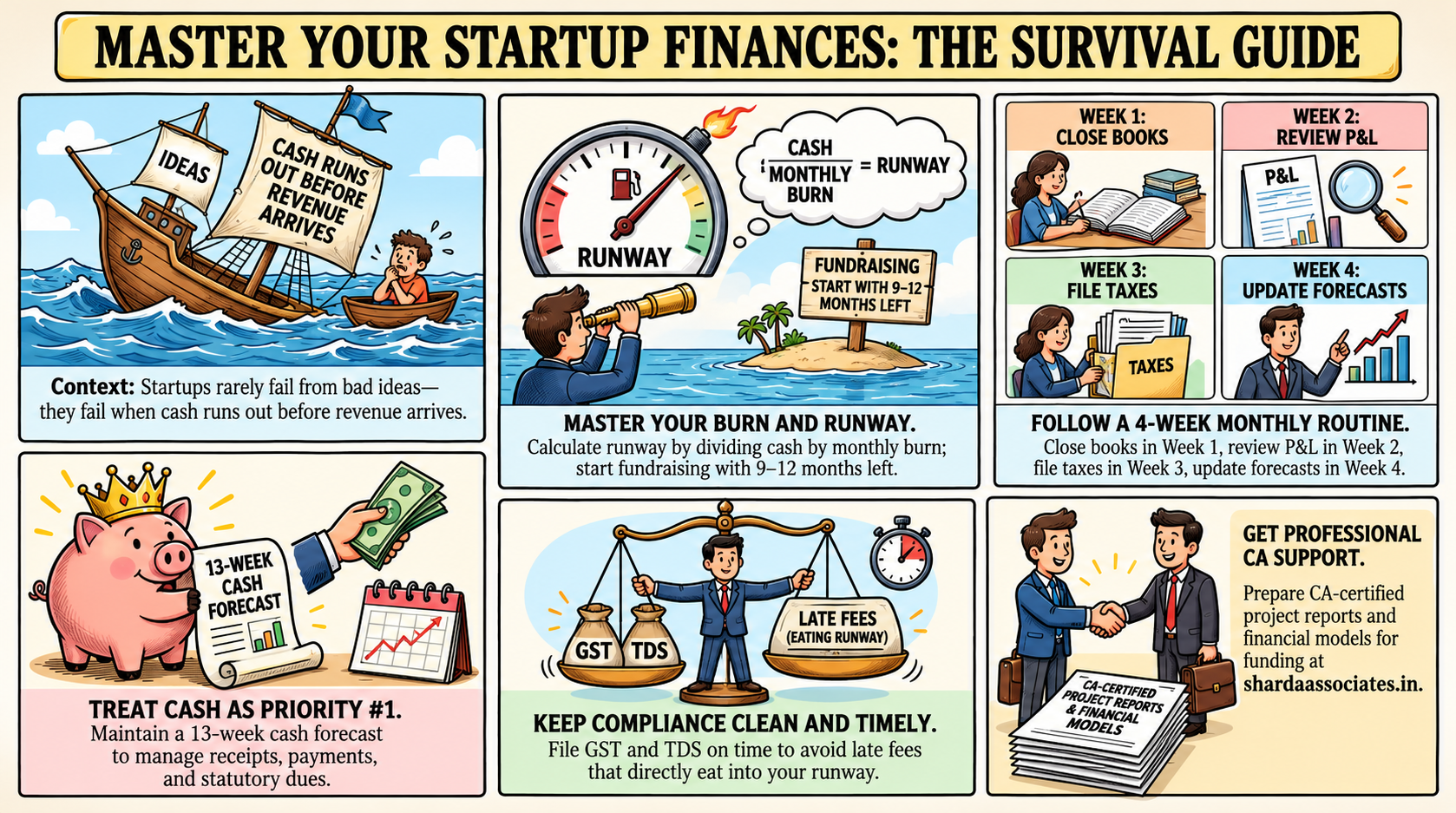
- Keep a 13-week cash forecast showing expected receipts and payments.
- Follow up on overdue customer payments early.
- Negotiate longer credit from suppliers where possible, without damaging relationships.
- Keep a cash buffer for statutory dues such as GST, TDS and salaries.
2. Know Your Burn Rate and Runway
- Burn rate: the cash you spend each month beyond what you earn.
- Runway: current cash divided by monthly burn, which tells you how many months you can survive.
For example, with ₹30 lakh in the bank and a monthly net burn of ₹5 lakh, your runway is 6 months. Start fundraising or cost-cutting when runway drops to about 9 to 12 months, because raising money takes time.
3. Build a Simple Budget and Compare It Every Month
Create a monthly budget for sales, direct costs, salaries, marketing, rent, software and compliance. At month end, compare actuals with the budget and note the reasons for large gaps. Revise the budget quarterly, because a startup’s plan changes faster than a large company’s.
4. Track a Few Metrics That Matter
| Metric | What it tells you |
| Gross margin | How much is left after direct costs of delivering your product or service |
| Burn rate | How fast you are using cash |
| Runway | How long cash will last |
| Customer acquisition cost (CAC) | What you spend to win one customer |
| Customer lifetime value (LTV) | What a customer is worth over time |
| Monthly recurring revenue (MRR) | Predictable monthly income, for subscription businesses |
| Receivable days | How long customers take to pay |
| Payable days | How long you take to pay suppliers |
Choose five or six that fit your model and review them monthly, rather than tracking everything.
5. Keep the Accounting and Compliance Clean
- Use accounting software and record transactions weekly.
- Keep business and personal money separate.
- File GST and TDS returns on time and pay advance tax if it applies.
- Reconcile GST returns with your books each quarter.
- Reply to notices within the due date.
Late fees and interest are avoidable costs that eat directly into your runway.
6. Plan Funding Early
| Funding option | Best for | Things to prepare |
| Bank loan or working capital limit | Businesses with steady revenue or assets | Project report, financial statements, GST returns |
| Government-backed loan schemes | Small and micro enterprises, first-time entrepreneurs | Project report, Udyam registration, KYC |
| Angel or venture investment | High-growth businesses | Financial model, cap table, clean books |
| Customer advances or revenue-based financing | Businesses with predictable sales | Contracts, billing history |
| Founder or friends capital | Early stage | Written terms, proper records |
Whatever route you pick, record every funding transaction properly. Loans, equity and director funds each need different treatment in the books and in tax.
7. Control Costs Without Slowing Growth
- Review subscriptions and software every quarter.
- Tie marketing spend to customer acquisition cost.
- Outsource non-core work where it is cheaper than hiring.
- Ask for proper invoices so that GST input tax credit is not lost.
- Compare actual spending with budget before approving big purchases.
8. Build a Monthly Finance Routine
- Week 1: close the previous month’s books and reconcile bank statements.
- Week 2: review the profit and loss, cash flow and key metrics.
- Week 3: file GST and TDS returns, and pay statutory dues.
- Week 4: update the 13-week cash forecast and revise the budget if needed.
A one-page dashboard with cash, burn, runway, sales and receivables is enough for most founders.
When Should You Bring in a CA or Part-Time CFO?
- You are preparing for a loan or funding round.
- Your books are behind or cash is always short.
- You have crossed a GST or tax audit threshold.
- You received a notice and need a proper reply.
- You want a financial model and a project report for lenders.
Conclusion
Managing startup finances comes down to a few habits: watch cash weekly, know your burn and runway, compare actuals with a budget, track a handful of metrics and keep compliance clean. These habits let you make faster and safer decisions, and they make fundraising easier.
Start with the monthly routine above and refine it as you grow. For startup finance support, GST and tax compliance, and CA-certified project reports for bank loans and investors, call Sharda Associates on +91-8989977769
Questions Founders and CFOs Ask
Q1. What is the most important number for a startup? Cash in the bank, followed by monthly burn and runway.
Q2. How do I calculate runway? Divide current cash by monthly net burn.
Q3. How much cash buffer should I keep? Many startups aim for at least 6 to 12 months of runway, depending on funding plans.
Q4. Should a startup use the accrual or cash method? Most use accrual, since investors and lenders expect it, but ask your CA for your case.
Q5. How does a project report help with finances? It sets out your costs, funding needs, projections and repayment capacity in one document.
Q6. How often should I review financials? Cash weekly, and profit, budget and metrics monthly.
Q7. Can a CA act as my part-time finance head? Yes. Many startups use a CA for monthly MIS, compliance and funding support before hiring a full-time CFO.
Q8. What compliance mistake costs startups the most? Late GST and TDS filing, because of late fees, interest and notices.