
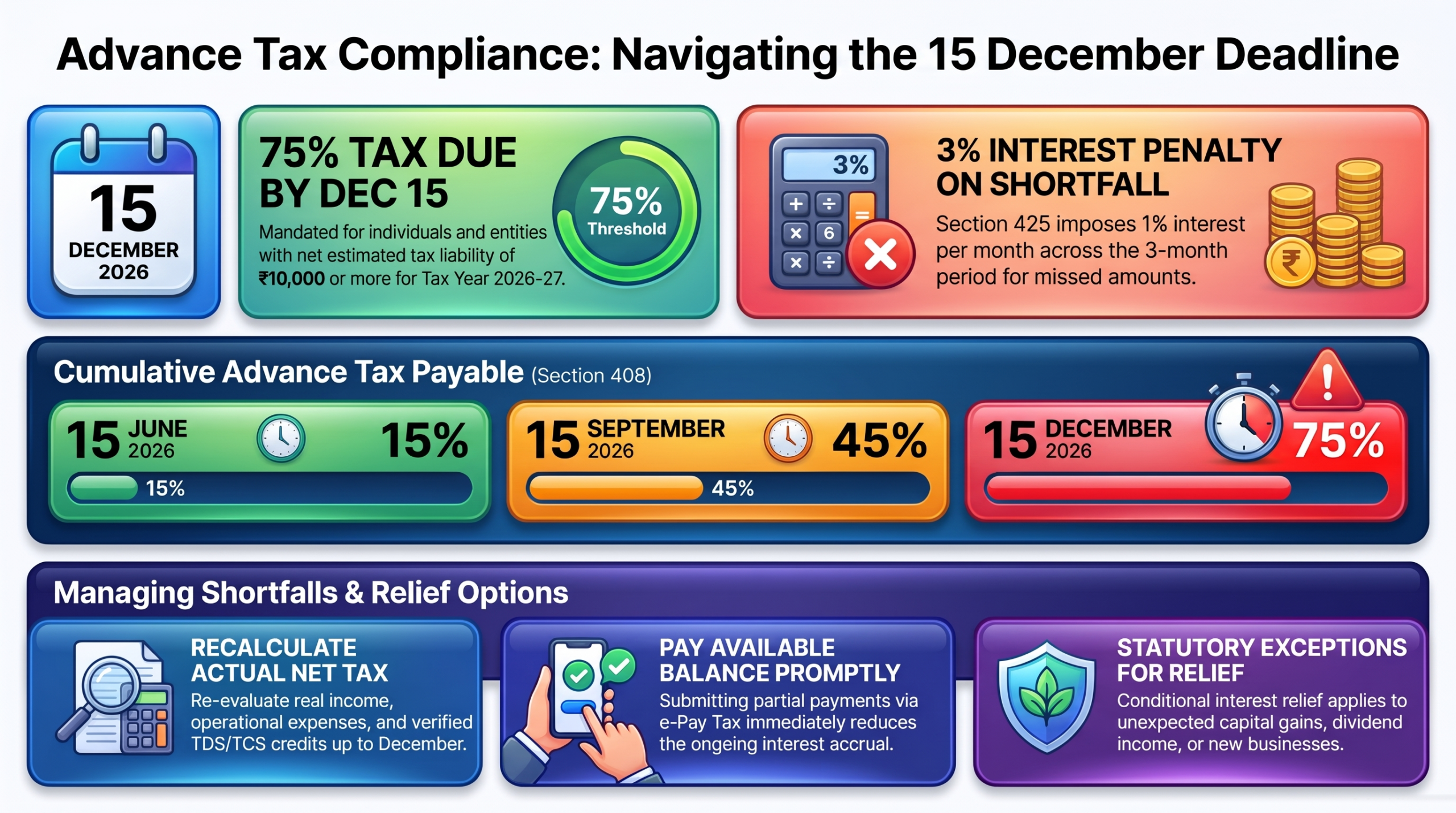
Advance tax is an important tax obligation for individuals, freelancers, and businesses whose estimated net tax liability is ₹10,000 or more. For Tax Year 2026–27, the third advance tax installment is due on 15 December 2026, by which eligible taxpayers generally need to pay 75% of their estimated annual advance tax liability.
But what happens if your business income is lower than expected or you cannot arrange the required amount before the deadline? A shortfall may attract interest under Section 425 of the Income Tax Act, 2025, subject to applicable exceptions.
Understanding the payment requirements, interest calculation, and available relief provisions can help you avoid unnecessary tax costs and plan your remaining payments before 15 March 2027.
Quick Answer: If your advance tax payment is below 75% of your estimated tax liability by 15 December 2026, you may have to pay interest on the shortfall under Section 425 of the Income-tax Act, 2025. You should reassess your income, calculate the remaining tax, and pay as much as possible before the deadline. The final advance tax installment is due by 15 March 2027.
What Is the Advance Tax Due Date for 15 December 2026?
The third instalment of advance tax for Tax Year 2026–27 is due on 15 December 2026. Eligible taxpayers must ensure that their cumulative advance tax payment reaches at least 75% of their estimated annual advance tax liability by this date.
The instalment schedule under Section 408 of the Income-tax Act, 2025 is:
| Payment deadline | Cumulative advance tax payable |
| 15 June 2026 | 15% |
| 15 September 2026 | 45% |
| 15 December 2026 | 75% |
| 15 March 2027 | 100% |
These percentages are cumulative, not additional instalments. For example, if you have already paid 45% by September, you need to pay another 30% by December to reach 75%.
Source: Section 408, Income-tax Act, 2025.
Who Needs to Pay Advance Tax?
Advance tax generally applies when your estimated net tax payable for the tax year is ₹10,000 or more after considering eligible tax deductions and credits, including TDS and TCS.It may apply to:
- Business owners and companies earning taxable profits.
- Freelancers and consultants receiving professional income.
- Salaried employees with additional taxable income.
- Individuals earning rental income or interest from deposits.
- Taxpayers earning capital gains or other taxable income.
If your employer or another payer has already deducted sufficient TDS, your remaining advance tax liability may be lower.
Important exception: Eligible taxpayers opting for the presumptive taxation provisions covered under Section 58(2), including specified cases under Sections 44AD and 44ADA, generally pay their entire advance tax by 15 March instead of following the four-instalment schedule.
What Happens If You Cannot Pay 75% of Advance Tax by 15 December?
If you cannot reach the required 75% payment by 15 December, you should not ignore the shortfall.
Under Section 425 of the Income-tax Act, 2025, interest may apply when the required advance tax installment is not paid on time.
For the December instalment, the applicable interest is 3% of the shortfall, representing 1% per month for the specified three-month period.
However, the actual calculation depends on your tax liability, earlier payments and applicable statutory exceptions.
Example: Advance Tax Shortfall in December 2026
Suppose your estimated advance tax liability for Tax Year 2026–27 is ₹1,00,000.
| Particulars | Amount |
| Total estimated advance tax | ₹1,00,000 |
| Required cumulative payment by 15 December (75%) | ₹75,000 |
| Advance tax already paid | ₹45,000 |
| Additional payment required | ₹30,000 |
If you pay nothing further by 15 December, the shortfall is ₹30,000.
Illustrative interest under Section 425:
₹30,000 × 3% = ₹900
This example assumes the stated tax liability and payments are correctly determined and no statutory exception applies.
What Should You Do If You Cannot Pay the Full Amount?
If your business is facing a cash shortage or your income is lower than expected, take the following steps:
1. Recalculate Your Actual Tax Liability
Do not blindly use your earlier estimate. Review your actual income and expenses up to December.
For business owners, consider sales, operating expenses, salary payments, business profits and other taxable receipts.
2. Check Your TDS and TCS Credits
Review your available tax credits and verify whether TDS or TCS has been correctly considered. Do not pay advance tax twice on income for which tax has already been deducted or collected.
3. Pay the Amount You Can Afford
If you cannot arrange the entire amount, pay the available amount through the official Income Tax e-Pay Tax facility. This can reduce the unpaid balance, although it does not automatically eliminate interest on any shortfall.
4. Reassess Your Tax Before March
Your income may change during the remaining financial year. Recalculate your liability and pay the balance by 15 March 2027.
5. Maintain Payment Records
Keep your challan receipt, payment reference and tax calculation. Verify that the payment is reflected against the correct Tax Year 2026–27.
Are There Any Exceptions to Advance Tax Interest?
Yes. Section 425 provides relief in specified circumstances where additional income could not reasonably have been estimated earlier.
These include certain income arising from:
- Capital gains.
- Dividend income.
- Business or professional income arising for the first time.
- Specified income covered under the relevant statutory provision.
The relief is conditional. The tax payable on such income must be paid in the remaining advance tax instalments or by 31 March 2027, as applicable.
Therefore, receiving unexpected income does not automatically exempt a taxpayer from advance tax interest. The statutory conditions must be satisfied.
How Can Businesses Avoid Advance Tax Shortfalls?
Businesses should review their estimated taxable profits regularly rather than calculating advance tax only once a year.
Some useful practices include:
- Preparing monthly profit and loss statements.
- Monitoring sales, expenses and cash flow.
- Reviewing TDS and TCS credits.
- Estimating tax on additional income.
- Keeping funds aside for upcoming tax instalments.
- Reviewing tax calculations with a qualified tax professional.
A proper tax estimate helps businesses avoid unexpected tax demands and interest expenses.
How Can Sharda Associates Help?
Sharda Associates assists individuals, startups, and businesses with income tax compliance, tax planning, and financial consultancy.
Our team can help review estimated taxable income, reconcile available TDS/TCS credits, calculate advance tax liability, and understand applicable payment requirements.
Conclusion
Missing the 75% advance tax target on 15 December 2026 can result in interest, but taxpayers should first review their actual income,
tax credits and previous payments before calculating the shortfall. Paying the available amount, correcting estimates and clearing the remaining liability within the applicable timeline can help manage tax compliance. If you are unsure about your advance tax calculation, Sharda Associates can assist with tax estimation and compliance planning.
For assistance with advance tax calculations and income tax compliance, contact Sharda Associates at +91 89899 77769 or +91 79870 21896.
Frequently Asked Questions
1. What is the advance tax due date in December 2026?
The third advance tax installment for Tax Year 2026–27 is due on 15 December 2026. Taxpayers generally need to have paid at least 75% of their estimated advance tax liability cumulatively by this date.
2. What happens if I pay less than 75% advance tax by 15 December?
Interest may apply to the shortfall under Section 425 of the Income-tax Act, 2025. For the December instalment, the specified interest is 3% of the shortfall, subject to applicable conditions and exceptions.
3. Can I pay advance tax after 15 December 2026?
Yes. You can still pay the outstanding advance tax. However, delayed payment may attract interest. The next regular instalment deadline is 15 March 2027.
4. Is advance tax compulsory for salaried employees?
It may be compulsory if the estimated net tax payable after TDS and other eligible credits is ₹10,000 or more. Additional income from rent, interest, capital gains or other sources may create an advance tax liability.
5. Is advance tax applicable if my employer deducts TDS?
Yes, if your remaining estimated tax payable after considering TDS and other eligible credits is ₹10,000 or more. If sufficient TDS covers your tax liability, additional advance tax may not be necessary.
6. Can I avoid interest if I receive unexpected capital gains?
Section 425 provides a conditional exception for certain capital gains and other specified income. The relevant tax must be paid in the remaining instalments or by 31 March 2027, subject to statutory requirements.
7. What is the final advance tax payment date for Tax Year 2026–27?
The final advance tax instalment is due on 15 March 2027. By this date, taxpayers generally need to pay 100% of their estimated advance tax liability cumulatively.
8. Where can I pay advance tax online?
You can pay through the official Income Tax e-Filing portal using its e-Pay Tax facility. Select the correct tax year, 2026–27, and verify the payment details before submitting the challan.