
Sharda Associates is a Bhopal-based CA and financial consultancy firm with 45,500+ CA-certified reports delivered, accepted by SBI, PNB, Bank of Baroda, and other scheduled banks. We prepare your project report for bank loan, CMA data and subsidy applications, so you can use any new Budget benefit the day it opens.
The Union Budget 2027-28 is expected in early February 2027. MSMEs want faster payments, easier credit and simpler compliance from it, because cash is still stuck in unpaid invoices, and businesses needing ₹20 to ₹50 lakh still find credit hard to get.
This guide lists the expectations in industry commentary, what is already delivered, and what you can prepare today. Everything under “expectations” is a wishlist, not an announcement.
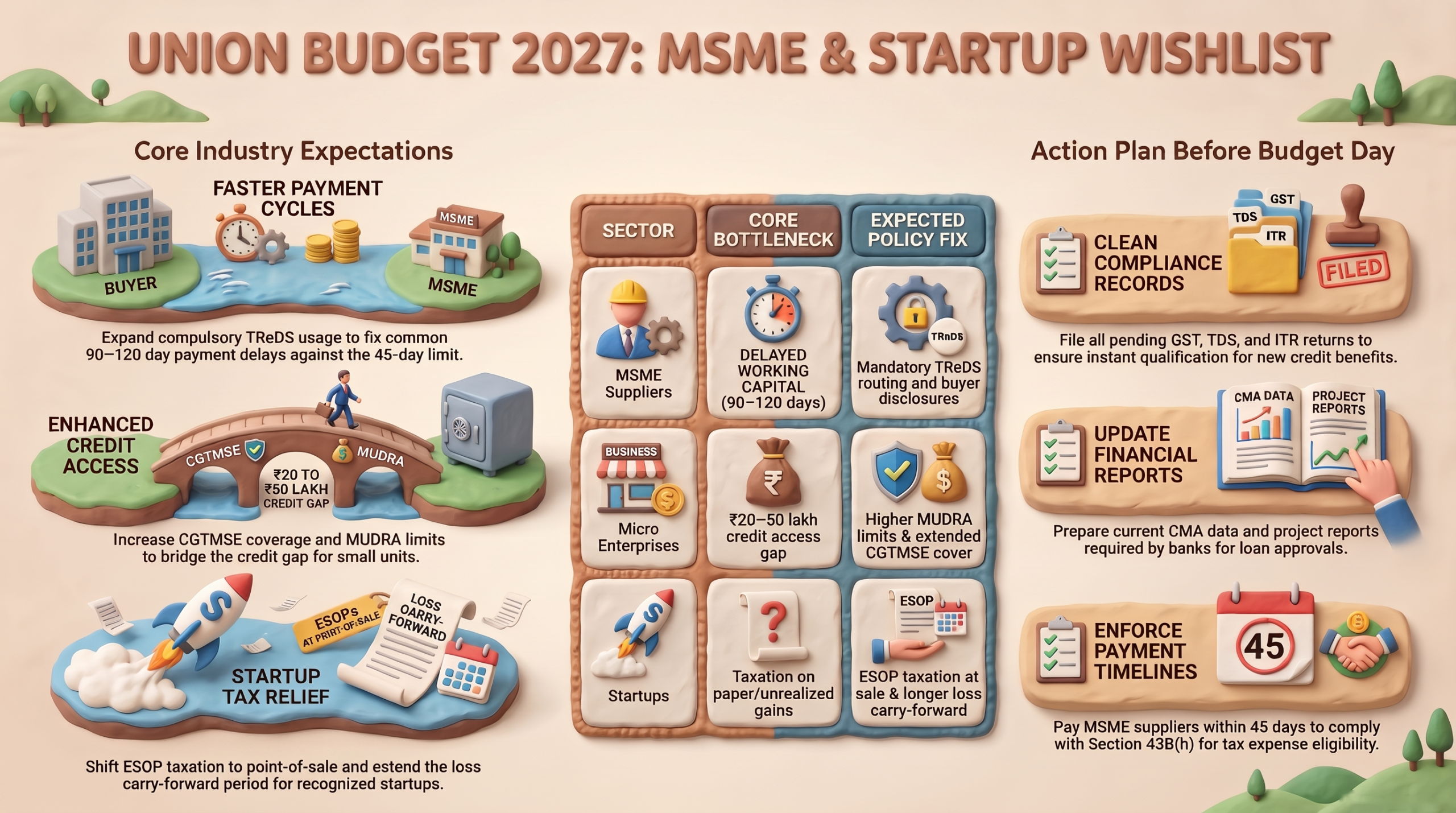
Quick Answer: MSMEs and startups expect Budget 2027 to focus on faster payments (wider TReDS use), easier credit (CGTMSE and MUDRA), simpler compliance with faster GST refunds, and for startups, ESOP tax relief and a longer loss carry-forward. The Budget is expected in early February 2027, and nothing is confirmed until it is presented.
Why does this budget matter for small businesses?
India has an estimated 6.3 crore MSMEs, which are commonly cited as contributing nearly 30% of GDP. The law says MSME suppliers must be paid within 45 days, but receivable cycles of 90 to 120 days are common. Cutting that gap works like a working-capital injection without a loan, which is why payment reform tops almost every wishlist.
Top Budget 2027 expectations
| Expectation | Who benefits | Why it matters |
| Time-bound small loan approval, wider CGTMSE cover | Micro and small units | Credit gap of ₹20 to ₹50 lakh |
| Higher MUDRA limits for compliant borrowers | Small traders, service units | Rewards clean GST and ITR record |
| Disclosure of MSME payment timelines by large buyers | MSME suppliers | Payments take 90 to 120 days against the 45-day limit |
| Wider compulsory use of TReDS | Suppliers to large buyers | Working capital without borrowing |
| Faster GST refunds | Exporters, manufacturers | Frees blocked cash |
| Simpler compliance, leniency for first-time lapses | Micro enterprises | Lower compliance cost |
| Optional presumptive tax for platform-based MSMEs | E-commerce and gig sellers | Less audit burden |
| ESOP tax at sale, longer loss carry-forward | Startups | Better for employees and founders |
What has Budget 2026-27 already given MSMEs?
- ₹10,000 crore SME Growth Fund for “Champion SMEs”.
- ₹2,000 crore top-up to the Self-Reliant India Fund.
- TReDS mandated for MSME invoices with central public sector enterprises, plus a GeM-TReDS linkage.
- CGTMSE support for invoice discounting. See our guide on the CGTMSE scheme and its ₹10 crore limit.
- ₹12.2 lakh crore capex, which supports MSME suppliers.
The MSMED Amendment Act 2026 received assent on 13 August 2026. It requires CPSEs to route MSME invoice settlement through an RBI-authorised TReDS platform, and the Government can extend this to other entities. The commencement date depends on a Government notification. If TReDS is new to you, read invoice discounting vs business loans.
What do startups expect?
Angel tax is off the list, as it was abolished from 1 April 2025. Startup talk now centres on three things:
- ESOP taxation at sale, not at exercise, so employees are not taxed on paper gains.
- A longer loss carry-forward for recognised startups.
- Easier DPIIT benefits. See how to get DPIIT recognition for a Madhya Pradesh startup.
Founders raising funds also need a strong investor story, and our pitch deck service builds one.
What should you do before Budget day?
- File everything due. Clean GST, TDS and ITR records decide your eligibility for any new credit benefit.
- Pay MSME suppliers within the agreed time, and within 45 days at most. Under Section 43B(h), the expense is allowed only when paid.
- Update your Udyam registration and keep turnover figures ready.
- Get a current CMA report. Banks ask for it with every loan. Our CMA report for bank loan service covers this.
- Review funding options with a project finance consultant.
We prepare CA-certified project reports and CMA data, apply for CGTMSE, MUDRA, PMEGP and state schemes, build startup pitch decks and projections, and review your compliance so you meet the conditions for new benefits.
Conclusion
The Budget 2027 wishlist is simple: pay MSMEs on time, make credit faster and cut compliance. For startups, ESOP and loss carry-forward relief matter most.
You cannot control the Budget, but you can control your readiness. Clean filings, timely supplier payments and a current project report put you first in line.
Get your reports and compliance ready before February 2027. Call Sharda Associates on +91 79870 21896 or +91 89899 77769, or contact us online.
Frequently asked questions
1. When is Union Budget 2027-28?
It is expected in early February 2027. The date had not been announced at the time of writing.
2. Will these expectations become law?
Only if announced in the Budget and passed through the Finance Bill. Until then they are suggestions from industry and advisers.
3. What did Budget 2026-27 give MSMEs?
A ₹10,000 crore SME Growth Fund, a ₹2,000 crore top-up to the Self-Reliant India Fund, mandatory TReDS for CPSE invoices and CGTMSE support for invoice discounting.
4. Is angel tax still applicable to startups?
No. It was abolished from 1 April 2025.
5. What is TReDS?
An RBI-authorised platform where MSMEs sell their invoices to financiers and get paid early.
6. What is the 45-day payment rule?
Under Section 43B(h), a buyer can claim the expense on purchases from micro and small suppliers only when paid, within the agreed time and in no case beyond 45 days.
7. How can an MSME prepare for new credit benefits?
Keep returns filed, books updated, Udyam current and a bank-ready project report and CMA on hand.
8. Can Sharda Associates prepare a project report for a CGTMSE or MUDRA loan?
Yes. We prepare CA-certified project reports and CMA data accepted by scheduled banks.