
Looking for a reliable tax consultant in Bhopal? Sharda Associates provides income tax consultation and tax planning services for salaried individuals, professionals, startups, and business owners. Our taxation team evaluates your income, compares the old and new tax regimes, identifies eligible deductions beyond Section 80C, and helps you maintain the necessary investment and expense proofs.
With experience in delivering 45,500+ CA-certified reports, we also support businesses with financial planning and tax compliance. Whether you need income tax planning, tax-saving investment advice or professional income tax consultancy, Sharda Associates helps you make informed tax decisions based on your financial situation.
Explore our Income Tax and Taxation Services for professional assistance.
This guide lists them, their limits, and which tax regime lets you claim them.
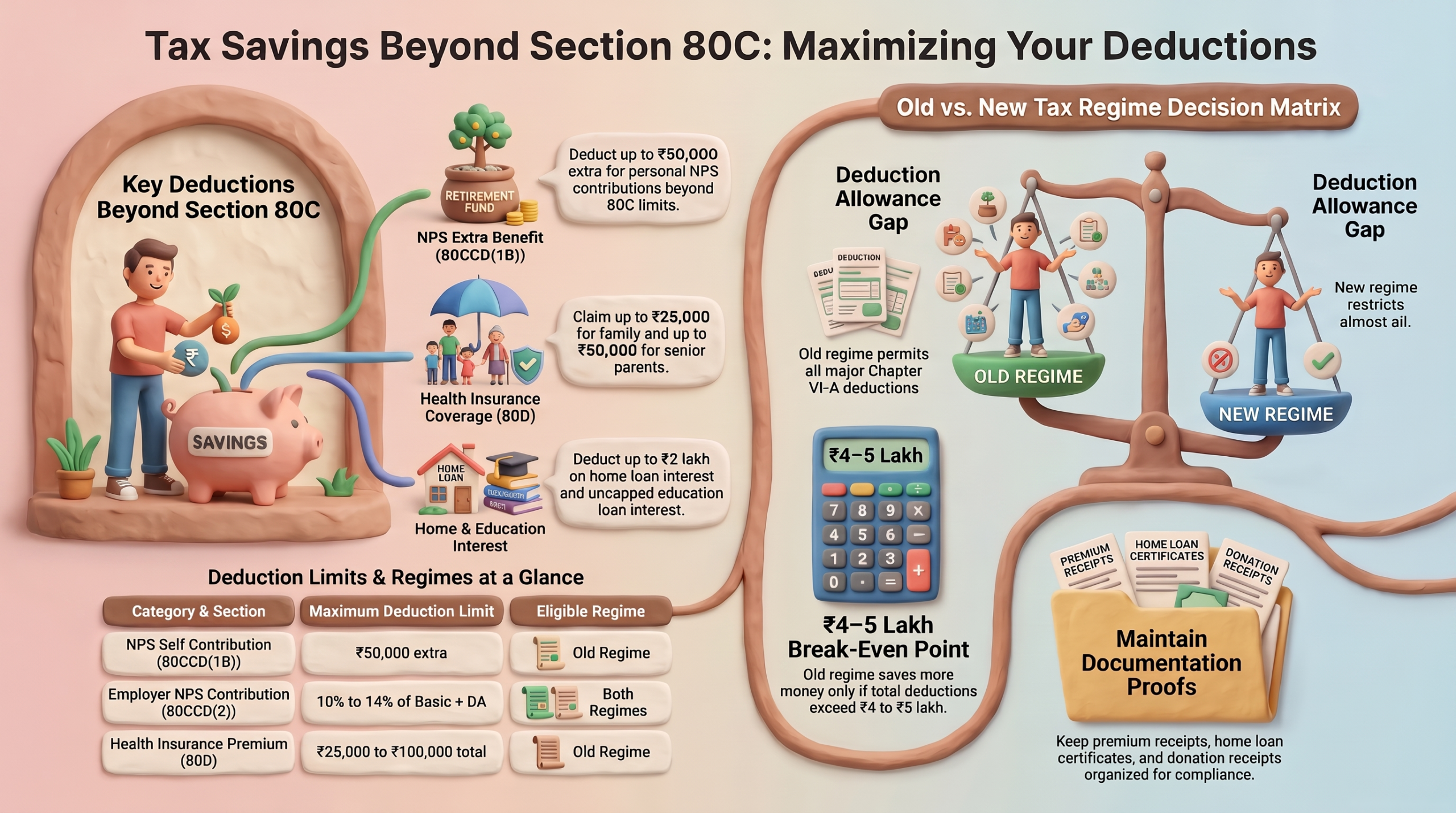
Quick Answer: Beyond Section 80C (₹1.5 lakh), you can save tax through NPS under 80CCD(1B) (extra ₹50,000), health insurance under 80D (up to ₹25,000 for family and ₹25,000 for parents, ₹50,000 each if senior), home loan interest (up to ₹2 lakh on a self-occupied house), education loan interest under 80E (no upper limit, for 8 years), donations under 80G, savings interest under 80TTA (₹10,000) and HRA. Almost all of these work only in the old tax regime. The main exception is the employer’s NPS contribution (80CCD(2)), which is allowed in both regimes.
Deductions beyond 80C at a glance
| Deduction | Limit | Regime |
| NPS self-contribution, 80CCD(1B) | ₹50,000 extra | Old |
| Employer NPS, 80CCD(2) | Up to 10% of basic + DA (14% for government employees; 14% in the new regime) | Both |
| Health insurance, 80D | ₹25,000 self and family, ₹25,000 parents (₹50,000 each if senior) | Old |
| Home loan interest, 24(b) | ₹2,00,000 (self-occupied) | Old |
| Education loan interest, 80E | No limit, up to 8 years | Old |
| Donations, 80G | 50% or 100% of the gift, depending on the fund | Old |
| Rent without HRA, 80GG | Up to ₹5,000 a month | Old |
| Savings interest, 80TTA / 80TTB | ₹10,000 / ₹50,000 (senior citizens) | Old |
| Disability, 80DD / 80U | ₹75,000 to ₹1,25,000 | Old |
Under the Income-tax Act, 2025, which applies from 1 April 2026, these sections are renumbered. For example, 80C is now Section 123, 80CCD(1B) is Section 124(3), and 80D is Section 126. The limits remain the same, but quote the new section number in your records and confirm it on the official text.
1. NPS: ₹50,000 over and above 80C
You can deduct up to ₹50,000 of your own NPS contribution, over and above the 80C limit. At the 30% slab, that is a saving of ₹15,000 plus cess. NPS is locked until retirement, so treat it as a long-term investment, not a tax trick.
2. Health insurance: 80D
Premiums for yourself, your spouse and your children get ₹25,000, or ₹50,000 if you are a senior citizen. Premiums for parents get another ₹25,000, or ₹50,000 if they are seniors. If everybody is a senior, the total can reach ₹100,000. Preventive health check-ups are included within the limit.
3. Home loan interest
Interest on a self-occupied house is deductible up to ₹2 lakh a year in the old regime. If the house is let out, the full interest can be set off against rent, subject to the overall loss limit. The old extra deduction for first-time buyers (80EEA) is available only for loans sanctioned on or before 31 March 2022. Keep your lender’s interest certificate every year. If you are planning a loan for a business property, see our project report for bank loan service.
4. Education loan interest: 80E
The entire interest is deductible, with no limit, for up to 8 years from the year you start repaying. It applies to loans for yourself, your spouse or your children. Only interest counts, not the principal.
5. Donations, rent and savings interest
Donations to approved funds under 80G qualify for 50% or 100% depending on the fund, and cash gifts above ₹2,000 do not qualify. If you pay rent but receive no HRA, Section 80GG gives up to ₹5,000 per month. Savings bank interest gets ₹10,000 under 80TTA (₹50,000 on deposits for seniors under 80TTB).
Old regime or new regime?
| Point | Old regime | New regime |
| Standard deduction (salaried) | ₹50,000 | ₹75,000 |
| Chapter VI-A deductions | Allowed (80C, 80D, NPS and others) | Mostly not allowed |
| Tax-free income | Up to ₹5 lakh with rebate | Up to ₹12 lakh with rebate (₹12.75 lakh for salaried) |
The new regime wins for most people with income under about ₹15 lakh and few deductions. The old regime can win if your claims (80C, NPS, 80D, home loan interest, HRA) total well above ₹4 to 5 lakh. Compare both on your real numbers each year. Our income tax return filing team does this comparison before filing.
Documents to keep
- Premium receipts and the policy schedule for 80D.
- NPS statement and the home loan interest certificate.
- Donation receipts showing the donor’s PAN and the donee’s 80G number.
- Rent receipts and landlord PAN where required.
Keeping these organised saves you in a notice. Our guide on organising billing and payment records shows a simple system.
Tax Planning Tips for Business Owners
If you run a business, effective tax planning starts with accurate financial records. Personal tax deductions are separate from business expenses, but proper accounting helps you track income, expenses, profits and eligible deductions correctly. Maintaining organised books also makes GST returns and income tax filing easier while reducing the risk of reporting errors.
Using reliable accounting software can help manage GST transactions, business expenses and income tax records in one place. Read our guide on accounting software for GST and income tax records to understand how better bookkeeping supports tax compliance and smarter financial decisions
Conclusion
Looking for tax-saving investment options beyond Section 80C? Several deductions and exemptions may help reduce your taxable income, particularly under the old tax regime.
Apart from Section 80C investments, eligible taxpayers can explore NPS contributions under Section 80CCD(1B), health insurance premiums under Section 80D, home loan interest under Section 24(b), and eligible charitable donations under Section 80G. Certain employer contributions to NPS may also qualify for tax benefits under Section 80CCD(2), subject to applicable conditions.
However, not every deduction is available under the new tax regime. Your tax savings depend on your income, investment choices, eligibility and applicable tax rules.
At Sharda Associates, we help individuals and business owners compare old and new tax regimes, identify eligible deductions and plan investments efficiently.
Don’t wait until the last minute. Start your tax planning before March and maintain all supporting documents.
Need personalised tax planning? Call +91 79870 21896 or +91 89899 77769, or contact Sharda Associates for professional tax consultation.
Frequently asked questions
1. Is the 80C limit still ₹1.5 lakh?
Yes. The limit is ₹1.5 lakh, and it applies only in the old regime.
2. Can I claim 80C and 80CCD(1B) together?
Yes. NPS under 80CCD(1B) is ₹50,000 over and above the 80C limit.
3. Which deductions work in the new regime?
Mainly the standard deduction and the employer’s NPS contribution under 80CCD(2). Most other deductions are not available.
4. How much can I claim for parents’ health insurance?
₹25,000, or ₹50,000 if the parents are senior citizens, over and above your own limit.
5. Is there a limit on education loan interest?
No upper limit, but it is available for a maximum of 8 years.
6. Is the home loan principal deductible beyond 80C?
No. The principal is part of the 80C limit. Only the interest has the separate ₹2 lakh limit.
7. Can I switch between regimes every year?
Salaried individuals can choose each year. Business owners have limited switching rights, so confirm before you opt.
8. Do I need proof for these deductions?
Yes. Keep receipts, certificates and PAN details, because the department can ask for them during assessment.