
Most business owners know that GST paid on purchases can be claimed back as input tax credit. What they miss is that the law blocks the credit on a list of expenses, even when the money was spent for business. A claim made on such an invoice is wrongly availed, and it is one of the commonest points raised in a GST notice and in GSTR-1 and GSTR-3B mismatch checks.
Sharda Associates is a Bhopal-based CA firm with 45,500+ CA-certified reports delivered, and we help businesses claim only the input tax credit they are entitled to, through our GST registration and return services. We check your purchase invoices, separate the eligible credit from the blocked one and file your returns accordingly.
This guide explains every blocked category in plain language, when the exceptions apply, what changed for construction in 2025, and how to reverse a wrong claim before it costs you interest. Keeping the list in front of your accountant also helps, so pair it with good GST accounting software.
Quick Answer: Section 17(5) of the CGST Act blocks input tax credit on: motor vehicles for up to 13 persons, food and beverages, outdoor catering, beauty treatment, health services and cosmetic surgery, club, health and fitness centre memberships, rent-a-cab, life and health insurance, employee leave or home travel concession, construction of immovable property on your own account (other than plant and machinery), goods used for personal consumption, goods
lost, stolen, destroyed, written off, gifted or given as free samples, and tax paid under the composition scheme, or in fraud, detention and confiscation cases. Credit is allowed in specific cases, such as when you sell the same goods or service onward, or the law makes the expense compulsory for you. If you claimed blocked credit, reverse it and pay interest.
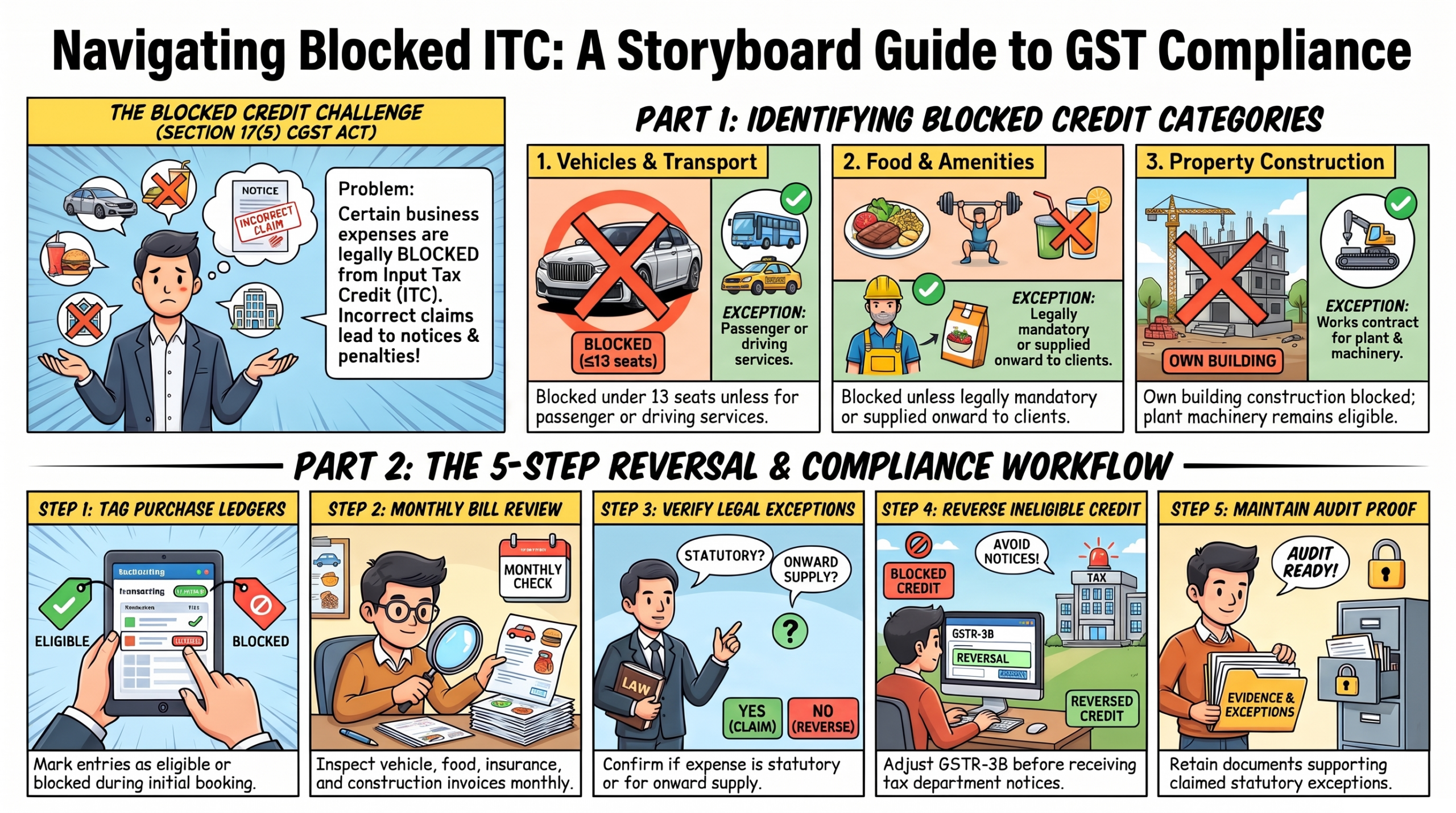
Blocked ITC at a glance
| Expense | ITC blocked? | ITC allowed when |
| Motor vehicle, seating up to 13 including driver | Yes | Used for further supply, transporting passengers, or driving training |
| Food, beverages, outdoor catering | Yes | You supply the same category onward, or the law makes it mandatory for you |
| Beauty treatment, health services, cosmetic surgery | Yes | You supply the same category onward, or it is mandatory by law |
| Club, health and fitness centre membership | Yes | Generally none |
| Rent-a-cab, life and health insurance | Yes | You supply the same service, or the law obliges the employer to provide it |
| Travel benefits to employees (leave or home travel) | Yes | Generally none |
| Construction of own immovable property | Yes | The asset is plant and machinery, or you resell the works contract service |
| Personal consumption | Yes | Not allowed |
| Goods lost, stolen, destroyed, written off, gifted, free samples | Yes | Not allowed |
| Tax paid under composition, or in fraud, detention and confiscation cases | Yes | Not allowed |
1. Motor vehicles and vessels
Credit on cars and other vehicles meant to carry up to 13 people (driver included) is blocked. You can claim it if you buy the vehicle to resell, to run a passenger transport business, or to give driving training. The same logic applies to vessels and aircraft. Credit on insurance, servicing, and repair of a blocked vehicle is blocked too, unless the vehicle itself is eligible. A goods truck is not a vehicle for carrying persons, so it stays outside this block.
2. Food, beauty, health, and similar services
Food, beverages, outdoor catering, beauty treatments, health services, and cosmetic or plastic surgery are blocked when you buy them for staff or guests. They are allowed if you supply the same kind of service onward. A restaurant claiming credit on food it later serves is a common example. A factory canteen required under a labor law may also qualify, so check the legal requirement before you decide.
3. Club, gym, cab, insurance and travel benefits
Club and fitness centre memberships are blocked. Rent-a-cab services and life and health insurance are blocked unless you provide the same service, or the law forces you as an employer to provide it. Leave or home travel concession for employees is also blocked. Group health policies that are not legally compulsory are a typical trap, so look at the reason behind the policy before you claim.
4. Construction of immovable property
You cannot claim credit on goods and services used to build an immovable property on your own account, even when the building is used in business. The block does not cover plant and machinery, and it does not apply if you pass on the works contract service to a customer. Under the Explanation, plant and machinery excludes land, buildings and other civil structures, along with telecom towers and pipelines laid outside the factory.
What changed in 2025?
Earlier, a Supreme Court ruling (Safari Retreats, October 2024) said the words “plant or machinery” need a functionality test, which gave builders of malls, hotels and similar assets an argument for credit. The Finance Act 2025 then amended the clause with retrospective effect from 1 July 2017, so that the exception now reads “plant and machinery,” which excludes buildings and civil structures. In October 2026, the GST Appellate Tribunal in Bengaluru applied the amended clause to deny credit on the construction of a resort building and upheld the demand. In practice, treat credit on a building, shed foundation, or civil work as blocked, and look at it separately for machinery installed in it.
5. Other blocked cases
- Personal consumption. Credit on goods or services you use for yourself or your family is blocked.
- Loss, theft and write-off. Credit on goods lost, stolen, destroyed or written off is blocked, so reverse it when the loss happens.
- Gifts and free samples. Credit on goods you give as gifts or samples is blocked. A Diwali hamper bought for customers is a good example.
- Composition scheme purchases and penal cases. Tax paid under the composition scheme, or under the fraud, detention and confiscation provisions, cannot be claimed.
Reverse charge purchases need care as well, because the credit rules differ between categories. Read our guide on reverse charge in GST alongside this one.
Blocked credit vs missing credit
A blocked credit is not the same as credit you cannot claim for other reasons. If your supplier has not filed GSTR-1, the invoice does not appear in your GSTR-2B, and that is a different problem. We have explained the fix in our guide on claiming ITC when the supplier has not filed GSTR-1.
There is also a time limit. Under Section 16(4), credit for a financial year is generally claimable only up to the earlier of 30 November after the year or the date of the annual return, so check your deadline for FY 2025-26 now.
What if you have claimed blocked credit?
- List the invoices that fall under Section 17(5), using your purchase register.
- Reverse the credit in GSTR-3B, in the table meant for ITC reversals.
- Pay interest on the wrongly availed credit. The rate is higher if the credit was also used to pay tax.
- Correct the mapping in your books so it does not repeat.
Paying before a notice arrives usually keeps the penalty away. Lenders also read your GST data when they assess you, as we explain in how GST returns impact your business loan.
A simple 5-step checklist
- Tag every purchase ledger as “eligible” or “blocked” when you book it.
- Review car, food, insurance and construction bills every month.
- Ask whether the expense is for onward supply or a legal requirement.
- Reverse blocked credit before filing GSTR-3B, not after a notice.
- Keep the proof for each exception you use, and let a bookkeeping team set up these tags for you.
Conclusion
Section 17(5) is a short list, but it hits the expenses businesses spend on most: cars, food, insurance and buildings. Knowing the blocked items and their exceptions protects you from interest and notices.
Tag your purchases as eligible or blocked from day one, review them monthly and reverse any wrong claim at once. A clean ITC record also improves how lenders and the GST department see your business.
Want Sharda Associates to review your ITC? Call us on +91 79870 21896 or +91 89899 77769, or contact us online.
Frequently asked questions
1. What is blocked credit under GST?
It is input tax credit that Section 17(5) of the CGST Act does not allow, even if the expense was incurred for business.
2. Can I claim ITC on a company car?
Not for a vehicle that carries up to 13 persons, unless you use it for further supply, passenger transport or driving training.
3. Is ITC allowed on food for employees?
Generally no. It is allowed if you supply the same category of service onward or the law makes the facility compulsory for you.
4. Can I claim ITC on health insurance for staff?
Not unless you supply the same service or the law obliges you to provide it as an employer.
5. Is ITC allowed on construction of a factory building?
No, on the civil structure, because it is not plant and machinery. Machinery installed inside is considered separately.
6. What changed after the Finance Act 2025?
The exception for plant and machinery now excludes buildings and civil structures, retrospectively from 1 July 2017. This reduces the scope of the Safari Retreats functionality test.
7. Is ITC allowed on gifts and free samples?
No. Credit on goods given as gifts or free samples is blocked.
8. How do I reverse blocked ITC?
Reverse it in GSTR-3B, pay interest and update your books. Doing it before a notice is better than after.